.svg)

.svg)
.svg)



TL;DR: Revenge trading happens when the goal shifts from following a tested setup to quickly recovering a recent loss. Common signs include entering without confirmation, increasing size, moving stops, trading outside normal hours, and taking several low-quality setups in a row. Stop the sequence with a hard daily loss limit, a mandatory cooling-off period, fixed position size, a two-loss rule, and a journal tag for every impulse trade. The aim is not to remove emotion. It is to make sure emotion cannot change size, setup quality, or risk.
One clean losing trade is ordinary. The next five minutes are where the real damage often begins.
You know the feeling. The stop gets hit, price turns without you, and suddenly the market seems to owe you an immediate recovery. The next entry appears faster, the size looks easier to justify, and the plan starts feeling optional.
That is revenge trading. It is not defined by whether the next trade wins. It is defined by why you took it and which rules you were willing to break.
What Revenge Trading Looks Like
Revenge trading is an emotional attempt to recover a loss quickly. The trader stops evaluating the next opportunity on its own merits and starts treating it as a way to repair the previous result.
It can look aggressive, but it can also be subtle. A trader may keep the same size yet enter before confirmation. Another may switch instruments because the usual market feels “dead.” Someone else may widen a stop so the new trade has more room to become right.
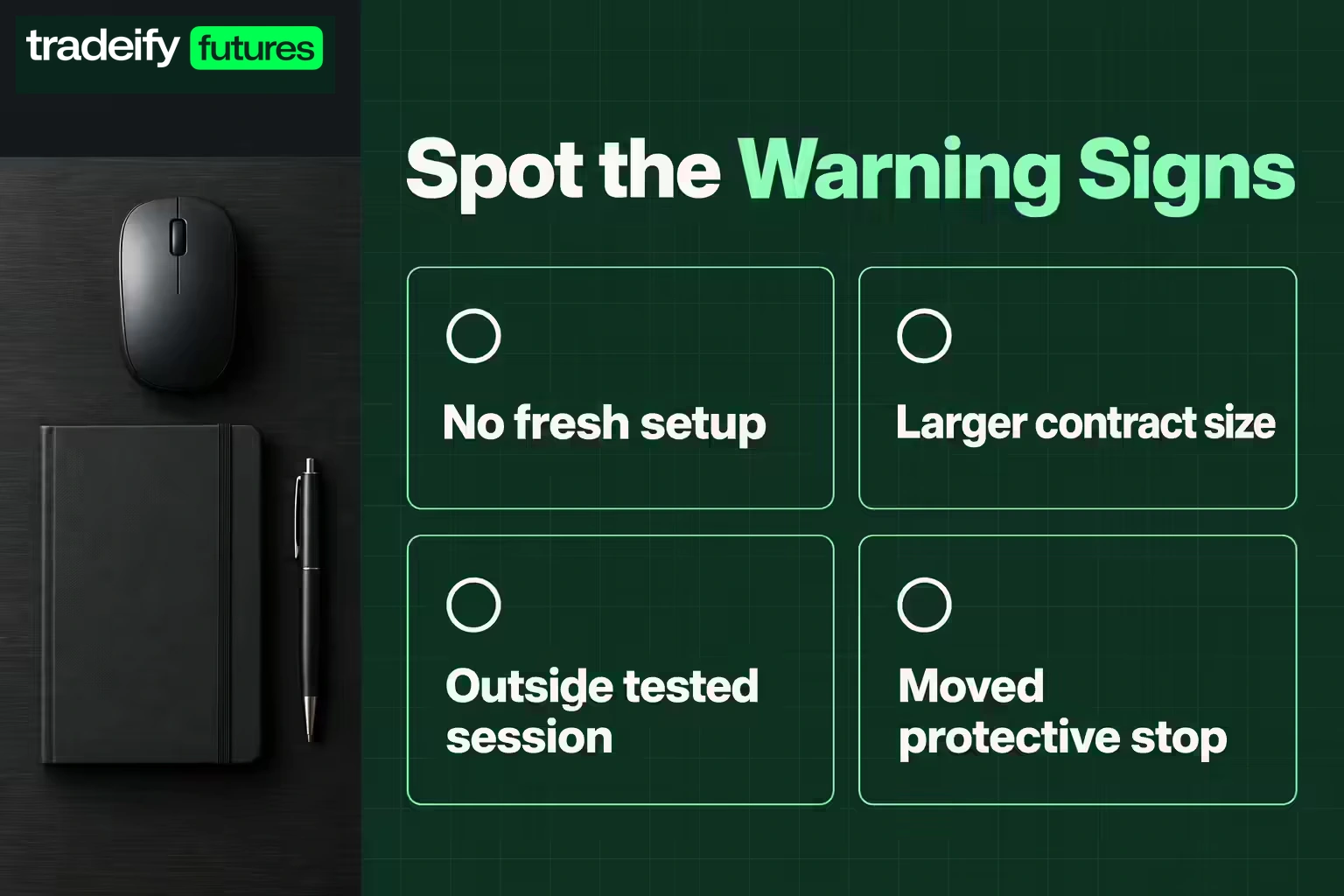
Common warning signs include:
- Entering immediately after a stop without a fresh setup
- Increasing contract size after a loss
- Taking trades outside the tested session
- Lowering the quality threshold for an entry
- Cancelling or moving a protective stop
- Watching open profit and loss instead of market structure
- Setting a goal to get back to breakeven before stopping
The result of the trade does not change the diagnosis. A profitable impulse trade can reinforce a damaging habit because it teaches the trader that rule-breaking sometimes works.
Why Revenge Trading Happens
A loss creates more than a financial change. It can feel like a judgment about skill, preparation, or control. The mind tries to remove that discomfort, and the fastest imagined route is another trade.
Several forces can combine:
Revenge trading and loss aversion
People often feel the pain of a loss more strongly than the satisfaction of a similar gain. That makes returning to the previous balance feel urgent, even though the market has no connection to the number on your screen.
Revenge trading and threatened identity
If being right is tied to being competent, a stop can feel personal. The next trade becomes an argument with the market. Traders then seek confirmation for what they want to see and ignore evidence that would invalidate the setup.
Revenge trading under time pressure
A short session, an evaluation deadline, or a desired payout can make a trader believe there are only a few chances left. Scarcity changes patience. Ordinary noise starts looking like opportunity.
Revenge trading after an unfair outcome
Slippage, a platform interruption, or a stop followed by an immediate reversal can feel unfair. The frustration may be understandable, but the next order still carries real risk. Anger cannot improve the next trade's expectancy.
How Revenge Trading Changes Decisions
The defining shift is from process to outcome. Before the loss, the question may be, “Is this my setup?” After the loss, it becomes, “Can this get the money back?”
That change affects three decisions at once.
First, entry quality falls. The trader sees an observation and treats it as confirmation. A fast candle near support becomes a reversal, even though the normal trigger has not appeared.
Second, risk grows. Size increases or the stop moves farther away because the desired dollar recovery is now setting the trade parameters.
Third, stopping becomes harder. If the second trade loses, the balance is farther from breakeven, so the same logic demands a third attempt.
Consider a trader who normally risks $100 on one qualified setup. After losing $100, the trader risks $200 on a weaker entry to recover the loss plus make the day's original target. If that trade loses, the next position must be even larger to meet the same emotional goal. The strategy did not create this sequence. The recovery target did.
How to Stop Revenge Trading in the Moment
You need a rule that works before judgment returns. “Be disciplined” is not a rule because it leaves every decision open when you are least prepared to make it.
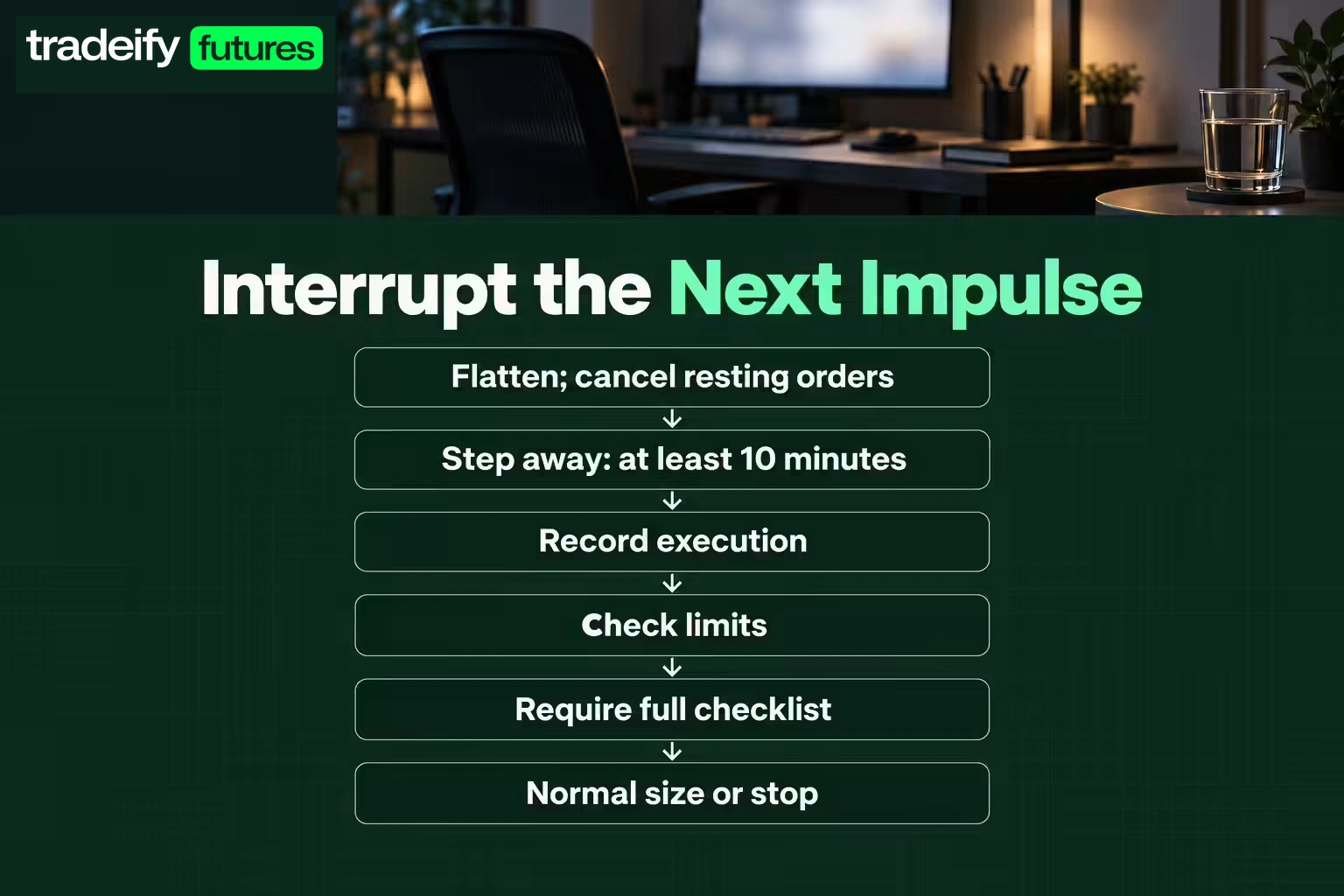
Use a short interruption protocol:
- Flatten the position and cancel resting orders.
- Step away from the screen for at least 10 minutes.
- Record the loss, setup name, and whether execution followed the plan.
- Check the daily loss limit and remaining trade allowance.
- Require a new setup to meet the full written checklist.
- Return at normal size or stop for the session.
The cooling-off period is not meant to create a perfect mood. It creates distance between the trigger and the next order.
If you already broke a rule, stopping for the day is often cleaner than trying to prove you can recover your discipline while money is still moving. Protecting the next session matters more than rescuing this one.
Revenge Trading Rules That Work Before the Loss
Precommitment removes choices from the emotional moment. The best guardrail is one you cannot easily reinterpret.
Set a daily loss limit
Choose a dollar amount or risk-unit limit based on tested strategy performance and account rules. The limit should sit inside any broker or funded-account threshold, leaving room for commissions and slippage.
When reached, trading ends. It is not a suggestion and it does not reset because a “perfect” setup appears later.
Use fixed position size
Write the allowed contract size for each setup before the session. Increasing size after a loss should require a separate risk review, not a click made during the same session.
Limit consecutive losses
A two-loss rule is common because it interrupts a possible emotional sequence without claiming that every two-loss sample means the strategy stopped working. The number should reflect your backtest and normal trade frequency. If your written trigger is three consecutive losses, add a non-trading reset consequence: 30 air squats or pushups if physically appropriate, a short walk, and water before you review the next decision. The activity is there to break the loop, not to earn permission to place another trade.
Block unplanned sessions
If your strategy is built for the opening hour, do not add an afternoon session to recover a morning loss. A new time window is a different strategy until data proves otherwise.
Add platform friction
Remove one-click size increases, use preset bracket orders, or configure risk controls where available. Friction is useful. A two-second obstacle can be enough to interrupt an impulse.
How to Review Revenge Trading Without Shame
Shame hides data. A trader who labels the day “stupid” may avoid studying the exact decision that failed.
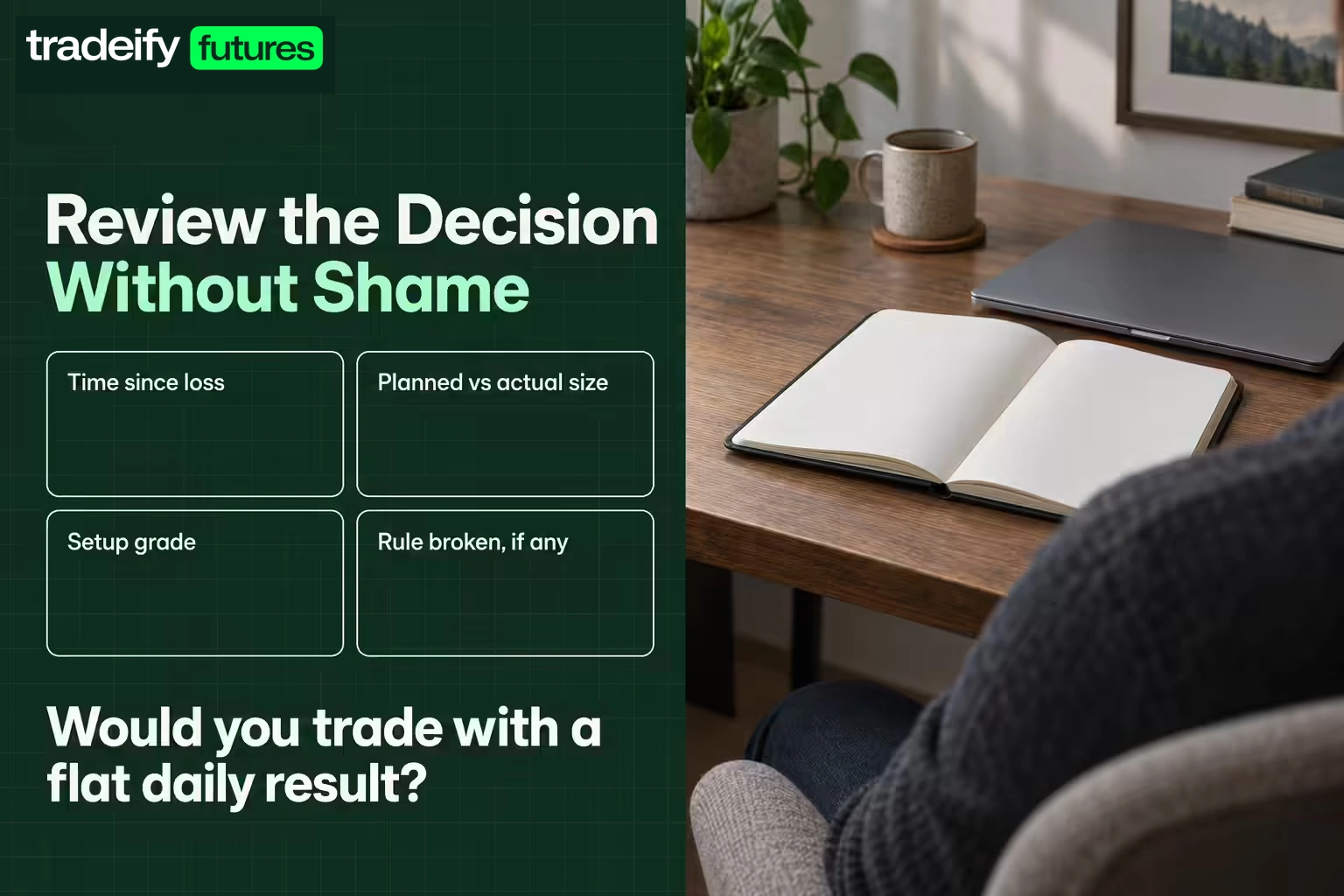
Tag each questionable trade with facts:
- Minutes since the previous loss
- Planned and actual position size
- Setup grade before entry
- Rule broken, if any
- Emotional intensity from 1 to 5
- Whether the trade would have been taken with a flat daily result
The last question is powerful. If the answer is no, recent profit and loss probably influenced the entry.
Review the tags over 20 sessions. Look for a repeated trigger such as the first stop, a missed move, a particular time of day, or being close to an account milestone. Then build one rule for that trigger.
Do not judge the rule by one outcome. A cooling-off period may cause you to miss a winner, and it can still be the correct rule if it prevents a larger pattern of impulse losses.
Revenge Trading in Funded Accounts
Funded-account rules can increase pressure because one poor sequence may violate daily loss or trailing drawdown limits. The displayed account size may also encourage more contracts than the actual drawdown supports.
Translate the account into risk units. If the permitted drawdown is $2,000 and normal risk is $200 per trade, you have ten theoretical risk units before costs and slippage. That is the more useful number, not the large headline balance.
Keep your personal daily stop inside the firm's hard limit. A technical breach may close the account before you have time to recover composure. Also verify whether unrealized losses, commissions, or end-of-day calculations affect the threshold.
Build a Revenge Trading Reset Plan
Write the plan while calm and keep it beside the order screen:
- Define the loss or behavior that triggers a break.
- Set the minimum time away from the screen.
- List the exact conditions required for another trade.
- Fix the maximum size for the rest of the session.
- State the condition that ends the day.
- Schedule the journal review for after the market closes.
Then test the plan in simulation. The goal is to practice the interruption, not merely understand it.
Futures trading involves substantial risk, and losses cannot be eliminated. Your next step is specific: review your last 20 losing trades, mark every entry taken within 15 minutes of a loss, and create one hard rule for the pattern you find. A clean loss is part of trading. Turning it into an uncontrolled sequence does not have to be.
.svg)
.svg)
.svg)
.svg)





.webp)