



TL;DR: Market orders trade right away at the best available price, so you get a fast fill but no price control. On a one-tick MES spread, a one-lot buy pays half a tick, $0.625, against the midpoint. On an illustrative five-level book, a 100-lot averaged 1.25 ticks worse than the best offer. On CME Globex, protection limits can leave part of a market order resting unfilled. Use market orders when the fill matters more than the price, and limit orders when the price is the point.
You see the move starting, you hit Buy Market, and the fill comes back a tick or two worse than the price you were staring at. Nothing broke. That is how market orders work, and the cost is easy to miss because it is small on any single trade.
The fill is usually fast. The price is the part nobody promised you.
This guide explains what market orders are, how an exchange fills them, what they cost on a real futures contract, and when a limit order or another order type does the job better. The worked examples use the Micro E-mini S&P 500 (MES) with round, illustrative prices.
What a Market Order Is
A market order is an instruction to buy or sell right now at the best price available. You choose the side and the size. You do not choose the price.
When you buy with a market order, you take the lowest offer (the ask) sitting in the order book. When you sell, you hit the highest bid. The SEC's investor bulletin on order types puts the trade-off plainly: a market order is generally executed immediately, but the price at which it executes is not guaranteed.
The same bulletin adds the warning most beginners need to hear. The last traded price on your screen is not necessarily the price your market order will get. Prices move between the moment you look and the moment your order reaches the market, and the quote you saw only covered a certain number of contracts or shares.
So a market order is a trade of price for time. You accept whatever the market is offering so that you are in, or out, now. Whether that is a good trade depends on what the book looks like when you send it.
Related lesson: The order book
How Market Orders Work on an Exchange
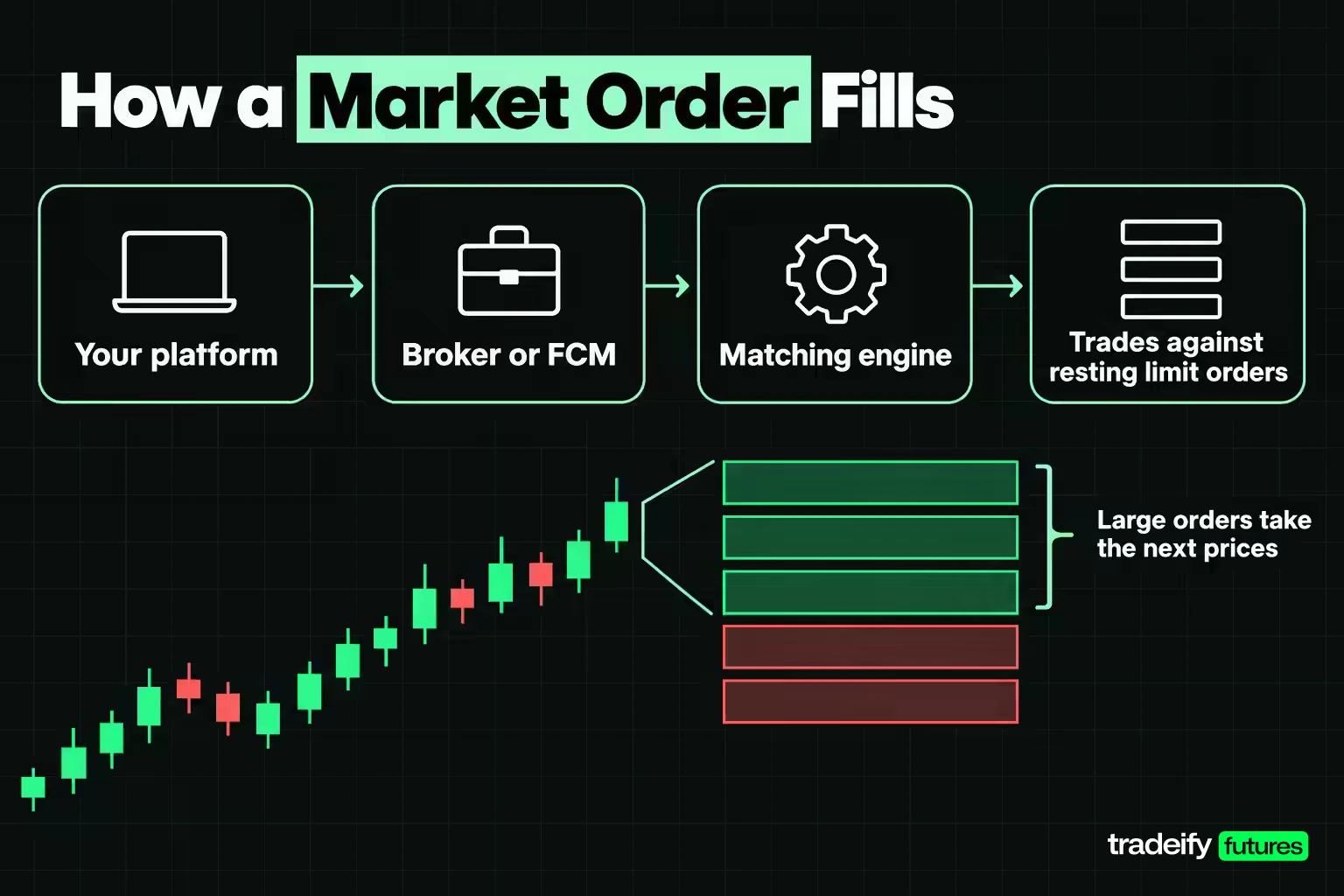
A market order travels from your platform to your broker and then to the exchange's matching engine. There it trades against limit orders that other participants have already left resting in the book. Your order is the aggressor; theirs are the resting liquidity.
If the best price has enough size for your whole order, you fill at one price. If it does not, your order keeps taking the next best prices until it is complete. That is why one market order can come back with several fills.
Who handles a market order on the way to the exchange
Your broker or futures commission merchant passes the order along and confirms the fill. Your platform decides which exchange order type your "Market" button actually sends. On most retail platforms you never see that translation, so it is worth reading the platform's order-type documentation once.
Market-limit and protected market orders on CME Globex
Futures exchanges add guardrails that equity guides rarely mention. CME Globex documents two market-style order types for futures: the market-limit order and the market order with protection.
- Market-limit order. It executes at the best price available. If it can only be partly filled, the rest becomes a limit order resting in the book at that price.
- Market order with protection. It is designed to stop a market order from filling at an extreme price. For a buy, CME adds a set number of protection points to the current best offer to get a protection price limit. For a sell, it subtracts them from the best bid. If the whole order cannot fill inside that range right away, the unfilled quantity rests in the book as a limit order at the protection limit.
Protection point values are set per product, so do not guess them. As a purely hypothetical illustration, a 6.00-point protection range on a buy with the best MES offer at 7,000.25 would give a protection limit of 7,006.25. That is 24 ticks, or $30.00 per contract, above the best offer. Inside that range your order can sweep. Beyond it, the rest waits as a limit order.
The practical consequence matters most on exits. In a market that gaps past the protection limit, you can end up partly filled with a resting order instead of fully flat. Market orders on futures are fast, but they are bounded, and the unfilled part does not disappear.
Market Order Examples on the Micro E-mini S&P 500
The MES contract is worth $5 times the S&P 500 Index. Its minimum price move is 0.25 index points, which is $1.25 per contract. Those two numbers turn every price difference in these examples into dollars.
A one-contract market order
Say MES is quoted 7,000.00 bid and 7,000.25 ask. The spread is one tick, $1.25. The midpoint between the two prices is 7,000.125.
You send a buy market order for one contract and fill at 7,000.25. You paid 0.125 points above the midpoint, which is $0.625. If the quote stays put and you immediately sell with another market order, you get 7,000.00 and lose the full spread, $1.25 per contract, before commissions.
A market order larger than the best offer
Now give the book some depth. This is an illustrative five-level book, not a live quote.
| Level | Bid price | Bid size | Ask price | Ask size |
|---|---|---|---|---|
| 1 | 7,000.00 | 25 | 7,000.25 | 20 |
| 2 | 6,999.75 | 40 | 7,000.50 | 35 |
| 3 | 6,999.50 | 55 | 7,000.75 | 50 |
| 4 | 6,999.25 | 70 | 7,001.00 | 65 |
| 5 | 6,999.00 | 90 | 7,001.25 | 80 |
The offer side shows 250 contracts in total. Walk buy market orders of different sizes through it. The average fill is the total price paid divided by contracts filled. Depth cost is measured from the best offer, and total cost from the 7,000.125 midpoint.
| Order size | Contracts filled | Average fill | Depth cost in ticks | Depth cost per contract | Total cost against the mid |
|---|---|---|---|---|---|
| 1 | 1 | 7,000.25 | 0 | $0.00 | $0.625 |
| 10 | 10 | 7,000.25 | 0 | $0.00 | $6.25 |
| 20 | 20 | 7,000.25 | 0 | $0.00 | $12.50 |
| 50 | 50 | 7,000.40 | 0.6 | $0.75 | $68.75 |
| 100 | 100 | 7,000.5625 | 1.25 | $1.5625 | $218.75 |
| 250 | 250 | 7,000.90 | 2.6 | $3.25 | $968.75 |
| 300 | 250 | 7,000.90 | 2.6 | $3.25 | $968.75 with 50 unfilled |
The 100-lot row shows the sweep. It takes 20 contracts at 7,000.25, 35 at 7,000.50 and 45 at 7,000.75. Three prices, one order, and an average 1.25 ticks worse than the best offer.
The 300-lot row shows the edge of the book. Only 250 contracts were offered, so 50 have nothing to trade against. What happens to them depends on the order type your platform sent, which is the market-limit and protection logic CME documents.
A sell market order on the same MES book
On the sell side of that book, 25 contracts are bid at 7,000.00 and 40 at 6,999.75. A 50-lot sell market order takes 25 contracts at 7,000.00 and 25 at 6,999.75. The average fill is 6,999.875.
Against the midpoint, that is one tick lower, $1.25 per contract or $62.50 on the order. Against a 7,000.25 last trade you might have been watching, it looks like 0.375 points, $1.875 per contract or $93.75. Same fill, two different "costs", depending on which reference price you had in your head.
Related lesson: Market depth and Level II data
Advantages of Market Orders
Market orders exist because sometimes getting filled matters more than the price.
- Speed. In an open, liquid market a market order generally executes immediately. There is no waiting for price to come to you.
- Near-certain participation. You trade against whatever is resting in the book. Investor.gov describes a market order as guaranteeing execution but not price, although on CME Globex a market order is bounded by a protection range, so a remainder can rest instead of filling. In a liquid contract that is rarely an issue at small size.
- Simplicity. You pick side and size. There is no limit price to choose and no order to babysit.
- Exits that have to happen. When a trade is wrong, the cost of staying in usually dwarfs the half spread. A limit order that does not fill leaves you holding the risk.
- Cheap in the right conditions. On a one-tick spread with your whole size at the top of the book, the cost is half a tick. On MES that was $0.625 per contract in the one-lot example.
The advantage is real only when you know the price of it. Paying half a spread for certainty is a fair deal. Paying three ticks because you never looked at the book is a habit.
Disadvantages and Risks of Market Orders
The risks of market orders all come from the same place: you hand price control to whoever is resting in the book at that moment.
- Price uncertainty. The fill can differ from the quote you saw, especially in fast markets.
- Slippage from size. A market order larger than the best level sweeps into worse prices, as the 100-lot and 250-lot rows in the MES table show.
- Thin books. When few contracts rest at each price, even small orders travel.
- Partial fills at the edge of the protection range. On CME Globex, an order that cannot fill inside the protected range leaves a resting limit order instead of a completed trade.
- The temptation to chase. A market order makes it easy to buy a move that has already happened.
A thin-book market order example
Take an illustrative thin MES book with 3 contracts offered at 7,000.25, 4 at 7,000.75, 5 at 7,001.50 and 6 at 7,002.50. Gaps between levels like these can show up in quiet hours or around a major data release.
A 10-lot buy market order fills 3 at 7,000.25, 4 at 7,000.75 and 3 at 7,001.50. The average is 7,000.825. That is 0.575 points, 2.3 ticks or $2.875 per contract above the best offer, $28.75 on the order. In a deep book the same 10 lots would have filled at the offer.
The lesson is not "never use market orders". It is that the cost of a market order is set by the book, not by the chart. If the depth looks like this, cut the size, wait for the book to refill, or switch to a limit.
Related lesson: Slippage explained
How Limit Orders Work
A limit order sets the worst price you will accept. A buy limit can only fill at the limit price or lower. A sell limit can only fill at the limit price or higher. That is the SEC's definition, and it applies the same way to stocks, futures and forex.
If your limit is not marketable, the order rests in the book and waits. It becomes the liquidity that someone else's market order trades against.
The catch is that a limit order is not guaranteed to fill. Price has to reach your level, and then the orders ahead of you have to be filled first. On CME's FIFO matching algorithm, orders at the same price fill by time priority, oldest first. Increasing the quantity or changing the price sends your order to the back of the queue.
So a limit order gives you price control and gives up certainty. A partial fill is also possible if only some of the contracts at your price trade.
Related lesson: Limit orders
Limit Order Examples on an MES Order Book
These limit order examples use an illustrative MES quote of 7,000.00 bid and 7,000.25 ask. MES moves in 0.25-point ticks worth $1.25 per contract.
A buy limit below the market
You place a buy limit at 6,999.50, two ticks below the bid. Nothing happens unless sellers push price down to 6,999.50. If they do and enough contracts trade there to reach your place in the queue, you are long at 6,999.50. That is 0.75 points, or $3.75 per contract, better than a market order at 7,000.25.
If price never comes down, you have no position. That outcome is the cost of the better price.
A sell limit at a profit target
You are long from 7,000.25 and rest a sell limit at 7,004.00. Price trades up to 7,004.00, prints a few contracts and reverses. Your order may not fill, because other sell orders were resting at 7,004.00 before yours.
A limit is only certain to fill when price trades through it, so a print at 7,004.25 would almost certainly have filled you. A touch at exactly your price is not a fill.
A marketable limit order
A buy limit at or above the current ask is called marketable. It executes right away against the resting offers, like a market order, but it will not pay more than your limit. Say 20 contracts are offered at 7,000.25 and 35 at 7,000.50. A 100-lot buy limit at 7,000.50 fills those 55 contracts only, and the other 45 wait in the book at 7,000.50 instead of chasing higher offers. Many traders use this as a market order with a hand-drawn price cap.
Market Orders vs Limit Orders
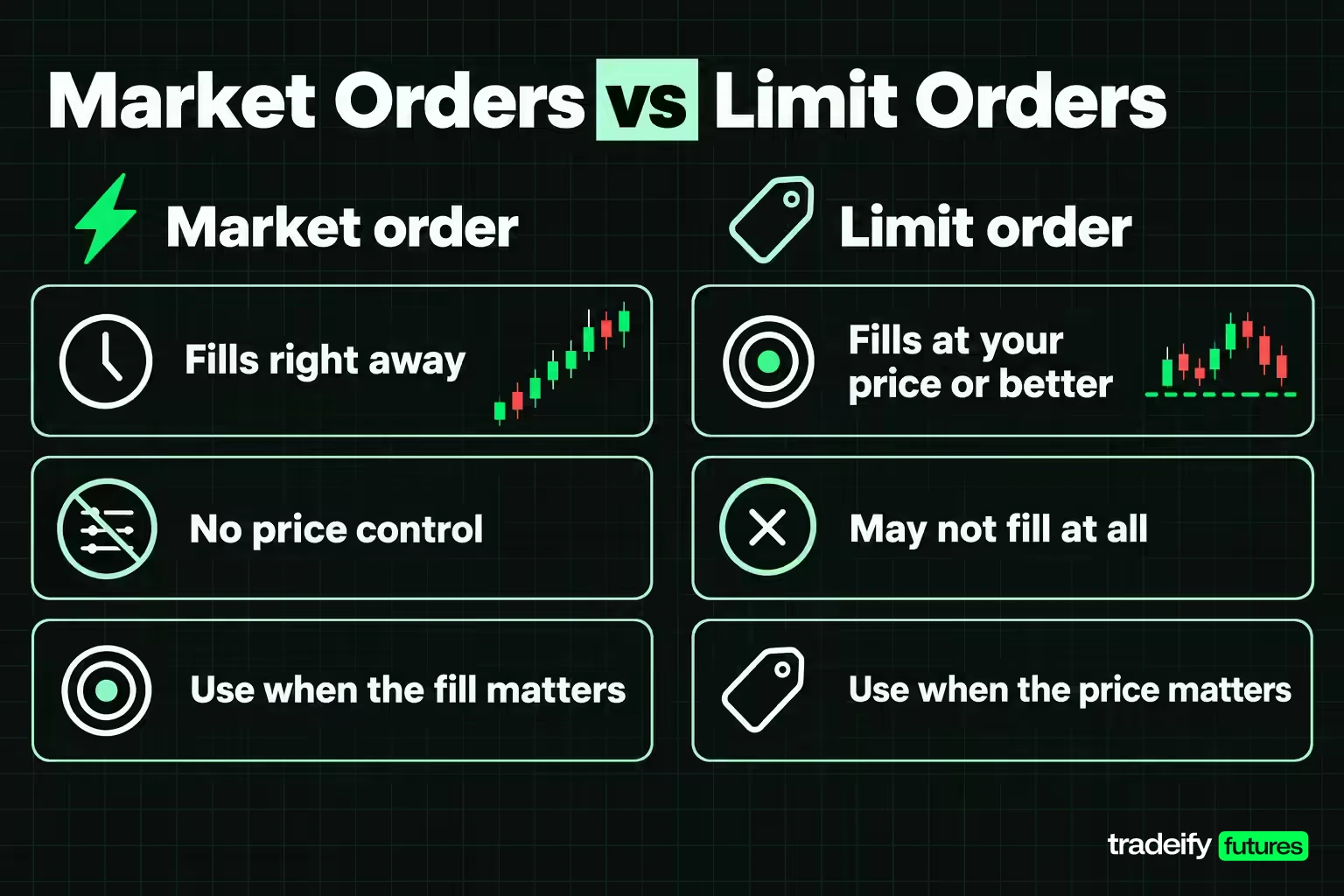
The basic difference is price control versus execution certainty. A market order fills now at an unknown price. A limit order fills at a known price or better, or not at all.
The honest comparison is one decision at one moment, priced both ways. Take the five-level MES book. A trader wants 100 contracts.
- Market order. It fills at an average of 7,000.5625.
- Limit order at the 7,000.00 bid. It fills only if sellers trade into it.
The entry difference is 0.5625 points, 2.25 ticks or $2.8125 per contract. On 100 contracts that is $281.25 in the limit order's favor.
Now price the other outcome. If the market runs 4.00 points without ever trading back to 7,000.00, the limit fills nothing. Four points on 100 MES contracts is $2,000 of move the trader did not take part in.
A useful way to judge the market order is to set its cost against the trade's target. The 100-lot market fill sits 0.4375 points above the midpoint. On a 1.00-point target, that is 43.75% of the target spent on entry. On a 2.00-point target, it is about 21.9%. The smaller your targets, the more market-order costs matter.
| Situation | Market order | Limit order | Practical read |
|---|---|---|---|
| One-tick spread, deep book, small size | Fills at the offer, near-zero depth cost | Fills only if price comes to you | Market order is cheap here |
| Your size exceeds the top level | Fills across several levels | Holds one price or stays unfilled | Cut size or work the order with limits |
| Wide or unstable spread | Pays the spread plus any move | Protects the entry price | A limit is usually the better risk |
| Exiting a losing position | Executes, bounded by exchange protection | May not execute at all | Market order is the defensible choice |
| Entry that only works at a set price | Pays at least half the spread | May never fill | Decide in advance which outcome you accept |
Stop Orders and Other Order Types Built on Market Orders
Several common order types are really market orders or limit orders with a trigger attached.
- Stop order (stop-loss). It sits dormant until a stop price is reached, then becomes a market order. A sell stop goes below the market to cap a loss on a long; a buy stop goes above it. The SEC stresses that the stop price is a trigger, not a guaranteed execution price.
- Stop-limit order. Once the stop price is reached, it becomes a limit order instead of a market order. You control the worst price, but the order may not fill if the market moves past your limit. The stop and limit prices do not have to match: the SEC's example is a sell stop-limit with a $3.00 stop and a $2.50 limit, which can only fill at $2.50 or better. On an illustrative MES long, a sell stop-limit with a 6,995.00 stop and a 6,994.00 limit allows up to four ticks of slippage, $5.00 per contract, and no more.
- Stop order with protection. CME Globex's version of a stop. When the market trades at or through the trigger, it enters as a market order bounded by protection points around the trigger, and any unfilled part rests at the protection limit.
- Trailing stop. A stop whose trigger follows the market by a set amount as price moves in your favor and stays fixed when it moves against you.
- Brackets and OCO orders. A stop and a profit-target limit linked together, so when one fills the other cancels.
A stop order is where most traders first feel the downside of market orders. In a fast move, a stop triggers and fills a few ticks away from where it was set. That is the order working as designed. If that slippage is unacceptable, the alternative is a stop-limit, and the price of that choice is an exit that might not happen at all.
Related lesson: Stop orders
Time in Force for Market and Limit Orders
Time in force tells the exchange how long an order should stay active. CME Globex calls these order qualifiers.
- Day. Active only for the trading day it is entered, then expires. CME treats orders as Day orders unless you specify otherwise, and the SEC bulletin says the same of stock orders.
- Good till canceled (GTC). Stays in the book until it is filled, you cancel it, or the contract expires. Brokers may set their own time limits for stock orders.
- Good till date (GTD). Stays active until a date you choose.
- Fill and kill (FAK), also called immediate-or-cancel (IOC). Fills whatever it can immediately and cancels the rest. CME lets you add a minimum quantity.
- Fill or kill (FOK). Must fill in full immediately or is canceled completely. On CME, FAK and FOK orders are accepted only while the market is open.
- All or none (AON). A stock-market instruction that must fill in full, but unlike FOK it can stay active until it does.
- On open and on close. Stock-market instructions to execute in the opening or closing trade.
Time in force matters mainly for limit and stop orders, because those are the ones that wait. A market order usually fills within moments, so its duration only comes into play for the leftover part: a remainder that rests as a limit order will live as long as its time in force allows.
Market Order Fill Problems and How to Spot Them
Most market order problems are not mysterious. They come from a handful of mechanics, and each one shows up on the fill report if you actually check it.
| What happened | Why it happens | How to spot it | What to do |
|---|---|---|---|
| Filled far from the quote you saw | Price moved before the order arrived, or size swept several levels | Average fill differs from the last price | Read depth first; size the order to the top levels |
| Partial fill with a working order left | Size exceeded visible depth or the protection range | Filled quantity is less than the ticket | Check positions and working orders after every fill |
| Order rejected | Market closed or halted, unsupported contract, or a size or risk limit hit | Rejection message in the orders panel | Read the message before resending |
| Stop filled well past its trigger | A stop becomes a market order in a fast or thin market | Fill price beyond the stop price | Allow for slippage when sizing the trade |
| Exit left a position open | Remainder rested at a capped price instead of filling | Position not flat after the exit | Confirm flat, then cancel stale orders |
The habit that catches nearly all of these is the same: after every market order, compare the filled quantity with the ticket and check for working orders. A position that is smaller than planned, or an exit that left contracts open, is easy to fix in the first minute and expensive later.
Related lesson: Partial fills
Choosing Between Market Orders and Limit Orders
Choosing between market orders and limit orders comes down to one question: on this trade, is the price or the fill more important? Decide that before the setup appears. In the moment, with price moving, most traders reach for the market button by reflex.
Market orders tend to fit when:
- You need out of a losing position and a missed exit costs more than a few ticks.
- The spread is one tick, the book is deep and your size fits at the top level.
- The setup is only valid right now and the alternative is no trade.
- You must be flat before a deadline, such as a session close or your own daily loss limit.
Limit orders tend to fit when:
- The entry price is the reason the trade works.
- The spread is wide, the book is thin, or a major release is about to hit.
- Your size is larger than the best bid or offer.
- You are taking profit at a planned level and can accept missing it.
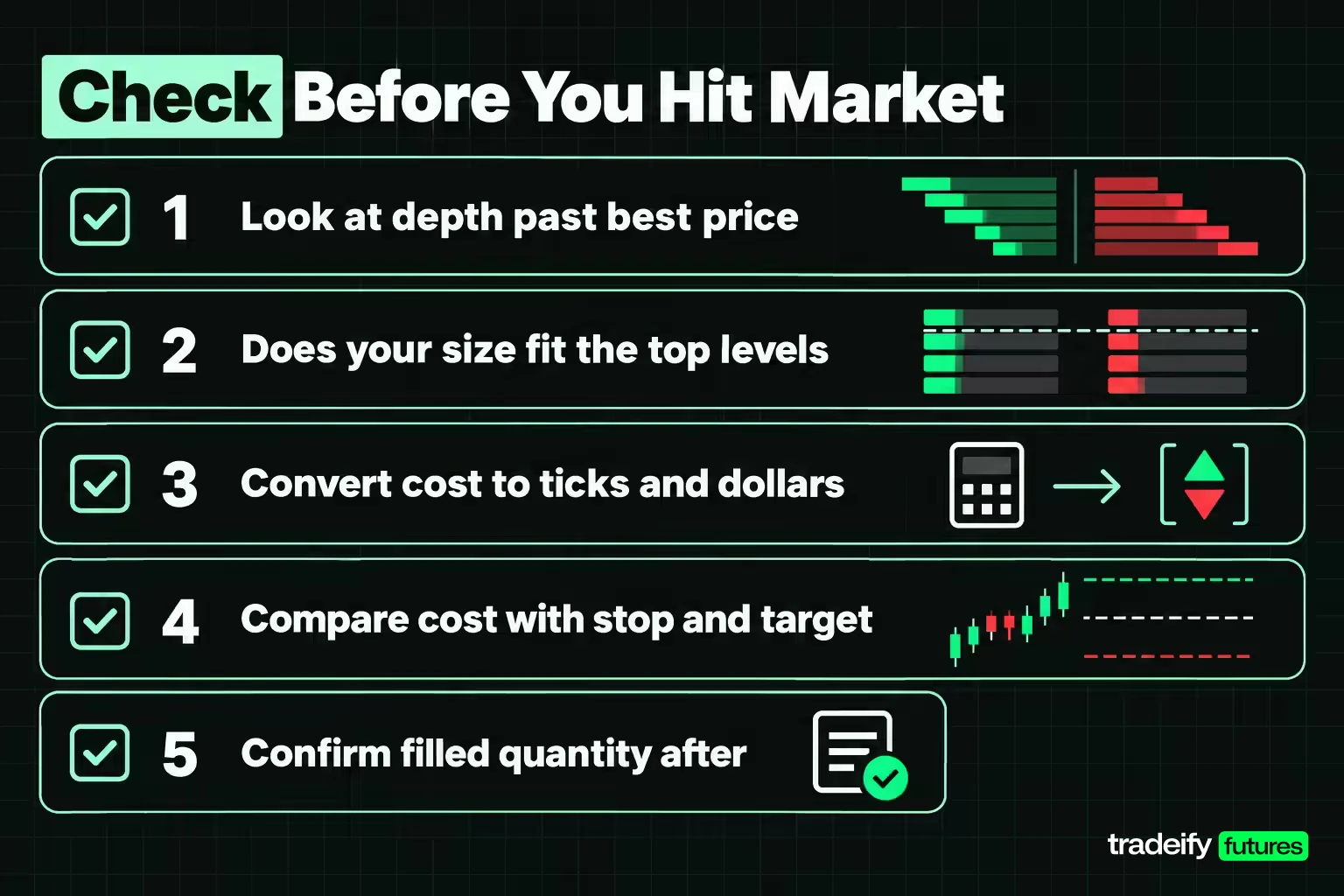
A quick check before you press the button:
- Look at the depth beyond the best price, not only the quote.
- Estimate whether your size fits inside the first one or two levels.
- Convert the likely cost into ticks and dollars per contract.
- Compare that cost with your stop distance and your target.
- After the fill, confirm the filled quantity and any working orders.
On our accounts, the same logic applies. Our Help Center's order-types guide suggests checking the bid-ask spread before any market order, using a limit order when the spread is wider than 2 ticks, and avoiding market orders during major announcements. News trading is allowed, but at your own risk of slippage. Positions must be closed by 4:45 PM ET, and anything still open at the close is closed automatically, which does not fail the account but can mean unfavorable fills, so it pays to flatten yourself first.
Related lesson: Order types overview
Market Orders FAQ
What is the difference between limit orders and market orders?
A market order fills immediately at the best available price, so execution is likely but the price is not guaranteed. A limit order fills only at your price or better, so the price is controlled but the fill is not guaranteed. Market orders suit exits and urgent entries; limit orders suit entries and targets where price is the point.
Do market orders always fill?
Not always, though in a liquid, open market they almost always fill quickly. In a thin market they can fill at several prices, and on CME Globex any part that cannot fill inside the protection range rests as a limit order. They will not fill while a market is closed or halted.
What does a buy limit order mean in forex?
A buy limit is an order to buy at a set price or lower, usually placed below the current price. It fills only if the market falls to that level. The definition is the same in forex, stocks and futures.
What is the 3 5 7 rule in stocks?
The 3 5 7 rule is an informal risk rule of thumb, not a regulation. A common version caps risk at 3% of the account per trade and 5% across all open positions, and aims for winners at least 7% larger than losers. Versions differ, so treat it as a starting point for position sizing.
What are the different types of trading in the stock market?
The main types of trading in the stock market are scalping, day trading, swing trading and position trading, plus longer-term investing. They differ mainly by holding period, from seconds or minutes for scalpers to weeks or months for position traders. Shorter styles place far more orders, so the cost of each market order adds up faster.
This guide is educational and is not financial advice or a recommendation to trade any instrument. Futures and other leveraged products can lose money quickly, and losses can exceed what you expect. All quotes, order books and dollar figures here are illustrative, not market data; check current contract specifications and order-type rules with your exchange and platform. Funded and evaluation accounts at prop firms are simulated, and simulated fills can differ from live market fills.


