



TL;DR: Patience in trading means taking only the set-ups your written rule confirms and holding to the exit you planned. On 20 years of E-mini S&P 500 data, buying every touch of a breakout level cut a rule's net result from 0.1301R to 0.0206R per trade. Taking profit at 1 ATR instead of 2 ATR raised the win rate and cut the money. Waiting is the normal state: the rule fired on 11.68% of sessions.
What Patience in Trading Means
Patience in trading is not a calm mood. It is a short list of decisions you either make or skip, and each one has a price you can measure.
Most traders feel impatience long before they can name it. The level trades and you buy it before the bar closes. The trade is up and you take the money early because the last one came back. The screen is quiet and you find a reason to be in something. Reading the direction right is one decision; having a valid entry is another.
Strip those moments down and patience comes to three decisions:
- Entry patience. Wait for the condition you wrote down, not the first sign that it might happen.
- Exit patience. Hold to the stop and target you set before the trade, instead of picking a new exit while the position is moving.
- Flat-time patience. Stay out when nothing qualifies, even for weeks.
Patience is not the same as doing nothing forever. A patient trader still acts, and acts quickly, once the condition is met. The difference is who decides the timing: the rule, or the feeling in the moment.
This guide puts a number on each of the three decisions using one rule run on 20 years of E-mini S&P 500 futures data, then turns the results into habits you can practise.
Related lesson: Trading discipline and the rules that hold
How the E-mini Breakout Study Was Measured
The study behind this patience guide uses one deliberately plain breakout rule, because the subject is the waiting, not the edge. Anyone with daily data can rebuild it.
- Data. Continuous front-month E-mini S&P 500 futures (ES) daily bars from Yahoo Finance, 5,067 completed sessions from September 18, 2006 to November 4, 2026. The series is not back-adjusted, so contract rolls show up as small price jumps.
- Signal. The session closes above the highest high of the prior 20 sessions. That happened 592 times, on 11.68% of sessions.
- Entry. The next session's open.
- Risk unit. One 14-session average true range (ATR, Wilder's method) measured on the signal session. One ATR is called 1R.
- Stop and target. Stop 1 ATR under the entry, target 2 ATR above it.
- Time limit. Exit at the close of the 20th session if neither is hit.
- Bar rules. If a bar touches both the stop and the target, the stop counts first. A session that opens past the stop or target fills at the open.
- Cost. An assumed $25 per ES round turn for commission and slippage, which averaged 0.02R per trade.
The risk unit moves a lot. ATR ranged from 9.54 to 225.50 points across the sample, so every result is reported in R rather than dollars. On one ES contract ($50 per point) a 1R loss could be a few hundred dollars in a quiet year or over $10,000 in a violent one.
This is a historical study of one rule on one market. It is not a strategy recommendation, and it does not represent any live account.
Waiting for the Setup to Confirm
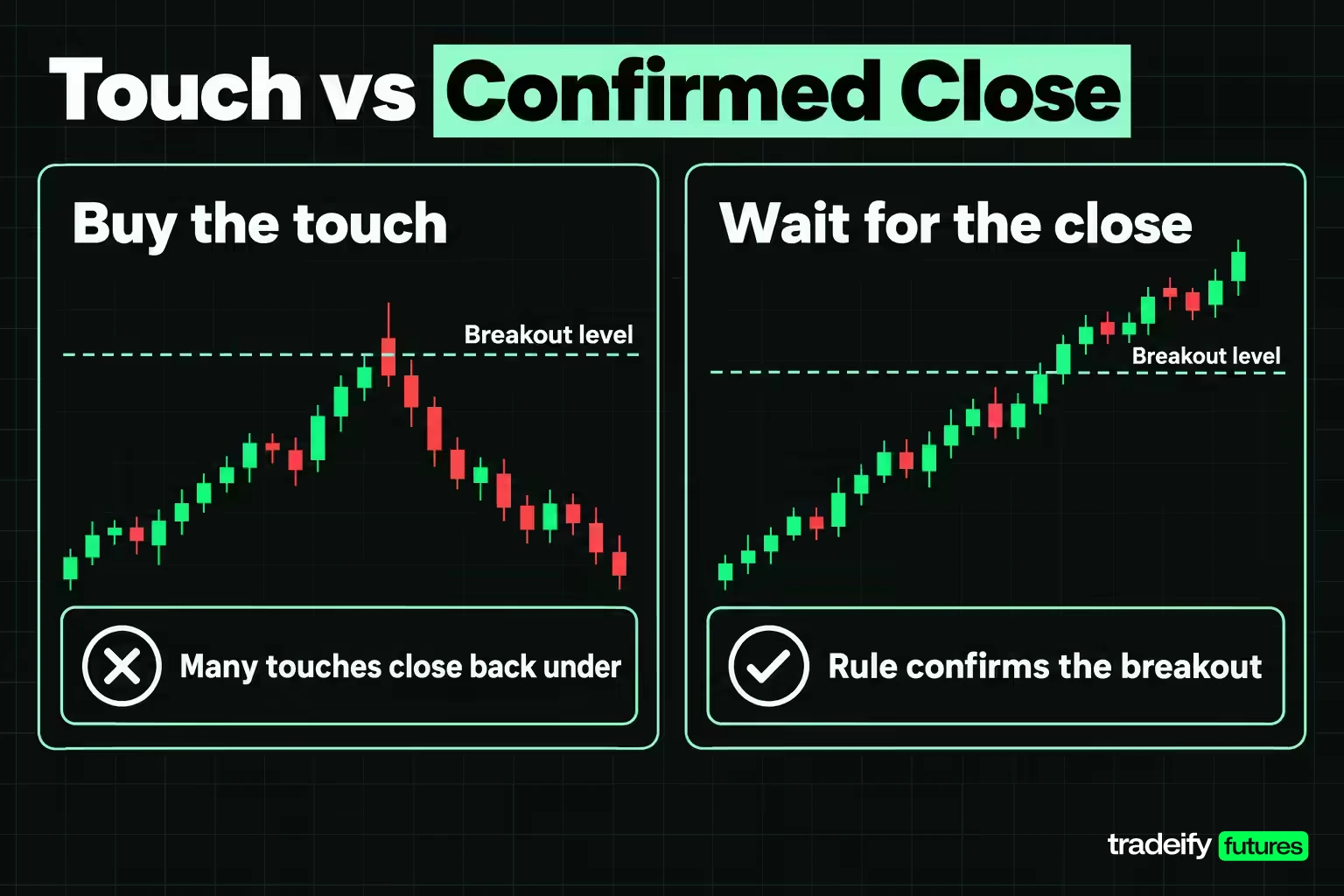
Waiting for the setup to confirm is the entry decision most traders get wrong, because the unconfirmed version looks identical at the moment you act.
The breakout rule in this E-mini study waits for the session to close above the prior 20-session high. The impatient version buys the level the moment price trades through it, with a resting buy stop. Over 20 years of Yahoo Finance ES daily data, the level traded 1,173 times, about 1.98 times as often as the rule confirmed. The table shows this guide's own test of those touches, which split almost evenly into two groups that behaved very differently.
| Breakout touch group | Touches | Win rate | Net R per trade, strict same-bar rule | Net R per trade, lenient same-bar rule |
|---|---|---|---|---|
| Closed above the level | 591 | 44.84% | 0.2979R | 0.3575R |
| Closed back under the level | 582 | 26.80% | -0.2611R | -0.1685R |
The two columns exist because daily bars cannot show whether the day's low came before or after the touch. The strict rule assumes the stop was hit first whenever the low reached it. The lenient rule counts a same-day stop only when the session closed under the stop, which proves it was hit after entry. The true figure sits somewhere between them. Either way, the touches that failed to close above the level lost money, and the confirmed ones made it.
A rejected E-mini breakout touch from October 2025
An E-mini session on October 30, 2025 shows what waiting for a breakout close filters out. The prior 20-session high sat at 6,952.00. ES opened at 6,906.50, traded up to 6,953.75, then fell to 6,851.00 and closed at 6,855.50.
A buy stop at 6,952.00 filled. With that session's ATR of 79.06 points, the stop sat at 6,872.94, and the close was already under it. That is a full 1R loss, 79.06 points or $395.30 on one Micro E-mini (MES, $5 per point), taken on a day the written rule never triggered.
A trader waiting for the daily close took nothing that day. Nothing clever happened. The breakout rule asked for a close above 6,952.00, the close never came, and the account stayed flat.
Related lesson: Trade setups and confirmation
The Cost of Impatience in Numbers
The cost of impatience shows up most clearly when you change one habit at a time and leave everything else in the E-mini breakout rule alone. This guide's test on Yahoo Finance ES daily data, September 2006 to November 2026, counts every signal in the first table, so trades can overlap.
| Impatience habit, every signal | Trades | Win rate | Net R per trade |
|---|---|---|---|
| Written plan, wait for the close | 592 | 40.20% | 0.1301R |
| Buy every touch of the level | 1,173 | 35.89% | 0.0206R |
| Take profit at 1 ATR instead of 2 ATR | 592 | 53.55% | 0.0504R |
| Exit after 5 sessions instead of 20 | 592 | 51.52% | 0.0445R |
| Enter one session late, at the next close | 592 | 39.36% | 0.1217R |
Impatience costs with one position at a time
Many traders can only run one idea at a time, so this table runs the same impatient habits on the same E-mini breakout rule with one position open at a time. A new signal is ignored while a trade is live.
| Impatience habit, one position at a time | Trades | Win rate | Net R per trade |
|---|---|---|---|
| Written plan, wait for the close | 231 | 38.96% | 0.0953R |
| Take profit at 1 ATR instead of 2 ATR | 333 | 52.25% | 0.0258R |
| Exit after 5 sessions instead of 20 | 306 | 53.92% | 0.0697R |
| Enter one session late, at the next close | 217 | 38.25% | 0.1008R |
Which impatient habits cost the most
Three patterns hold on both the every-signal and one-position versions of the E-mini breakout test.
Buying the touch costs the most. It doubles the trade count and adds 582 set-ups that lost money on average. Under the lenient same-bar rule every touch still earns only 0.0965R, under the plan's 0.1301R, and you pay commission and attention on twice as many trades.
Early exits raise the win rate and lower the money. The 1 ATR target wins 53.55% of the time against 40.20% for the plan, and it earns less than half as much per trade. Exiting after five sessions does the same thing: 334 of the 592 trades ended at that five-session exit instead of reaching the stop or the target.
A little lateness is cheap here. Entering at the close of the session after the signal, instead of its open, cost under 0.01R per trade on daily bars. On this rule the close averaged only 1.41 points above the open. A late fill on a fast intraday chart can cost far more, so treat this as a daily-bar result.
Why Patience Pays as a Trading Strategy
Patience pays as a trading strategy for a plain reason: most sessions offer nothing that qualifies, and the trades you add in those sessions dilute the few that do.
In this guide's E-mini breakout test on Yahoo Finance ES daily data, the signal fired on 11.68% of sessions. Holding one position at a time, the rule had no open trade on 62.38% of sessions. Doing nothing was the rule's normal state, not a malfunction.
Patience does not create an edge. It protects whatever edge the rule has. That distinction matters, because this rule's edge is thin. A control test took 592 random sessions that were not signals, entered at the next open and used the same stop, target and time limit. Across 20 random draws those entries averaged 0.1124R, against 0.1301R for the plan, and the plan beat 13 of the 20 draws.
That is an honest result, and it cuts both ways. The S&P 500 rose over those 20 years, so almost any long entry with a 2-to-1 target earned something. The breakout rule added a little on top. The impatient habits did not just shave that small extra; buying every touch pushed the result well under what random entries earned.
The practical version is modest. If your rule's edge is small, and most are, patience is what keeps it from leaking away through extra trades, early exits and unconfirmed entries. It cannot turn a rule with no edge into one with an edge.
Trading Frequency and Patience
Trading frequency and patience are linked through one uncomfortable fact: a working rule often goes quiet for weeks, and the urge to fill that gap is where impatient trades come from.
Held one position at a time, the E-mini breakout rule produced:
- A median of 12 trades per full calendar year from 2007 to 2025, with 4 in 2008 and 18 in 2017.
- A median gap of 6 sessions between one exit and the next entry, and a mean of 13.57.
- A longest gap of 101 sessions, from May 26, 2015 to October 19, 2015. That is almost five months with the rule saying nothing.
So is a day with no trades a good day? If the rule had nothing to offer and you took nothing, yes. A zero-trade day only becomes a bad day when the rule did fire and you missed or ignored it.
Research on individual investors points the same way. Barber and Odean's study of 66,465 brokerage households from 1991 to 1996, published in the Journal of Finance as "Trading Is Hazardous to Your Wealth", found the most active traders earned 11.4% a year net while the market returned 17.9%.
A daily trade cap is a blunt but useful tool. Pick it from your rule's own history, for example the most signals the rule ever produced in one session, and stop when you hit it. The cap is not there to restrict good trades. It catches the extra ones that appear after a loss or a slow morning.
Related lesson: FOMO and the entry you did not have
Holding a Winning Trade With Patience
Holding a winning trade with patience is harder than waiting to enter, because the money is already on the screen and every pullback feels like it is being taken back.
A held E-mini breakout trade from April 2026
The April 14, 2026 E-mini breakout signal shows what holding to the plan looks like. ES closed at 7,004.75, above the prior 20-session high of 6,928.25, with ATR at 120.08 points. The plan entered at the April 15 open, 7,004.00, with a stop at 6,883.92 and a 2 ATR target at 7,244.16.
- April 17, the third session. Price reached the 1 ATR level at 7,124.08 and kept going to 7,185.75, about 1.51R of open profit. A trader taking profit at 1 ATR was out here with $600.40 per MES.
- April 23. Price pulled back to 7,079.25. Open profit had shrunk to about 0.63R, and the trade had given back more than half of its best level. This is the day the urge to close it is strongest.
- April 30, the 12th session. The 2 ATR target at 7,244.16 filled, worth $1,200.80 per MES.
Same entry, same stop, same market. The only difference was a decision made before the trade about where it ended. Not every trade works out this way; 345 of the plan's 592 trades hit the stop. Holding pays across the sample, not on every trade.
Target and time limits for held trades
The target ladder from this guide's E-mini breakout test shows the trade-off across all 592 signals.
| Target size | Win rate | Net R per trade |
|---|---|---|
| 1 ATR | 53.55% | 0.0504R |
| 1.5 ATR | 44.43% | 0.0762R |
| 2 ATR | 40.20% | 0.1301R |
| 3 ATR | 34.97% | 0.1211R |
| 4 ATR | 34.12% | 0.1311R |
Every shorter target raises the win rate. Beyond 2 ATR the money stops improving, so this is not an argument for ever-wider targets. It is an argument for choosing the target before entry and leaving it alone.
The time limit tells the same story: 5 sessions earned 0.0445R per trade, 10 sessions 0.1007R and the full 20 sessions 0.1301R.
The urge to take profit early is well documented. Odean's 1998 study of 10,000 discount-brokerage accounts found investors realised gains at a rate of 0.148 against 0.098 for losses, and the winners they sold went on to beat the losers they kept by 3.4% over the following year.
Related lesson: Take-profit orders and targets
Patience vs Hesitation
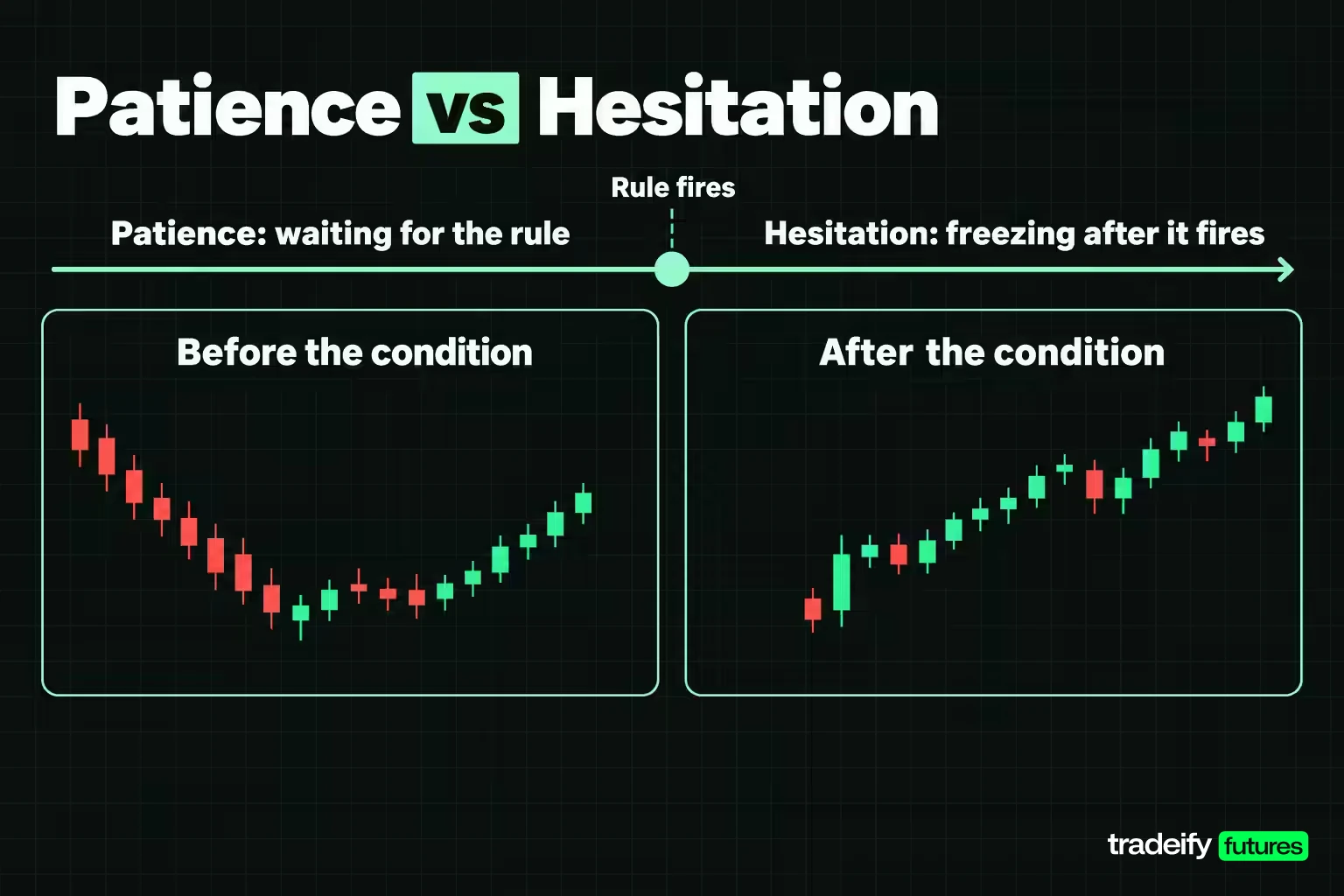
Patience vs hesitation is the distinction that keeps patience from turning into an excuse. Both look like not trading. They happen at different moments.
- Patience happens before the condition fires. You wait because the rule has not confirmed anything.
- Hesitation happens after the condition fires. The rule says go and you freeze, wait for one more bar, or skip it because the last trade lost.
The E-mini breakout study priced both kinds of hesitation.
Entering late. Waiting one extra session and entering at its close cost about 0.01R per trade on daily bars (0.1217R against 0.1301R). Hesitation by a bar was cheap here. It gets more expensive on faster charts, and much more expensive when the delay turns into a chase at a price the rule never planned for.
Skipping after losses. On the one-position basis, the trade right after a loss averaged 0.1334R across 140 trades, higher than the plan's overall 0.0953R. Sitting out after a single loss would have skipped some of the better trades. After two losses in a row, the next trade averaged 0.0348R across 82 trades. A sit-one-out-after-two-losses rule skipped 40 trades that averaged -0.0914R, but with a standard error of 0.2075R that result is noise, not a pattern.
The lesson is not that pausing is wrong. A planned pause written into your rules before the session is a risk control. An unplanned skip because the last trade hurt is hesitation, and the data gave no sign that the market rewards it.
A quick test helps. Ask whether the reason you are not trading is written in your plan. If it is, you are being patient. If the reason is a feeling about the last trade, you are hesitating.
Related lesson: Loss aversion and the trade you should have closed
Patience in Quiet or Choppy Markets
Patience in quiet or choppy markets matters because the same rule can behave very differently depending on conditions, and the poor conditions are rarely obvious while you are in them.
This guide's E-mini study on Yahoo Finance ES daily data split the 592 breakout signals into thirds by how volatile the market was at the signal. Each signal's ATR was ranked against its own previous 250 sessions.
| Volatility at the breakout signal | Trades | Win rate | Net R per trade |
|---|---|---|---|
| Quietest third, ATR at or under the 25.2% mark | 197 | 30.46% | -0.1303R |
| Middle third | 197 | 45.69% | 0.2804R |
| Busiest third | 198 | 44.44% | 0.2396R |
Breakouts from the quietest markets lost money, while the other two thirds made it. Each third carries a standard error of about 0.10R, so the gap between the quiet third and the rest is large relative to the noise, but it is still one split of one rule. Test it on your own rule before you trust it.
The useful habit is to define poor conditions before the session, in numbers, instead of judging them mid-session. For example:
- Skip breakout entries when the current ATR ranks in the bottom quarter of the past year.
- Skip range entries when the market has trended hard for several sessions.
- Write the filter down and track what the skipped trades would have done.
A filter you invent during a losing streak is usually a way to explain the streak. A filter you write in advance and test is patience with a definition.
Boredom Trades and Patience
Boredom trades are a quieter form of impatience. Nothing is wrong, nothing is happening, and a position starts to look like the cure for the slow session.
The E-mini study approximated boredom trades with random entries in quiet sessions: non-signal days in the lowest volatility band, entered at the next open with the plan's stop, target and time limit. Across 20 draws of 197 such entries, they averaged -0.004R, with individual draws ranging from -0.2433R to 0.1974R. The same random entries in livelier sessions averaged 0.1458R.
In plain terms, trades taken in quiet markets for no reason earned roughly nothing on average, and a run of them could just as easily lose 0.24R a trade as win. That is the market's way of charging you for entertainment.
A few ways to make flat time less painful:
- Set price alerts on the levels your rule watches, then step away from the screen.
- Use quiet sessions for review: mark up the last ten trades or replay a past session.
- Keep a short written list of what counts as a trade, and read it before you place any order.
- If you trade to feel busy, trade smaller. Lower stakes reduce the urge to make something happen.
Less screen time with nothing to do is also the simplest answer to stress. Most trading stress comes from watching positions and prices you have no plan for.
The Psychology of Patience in Trading
The psychology of patience in trading comes down to a few predictable feelings, each tied to a specific behaviour. Naming them is the first step to having a rule ready when they show up.
- The need to act. Sitting still feels like falling behind, especially after reading about other traders' results. The behaviour is the unconfirmed entry.
- Regret. Watching a missed move run makes the next touch of a level feel urgent. The behaviour is chasing.
- Fear of giving back open profit. A pullback in a winning trade feels like losing money you already had. The behaviour is the early exit.
- The urge to recover. After a loss the next trade feels like it has to happen now. The behaviour is lowering the bar for what counts as a set-up.
- Doubt after a run of losses. The rule feels broken after three stops. The behaviour is hesitation on the next valid signal.
None of these feelings mean something is wrong with you. Anyone who has watched a level break without them has felt at least one. The problem is not the feeling; it is letting the feeling pick the timing.
The fix that works most often is a decision made in advance. If the rule says what to do when price touches the level without closing above it, the feeling has nothing to decide. That is why patience and written rules are so closely tied.
Related lesson: Avoiding trading tilt
Patience and Discipline Working Together
Patience and discipline are different skills that only work together. Discipline is doing what the written rule says. Patience is putting up with the waiting the rule demands.
A trader can be disciplined about stops and still impatient about entries. Another can wait well for set-ups and then exit early every time. Both are following part of the plan.
The E-mini breakout study shows why both halves matter. The confirmed entries earned money and the unconfirmed ones lost it, which is a patience result. Holding to the 2 ATR target instead of exiting at 1 ATR more than doubled the result per trade, which is a discipline result. Lose either and most of the edge goes with it.
The bridge between the two is specificity. "Be patient" is not a rule. "Enter only after a daily close above the prior 20-session high" is. A specific rule turns patience into something you can check after the session:
- Did every entry match the written condition?
- Did every exit happen at the planned stop, target or time limit?
- Did you take every signal the rule produced?
Three yes answers mean the day was patient and disciplined, whatever the profit and loss says.
How to Build Patience as a Trading Skill

Building patience as a trading skill works best with drills that make waiting measurable rather than willpower you summon on the day.
Patience drills you can start this week
- Write the trigger in one sentence. If you cannot say exactly what confirms a set-up, you will confirm it with feeling.
- Replace watching with alerts. Set alerts at the levels your rule cares about and close the chart until one fires.
- Keep a set-up rejection log. Each time price tests a level without confirming, write down that you passed and what happened next. After 20 sessions compare the passed set-ups with the taken ones.
- Count the wait. Note how many sessions passed since your last valid signal. Seeing "this gap is normal for my rule" takes the sting out of a quiet week.
- Trade smaller while you practise. Smaller size lowers the emotional stakes of each decision, which makes it easier to follow the rule.
- Use a lockout. Many platforms let you set your own daily loss limit or block new orders for a set time. Decide the trigger before the session.
A five-number patience audit
A five-number patience audit turns waiting into something you can measure. Once a month, pull these five numbers from your trading journal:
- Share of sessions you were flat.
- Trades you took against signals your rule confirmed.
- Average R on winners against your planned target.
- Total costs as a share of gross profit.
- Your average R per trade and its standard error.
The second number is the one that usually pays. In this guide's E-mini breakout test on 20 years of Yahoo Finance ES data, taking every touch of the level meant 1.98 times as many trades as the rule asked for, and the extra, unconfirmed trades lost money on average.
On our accounts, a few tools support this directly. Growth evaluations carry a daily loss limit that puts the account in liquidation-only until the next trading day when it is hit, which forces a pause. Tradovate's personal Risk Settings let you set your own daily loss limit, and Tradesea offers a personal lockout timer that blocks new orders for a cooling-off period. Every position must be closed by 4:45 PM ET, so patience on our accounts happens within the trading day.
Related lesson: How to keep a trading journal
Long-Term Results of Patience
The long-term results of patience only show up across hundreds of trades, which is exactly why patience is hard to keep.
The E-mini breakout plan earned 0.1301R per trade across 592 signals, with a standard error of 0.0585R. At that edge and spread, about 460 trades are needed before a 95% confidence interval excludes zero. Held one position at a time, the result was 0.0953R with a standard error of 0.0932R, and about 850 trades would be needed. With a median of 12 trades a year, that is decades of data.
Two practical points follow. First, a week or a month cannot tell you whether patience is working; the sample is far too small. Second, small differences per trade add up. The gap between the plan and the 1 ATR target habit was 0.0797R per trade, which over 592 trades is about 47R.
Related lesson: Trade review process and what to measure
Patience in Trading FAQ
What is patience in trading?
Patience in trading means taking only the set-ups your written rule confirms and holding to the exit you planned before entry. It covers three decisions: waiting for the entry condition, holding the planned stop and target, and staying flat when nothing qualifies. It is not avoiding trades; it is letting the rule decide the timing.
How do you practice patience in trading?
Write your entry trigger in one sentence, use price alerts instead of watching every bar, and keep a log of the set-ups you pass on. Compare the passed set-ups with the ones you took after 20 sessions. Trading smaller while you practise lowers the pressure of each decision.
Why do 95% of traders lose?
Most traders lose because costs, overtrading and impatient entries drain whatever edge they have, though the exact 95% figure is rarely traced to a study. Barber, Lee, Liu, Odean and Zhang, using complete Taiwan Stock Exchange data from 1992 to 2006, found more than 75% of day traders quit within two years and less than 1% predictably earned profits.
What is the 5-3-1 rule in trading?
The 5-3-1 rule is an informal forex guideline: trade up to five currency pairs, master three strategies and focus on one trading session. It is a way to narrow focus, not a regulation or a proven system. Its value for patience is that a narrower watchlist produces fewer tempting set-ups.
What is the 3-6-9 rule in trading?
The 3-6-9 rule is an informal risk guideline, most often about 3% risk per trade, 6% combined open risk and a 9% profit target. It has no single definition, and other sources use the numbers as drawdown limits. Treat it as a starting point and test any version against your own rule.
What do you call a person who does trading?
A person who buys and sells markets for short-term profit is called a trader. Traders are often named by holding period, such as scalpers, day traders and swing traders, while someone trading a firm's evaluation or funded account is usually called a prop trader. An investor, by contrast, usually buys to hold for years.
How do you make trading less stressful?
Decide entries, stops, targets and a daily stop before the session, then spend less time watching positions you have no decision to make on. Use alerts, smaller size and a fixed review time. Most stress comes from improvising decisions under pressure.
Applying Patience to Your Next Trading Signal
Applying patience to your next trading signal is where the numbers in this E-mini breakout guide either change behaviour or don't. The next set-up you want to take early will feel different from the ones in the 20-year test. The market will look like it is leaving without you, and the reason for your rule will be hard to recall.
Three numbers from the Yahoo Finance ES study are worth carrying into that moment:
- Unconfirmed breakout touches lost -0.2611R per trade under the strict same-bar rule, while confirmed ones earned 0.2979R.
- Taking profit at 1 ATR instead of 2 ATR raised the win rate to 53.55% and cut the result per trade by more than half.
- The rule's longest quiet stretch ran 101 sessions, so a quiet week is not a broken rule.
Before your next session, write your entry trigger in one sentence, set alerts at the levels it watches and start a rejection log. Then let the rule do the waiting.
This article is for education only and is not investment, legal or tax advice. Futures trading uses leverage and carries substantial risk; losses can exceed what you expect, and you can lose more than you deposit. The study in this article is a historical test of one rule on one futures series and does not represent any live account or trader. Evaluation and funded prop accounts are simulated, and simulated or past results do not indicate future results.


