



TL;DR: Place your first trade only after the stop, the size and the order type are decided, because the click is the easy part. On one Micro E-mini S&P 500 contract, an 8 point stop is $40, or 0.8% of a $5,000 account. Enter with a buy limit, attach the stop and target as a bracket, and expect a stop to fill worse in fast markets. Then review the fill against the plan.
Most first trades go wrong for reasons that have nothing to do with direction. The size came from whatever number was already in the quantity box. The stop was going to be added once the trade moved. A market order went in during the opening minute and filled several ticks away from the chart. The idea was fine. The order ticket was not.
So the goal when you place your first trade is not a winner. It is a ticket where every decision was made before the click, and a result you can actually learn from. That means knowing what an order does, what to trade, how to size it from the stop, which order types to use, and what to check once it is live. Every number in the worked example is illustrative, and nothing here is a recommendation to buy or sell anything.
Trading Basics Before Your First Trade
Placing a trade means sending an order: an instruction to buy or sell a specific instrument, in a specific quantity, under conditions about price and time. The order goes to your broker, and from there to an exchange or another venue where it meets someone willing to take the other side.
Four basics decide where that first order fills and what it costs you.
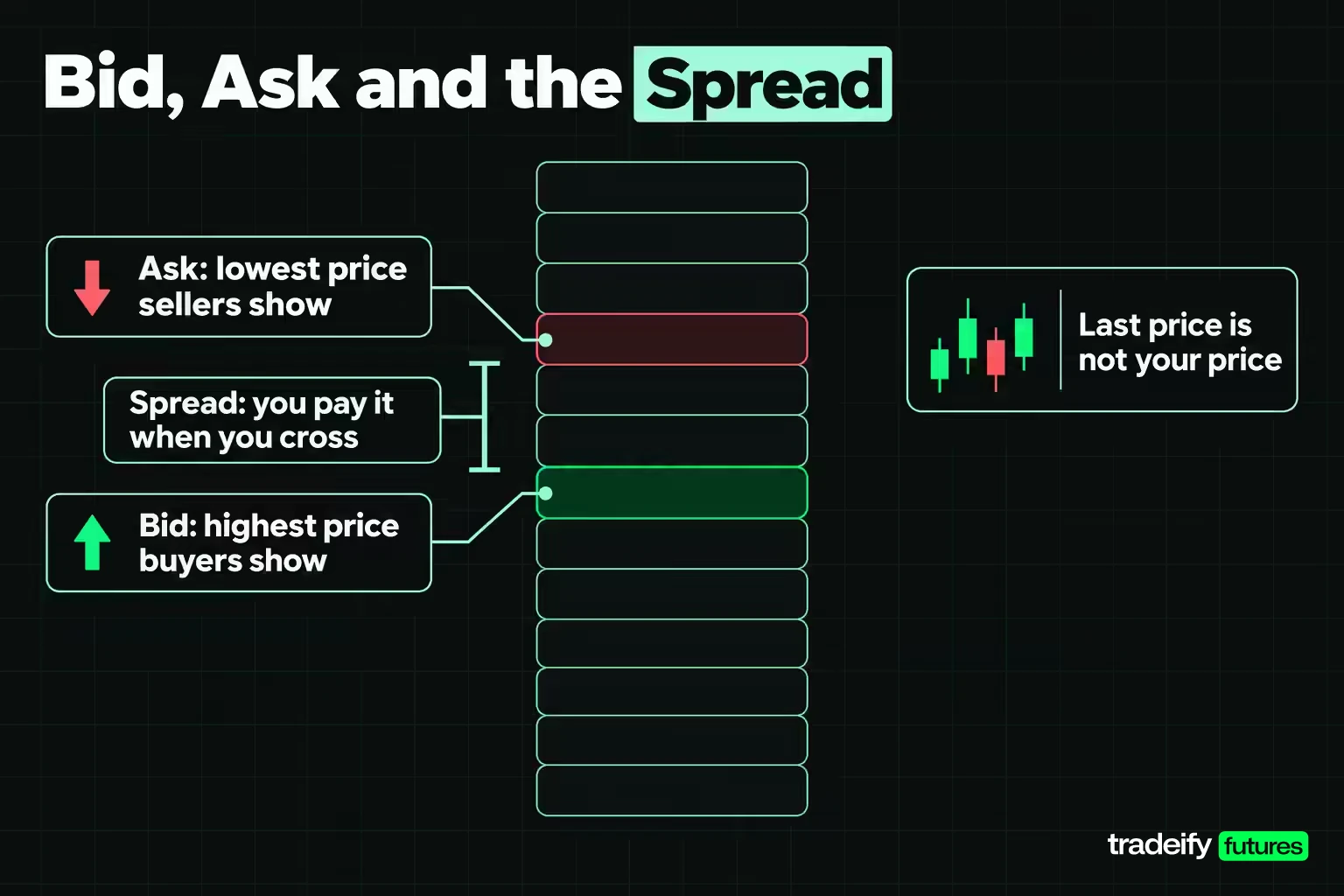
- Bid and ask. The bid is the highest price buyers are showing right now. The ask (or offer) is the lowest price sellers are showing. The gap between them is the spread, and you pay it every time you cross it.
- Last price is not your price. The SEC's investor education site says it plainly: the last-traded price is not necessarily the price at which a market order will be executed. Your fill comes from the orders resting in the book when your order arrives.
- Long and short. Buying first (long) profits if price rises. Selling first (short) profits if price falls. In futures, going short is as simple as selling first; there is no borrowing step.
- Different markets, different mechanics. Stocks are shares of ownership in a company. Futures are standardized exchange contracts on an index, commodity, currency or rate. Spot forex and crypto trade through dealers or crypto platforms with their own rules. A first trade is easier to understand when you know which of these you are actually in.
Related lesson: The order book
Why leverage changes your first trade
Futures are leveraged. One Micro E-mini S&P 500 contract (MES) is worth $5 times the S&P 500 Index, so at an illustrative index level of 7,700 a single contract controls $38,500 of exposure while the account behind it can be much smaller. That is why each point matters: every 0.25 point tick is $1.25, and every full point is $5, on every contract you hold.
The federal risk disclosure that US futures brokers must give before opening an account states that you may lose all the funds you deposit and may incur losses beyond that amount. Read that sentence once before your first trade. It is the reason position size is a calculation, not a guess.
Choosing What to Trade First
The best instrument for a first trade is boring: liquid, cheap per point, and open when you are free to watch it. You are learning order entry and risk, not hunting for the most exciting chart. The temptation is to trade whatever moved most yesterday. That is usually the market where a beginner's stop costs the most.
Three filters do most of the work.
- Dollars per point. Compare what one point costs you before anything else. The E-mini S&P 500 (ES) is $50 per point, so an 8 point stop on one ES is $400, which is 8% of a $5,000 account. The same 8 point stop on one MES is $40. Same chart, one tenth of the risk.
- Liquidity. Heavily traded contracts tend to have tighter spreads and more size at each price, which makes fills more predictable. Check the bid, the ask and the volume on the contract you plan to trade before the session.
- Hours that fit your day. CME Globex equity index futures trade from Sunday 6:00 PM to Friday 5:00 PM ET with a daily maintenance break from 5:00 PM to 6:00 PM ET. Trading nearly around the clock does not mean every hour behaves the same. Pick a window you can actually watch, and stick to it. A trade you cannot monitor is a trade you should not open.
Picking the right contract month
Futures expire, so "MES" is not enough on the ticket. MES lists quarterly contracts (March, June, September and December) for five consecutive quarters, and trading in each one ends at 9:30 AM ET on the third Friday of its contract month. As of November 4, 2026, the active MES contract on CME's site is December 2026, coded MESZ6 (Z is the December month code), and its last trading day is December 18, 2026. A wrong month on the ticket usually shows up as a thin book and an odd spread, so confirm the code before you size anything.
Research to do before the session
Research for a first trade is short and specific. Mark the levels you care about on the chart (a prior day's high and low, an area where price reversed). Check the economic calendar for scheduled releases during your window; the BLS releases the Consumer Price Index at 8:30 AM ET, and prices can move hard through stops around releases like that. Write down the time you plan to stop trading. If the research takes longer than the trade, that is normal. If you cannot name the level that makes the idea wrong, there is no trade yet.
Related lesson: How to choose a market to trade
Opening and Funding a Trading Account
Opening a trading account is mostly paperwork, but two checks are worth doing yourself before you send money.
First, check the firm's registration. For futures, NFA's free BASIC tool shows the registration and disciplinary history of derivatives firms and professionals; for stock brokers, FINRA BrokerCheck does the same job. A firm you cannot find is a reason to stop.
Second, expect identity checks. US futures commission merchants and introducing brokers must collect, at a minimum, your name, date of birth, address and an identification number (a taxpayer identification number for US persons) before opening an account. Futures brokers must also give you a written risk disclosure statement and get your signed acknowledgment before the account opens.
When comparing brokers and platforms, look at the all-in cost per round turn (commission plus exchange and clearing fees), the data fees, the order types the platform supports, and whether it can send a stop and a target together with the entry. Fund the account only with money you can afford to lose. If the first trade goes badly, adding money to win it back is the wrong reflex; the next deposit should wait until the review is done.
Practice Your First Trade on a Demo Account
A demo or paper trading account lets you rehearse the mechanics of a first trade without real money. Most platforms offer one, and it is the right place to learn where the buttons are.
Use the demo for things it does well:
- Finding the order ticket, the DOM and the order list without hunting.
- Sending a limit entry and watching it rest, fill or not fill.
- Attaching a stop and target as a bracket and confirming both legs appear.
- Cancelling an order, and checking that cancelling an order did not close the position.
Then be honest about what it hides. Many simulators can fill your limit the moment price touches it, with little or no model of your place in the queue or of slippage, so execution can look cleaner than it will be live. Simulated money also removes the feeling that makes beginners move stops. As Schwab's own paper trading page puts it, you cannot make money from paper trading. It is practice, not proof.
A practical routine: place the same planned trade ten times on the demo, with the same bracket, until you can do it without looking anything up. Then take the first live trade at the smallest size the instrument allows.
Related lesson: Practice with paper trading
Write the Trade Plan Before the Order
A first trade needs a plan short enough to write in one minute. One line covers it: instrument and month, direction, entry price, stop price, target price, size, and the condition that makes the idea wrong.
Here is an illustrative plan for a first trade on MES:
- Instrument: MES, active quarterly contract.
- Direction: long, only if price pulls back to the level and holds.
- Entry: buy limit at 7,696.00.
- Stop: 7,688.00, eight points below entry, below the level that would show the pullback failed.
- Target: 7,712.00, sixteen points above entry.
- Size: worked out from the stop, never typed from habit.
- Wrong if: price closes back below the level before the entry fills.
Pick one simple strategy for the first trade
You do not need a trading style decided for life. You need one setup you can describe in a sentence, such as "buy a pullback to the prior day's high after the market opens above it." The style you pick changes what the first trade asks of you:
- Scalping holds for seconds to minutes with very tight stops, so fills and costs dominate the result. It is the hardest place to learn order entry.
- Day trading opens and closes inside one session, so there is no overnight gap to manage and the trade can be reviewed the same day.
- Swing trading holds for days, which means wider stops, overnight and weekend gaps, and a smaller size for the same dollar risk.
- Position trading and investing hold for weeks or longer and depend more on the longer-term trend and fundamentals than on the order ticket.
For a first trade, an intraday setup with a written entry rule is usually the easiest to judge. The strategy also decides the entry order: a pullback setup waits with a limit at the level, while a breakout setup uses a buy stop above it. If you cannot say which of those two your setup is, the strategy is not finished. The ratio of 16 points of reward to 8 points of risk is 2 to 1, which is a plan, not a prediction. It only means something next to a win rate you have measured, and on a first trade you have not measured one yet. That is fine. The point of the first trade is a clean sample, not a verdict.
Related lesson: Build your first trading plan
Sizing Your First Trade From the Stop
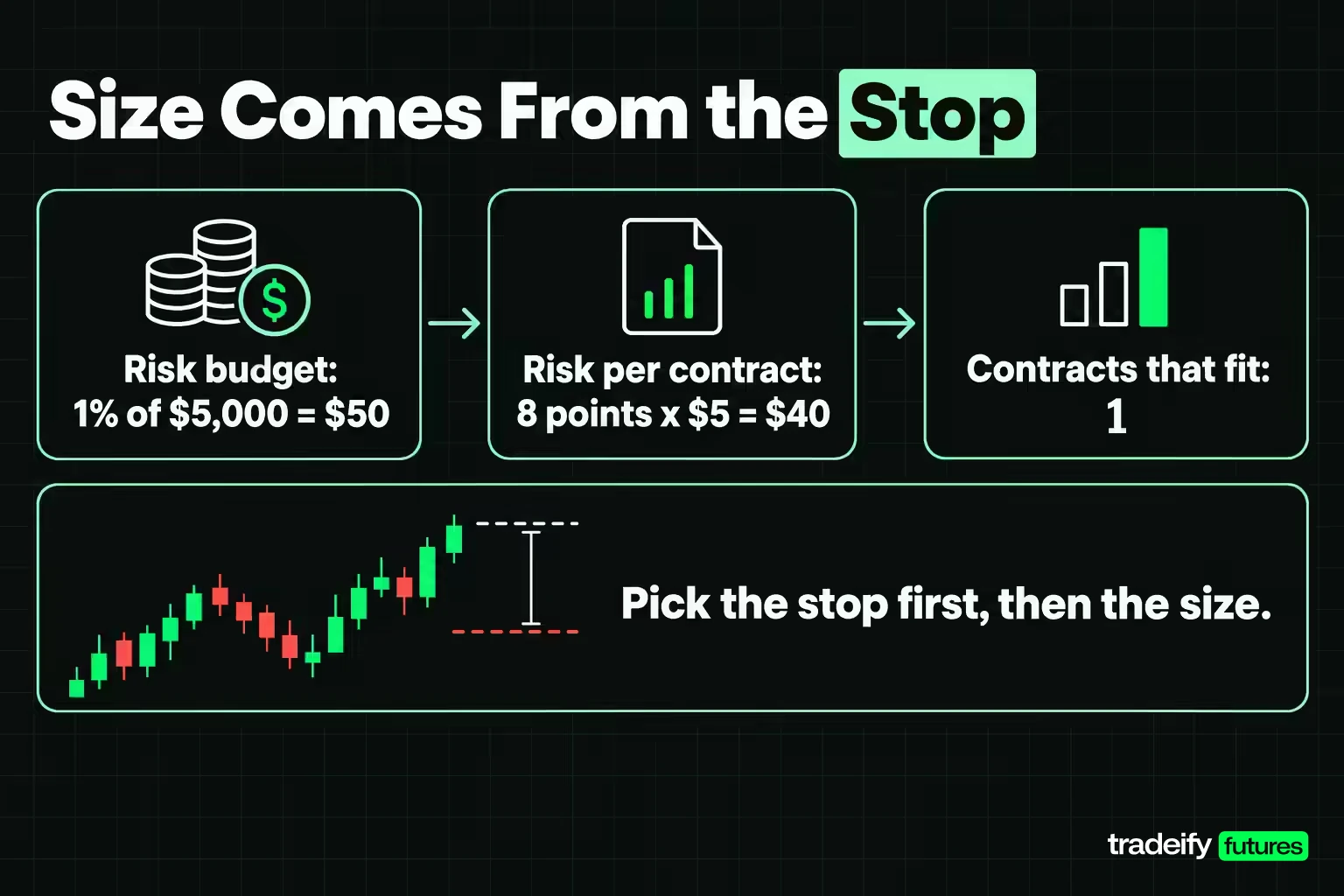
Size comes after the stop, because the stop distance in dollars is what turns a risk budget into a contract count. Traders who size first and place the stop afterwards run the equation backwards and usually find out while the position is open.
Take an illustrative long on MES with an entry at 7,696.00 and a stop at 7,688.00, an 8 point stop. The illustrative account has $5,000 and a rule of risking 1% per trade.
- Risk budget: 1% of $5,000 is $50.
- Risk per contract: an 8 point stop at $5 per point is $40.
- Contracts that fit: $50 divided by $40, rounded down, is 1.
One contract risks $40, or 0.8% of the account. Three contracts would risk $120, or 2.4%, and break the plan before the market has done anything.
Trading costs and the break-even win rate
Costs change the math more than beginners expect. Using the same MES trade (8 points of risk, 16 points of reward), assume an illustrative all-in round turn of $2.60 per contract and fills at your planned prices.
| Line | Before costs | After $2.60 round turn |
|---|---|---|
| Risk on one contract | $40.00 | $42.60 |
| Reward on one contract | $80.00 | $77.40 |
| Break-even win rate | 33.3% | 35.5% |
The break-even rate is risk divided by risk plus reward. A 2 to 1 trade looks like it needs to win a third of the time; once costs are on the ticket it needs about 35.5%.
When the stop is too wide for the account
The same sizing rule, applied to one MES contract at $5 per point with a 1% risk limit, tells you when a trade does not fit the account. A 20 point stop makes one MES contract $100 of risk, which needs a $10,000 account at 1%. A 40 point stop is $200 per contract and needs $20,000. If the math rounds to zero contracts, the fix is a tighter setup, a smaller instrument or a larger account, not a bigger risk percentage.
Related lesson: Position sizing
Order Types for a First Trade
Every order type trades certainty of execution against certainty of price. Nothing on the list gives you both. The definitions in this table follow CME's rulebook and the SEC's order-types bulletin.
| Order type | What it does | What you get | What catches beginners |
|---|---|---|---|
| Market | Fills at the best available prices now | Execution | The fill is not the chart price, and part of a larger order can fill at worse prices |
| Limit | Fills only at your limit price or better | Price control | It may never fill, which leaves you with no position and no loss |
| Stop | Becomes a market order once the stop price trades | An automatic exit | The stop price is a trigger, not a guaranteed fill price |
| Stop with protection | Triggers like a stop but fills only inside an exchange-set protected range | A bounded fill | Any quantity that cannot fill in the range rests as a limit and may not fill |
| Stop-limit | Triggers at the stop, then works as a limit | Price control after the trigger | In a fast move it can sit unfilled while the loss grows |
| OCO or bracket | Links a stop and a target so one fill cancels the other | Fewer missed steps | If a leg is rejected, the others may still be working |
The practical rule for a first trade: a limit for the entry, a stop for protection, and a linked bracket where the platform offers one. Market orders are for exits you need immediately, not entries you had all morning to prepare. On CME Globex, an order sent without a duration instruction is cancelled if it does not fill during that trading day, which is usually what you want for a first trade.
Related lesson: Order types overview
The Six Steps to Place Your First Trade
These six steps take a first trade from a written plan to working orders. Each step ends with a check. If the check fails, the trade waits, and waiting costs nothing.
- Write the trade down. Instrument, month, direction, entry, stop, target, size and the condition that makes it wrong. Check: it fits on one line.
- Check the contract and the quote. Confirm the symbol and month, then read the bid, the ask and the spread in ticks. Check: the spread looks normal for that contract and time of day.
- Type the size. Enter the quantity from your sizing math instead of accepting whatever the ticket shows. Check: the dollars at risk match the plan.
- Choose the entry order type. A limit at your level if you will wait for it, a stop if you are entering on a break, a market order only if getting in now matters more than the price. Check: the order type matches the plan's entry rule.
- Send the entry with protection attached. Use a bracket so the stop and target are placed with the entry. If the platform cannot do that, place the stop the moment the entry fills. Check: the order list shows the entry working and, after the fill, both exit orders resting.
- Confirm and step back. Verify the fill price, the stop and the target, then take your hand off the mouse. Check: nothing on the screen differs from the written plan.
Related lesson: Bracket orders
Managing the Trade After the Fill
Once your first trade is live, the job changes from deciding to checking. The most dangerous moment is right after the fill, when the position exists and you are not yet sure the protection does.
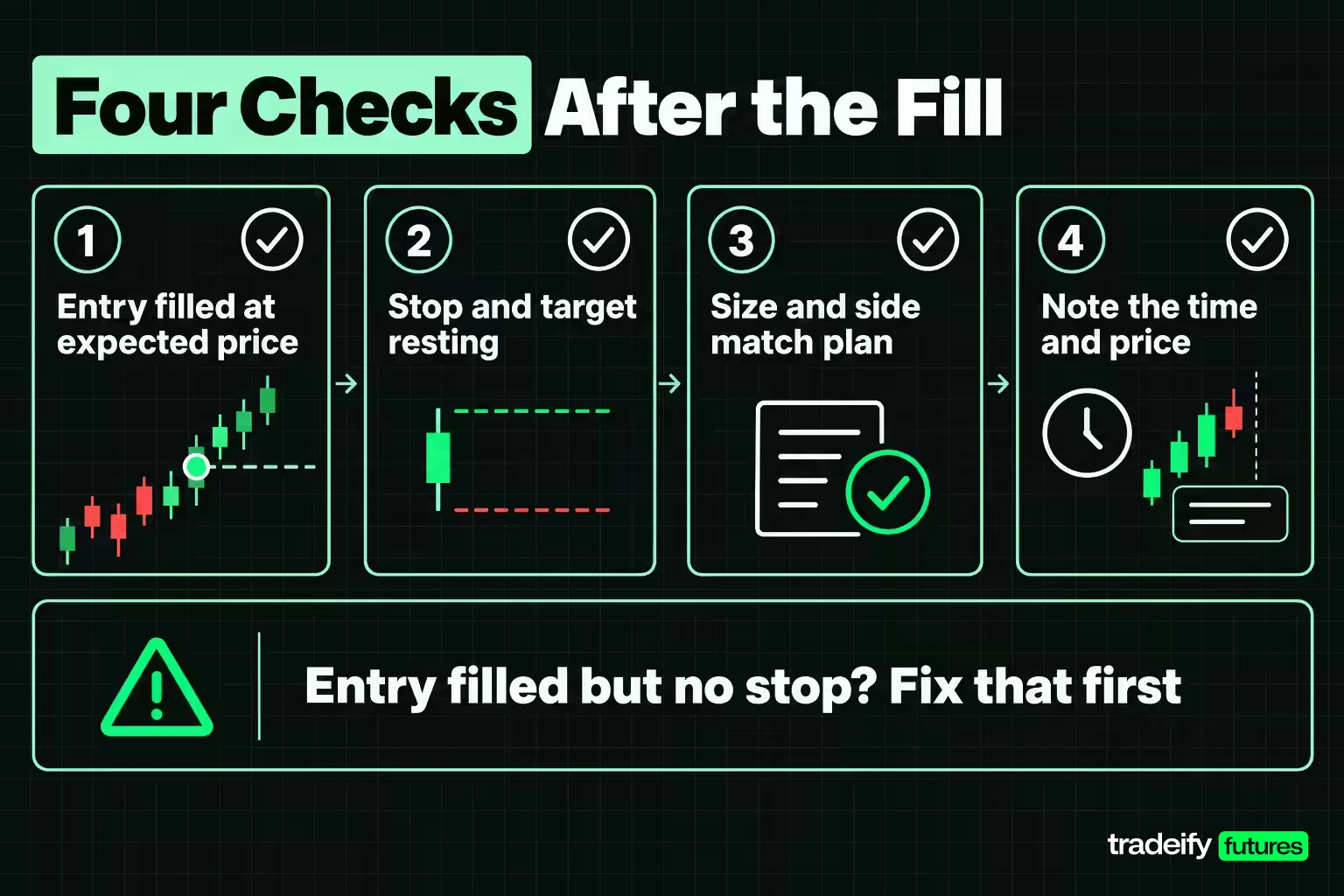
Run four checks in the first minutes:
- The entry filled at the expected price, and you know by how many ticks it differed.
- The stop and target are resting at the planned prices and quantities.
- The position size and side match the plan.
- You noted the time and what price did, to record it rather than react to it.
If the entry filled but the stop is missing, fix that first. Direction can wait.
Invalidation and moving stops
If the condition that makes a trade wrong appears before the stop is hit, follow the written rule and exit. The stop is the worst case, not a required exit. What you do not do is move the stop further away. A stop moves only for a reason written before entry, such as a rule to move it to break-even after a set gain.
What slippage on the stop costs
A stop is not a floor under your loss. Once it triggers it becomes a market order, and in a fast market the fill can land below the stop price. Here is what that does to an illustrative one-contract MES trade with an 8 point stop, a $40 planned loss (1R), with an illustrative $2.60 round turn included.
| Stop fill | Realised loss | Multiple of planned risk |
|---|---|---|
| 1 tick worse | $43.85 | 1.10R |
| 2 ticks worse | $45.10 | 1.13R |
| 5 ticks worse | $48.85 | 1.22R |
| 13 ticks worse | $58.85 | 1.47R |
Small slips are part of trading. Large ones usually cluster around scheduled releases and the open, which is one more reason to know the calendar before the trade.
Related lesson: Slippage explained
Reviewing Your First Trade
The review is where a first trade becomes useful, win or lose. A clean loss that followed the plan is a better first trade than a lucky win that broke it. When the trade closes, write answers to four questions before you take another one.
- Was the loss defined before entry, and did the realised loss match it?
- Was the size calculated from the risk budget?
- Did the fill match the planned level, and by how many ticks?
- Did you follow the rule you wrote, or the feeling you had?
Log the planned prices, the actual fills, the costs, and the result in dollars and in R. After ten or twenty trades the pattern starts to show: if realised losses keep running past 1R, the leak is execution or stop placement; if losses are 1R but the account is still shrinking fast, the leak is size or frequency. Honest answers make the second trade different from the first. Generous answers make the tenth trade the same as the first, with more size.
Related lesson: How to keep a trading journal
Common First Trade Mistakes
Most first trade mistakes are process mistakes, and each one leaves a trace you can spot in the platform or the trade log.
| Mistake | What you see | Fix |
|---|---|---|
| Market order at the open | A fill several ticks from the planned level | Use a limit, or wait until the opening minutes pass |
| Size from the default quantity | A position larger than the plan allows | Type the quantity and check dollars at risk before sending |
| Stop added after the fill | A window with no protection | Send entry, stop and target as one bracket |
| Stop treated as a guaranteed price | A loss larger than planned | Price in slippage and avoid trading through scheduled releases |
| Moving the stop mid-trade | A loss beyond the plan's limit | Move a stop only for a rule written before entry |
| Wrong contract month | A thin book and an odd spread | Verify the contract code before sizing |
| No target | A winner that turns into a loser | Set the exit level with the entry |
| Revenge trade after the first loss | A second, larger trade outside the plan | Stop for the session and review the first trade in writing |
Related lesson: Common beginner trading mistakes
A First Trade Checklist
Run this checklist before every order until it is automatic. One "no" is a reason to skip the trade, not to try harder.
| Check | Pass means | Why it matters |
|---|---|---|
| Instrument and month | Correct symbol and active contract | A wrong month means thin liquidity and odd fills |
| Direction and level | A written entry price and side | Keeps the order on the right side of the book |
| Invalidation | A specific price, not a dollar feeling | The stop distance sets the size |
| Size | Contracts calculated from the risk budget | Stops the default quantity becoming the position |
| Dollars at risk | Inside the per-trade limit | Keeps one loss from changing the week |
| Target | An exit level is set | Turns the trade into a defined outcome |
| Costs | Round turn cost known | The break-even rate is not the raw ratio |
| Order type | Matches the entry rule | Limit to wait, stop for breaks, market for urgency |
| Protection | Stop attached with the entry | An unprotected position has no defined loss |
| Calendar | You know any scheduled release in your window | Releases can move price through a stop |
| Time | You can watch the position until it closes | A stop-limit may not fill unattended |
First Trades on Prop Firm Evaluation and Funded Accounts
The mechanics of a first trade are the same on a demo, a prop firm evaluation, a simulated funded account or a live brokerage account. What changes is who sets the limits. A typical prop firm adds its own daily loss limit and drawdown on top of your personal risk rule, and some require every position to be closed before the session ends. Your per-trade rule still has to fit inside the firm's limits, not replace them. A firm's daily loss limit is a ceiling for the day, not a stop for a single trade.
On our accounts, your first trade runs on a simulated account, and size is capped by contract limits: a 25K account allows up to 1 mini or 10 micros. Every position must be closed by 4:45 PM ET, with no overnight holds. The Growth evaluation's daily loss limit is a soft breach that puts the account in liquidation-only mode until the next trading day, so never use it as a stop. On Tradovate, ATM strategies can place your stop and target automatically once the entry fills, and one MES round trip costs $1.82 in commissions.
FAQ About Placing Your First Trade
How much money should I put in my first trade?
Put in only enough that your stop loss is a small, fixed share of the account, such as 1%. Divide the dollars your stop represents by your risk percentage: at 1%, a $40 stop on one MES needs a $4,000 account. The dollars at risk are the number that matters, so keep it small enough that losing it changes nothing about your next decision.
What should I trade first as a beginner?
Pick one liquid instrument with a small dollar value per point and hours you can watch. Micro futures such as MES are $5 per point, one tenth of the E-mini, which lets a beginner use realistic stops with small dollar risk. Stay with that one instrument until the order entry is routine.
What is the 3-5-7 rule in trading?
The 3-5-7 rule is an informal risk heuristic, not an exchange or regulatory rule. One common version says risk no more than 3% on a trade, keep total open risk under 5%, and aim for winners at least 7% larger than losers. On a $5,000 account, 3% is $150 and 5% is $250, so it is worth comparing with a smaller per-trade rule such as 1% ($50) before adopting it.
Should I use a market order on my first trade?
Only when getting in or out immediately matters more than the price, which is rarely true for an entry you planned in advance. A limit entry with a stop and target attached covers the plan with fewer surprises.
Why did my stop fill at a worse price than I set?
A stop order becomes a market order once the stop price trades, so the fill comes from whatever prices are available at that moment. In a fast market that can be several ticks away. A stop-limit caps the price but may not fill at all.
What if my limit order never fills?
Then you had no trade, no loss and no commission. An unfilled limit is the order type doing its job. If it keeps happening, the level may be too far from where the market trades for that setup, which is a plan question rather than an execution one.
Your Next Step Before a First Live Trade
Before your first live trade, run the whole sequence on a demo account with one instrument and one setup. Write the one-line plan, size it from the stop, send the entry with a bracket, and when it closes, write down whether the loss was defined, the size was calculated, the fill matched and the rule was followed. Do that five times in a row without skipping a step.
Then take the first live trade at the smallest size the instrument allows, and judge it on one thing: did the ticket match the plan? The profit or loss on a single trade says very little. Whether you followed the process says a lot.
Related lesson: How to read a trade confirmation
This guide is educational and is not investment advice or a recommendation to trade any instrument. Futures and other leveraged products carry substantial risk, and losses can exceed what you expect or deposit. Prices, stops, costs and account sizes here are illustrative. Prop firm evaluation and funded accounts are simulated, and simulated results do not reflect live trading. Check current contract specifications with the exchange and your platform's order handling before you trade.


