



TL;DR: Trailing stop orders move your stop behind price as a trade works, then freeze when price turns, so the main choice is the trail distance. A tight trail keeps more of a run but gets shaken out by normal pullbacks. A wide trail survives noise but hands back more. On one MES contract, a 16-tick trail risks $20.00 and hits break-even after a 4.00 point gain. Most trigger as market orders, so fills can slip past the stop.
A trailing stop order is a stop order whose trigger price follows the market instead of sitting at one fixed level. You choose a side and a distance, and the platform keeps the stop that distance behind the best price the trade has reached.
That sounds simple, and the order itself is. The hard part is the distance. It decides how much open profit you keep and how often an ordinary pullback takes you out of a trade that was working, and those two pull in opposite directions. Most of the frustration traders have with trailing stops comes from setting that number by feel in the two seconds before they click.
What a Trailing Stop Order Is
A trailing stop order is a stop or stop-limit order with a moving trigger. The SEC's investor bulletin on order types defines the stop price as a percentage or dollar amount above or below the current market price, which trails the market while price moves in your favor and stays fixed when price moves against you.
The bulletin's own example is easy to follow. You buy a stock at $20, it rises to $22, and you place a sell trailing stop $1 below the market. Price peaks at $24, so the stop rises to $23 and stays there as price falls. The shares are sold when price reaches $23, though the execution price may differ from $23.
The difference from a regular stop is who moves it. A regular stop sits where you put it until you move it by hand, which in practice means you are making exit decisions mid-trade, with open profit on the screen, when judgment is worst. A trailing stop moves itself, but only one way: up behind a long position, down behind a short one.
What a trailing stop order does not change is how the exit fills. A stop is a trigger, not a price guarantee. Once the trailing stop price is reached, a trailing stop market order becomes a market order, and the SEC notes that a stop's execution price can deviate significantly from the stop price.
Related lesson: Stop orders
How Trailing Stop Orders Work
A trailing stop order runs on a few settings, and each one changes how the order behaves.
The settings on a trailing stop ticket
- Side. A sell trailing stop protects a long position. A buy trailing stop protects a short. Getting the side wrong usually means the order triggers at once or opens a new position.
- Trail distance. The gap the stop keeps from the best price. Futures platforms usually set it in ticks or points; stock platforms often allow dollars or a percentage. Interactive Brokers, for example, lets the trail be a dollar amount or a percentage of the current price.
- Initial stop price. Optional on many platforms. Interactive Brokers sets the stop to the last traded price minus the trail amount if you leave it blank, so the first stop is exactly one trail away.
- Order type on trigger. Trailing stop (market) or trailing stop limit.
- Activation price and step size. Some platforms let you delay trailing until price reaches an activation level, and set a step size, the minimum move before the stop adjusts again.
The one-way ratchet
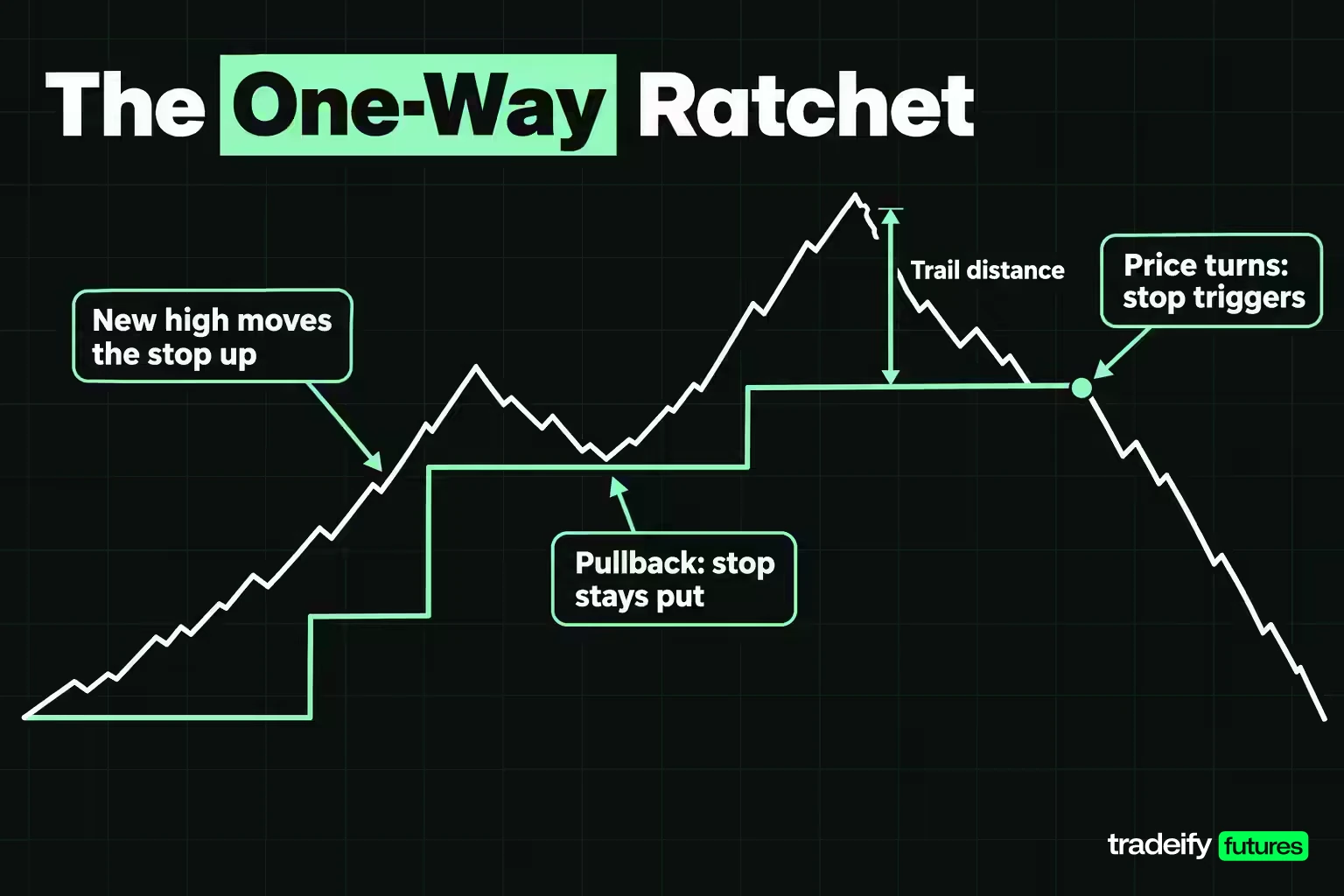
Once a trailing stop order is working, the platform tracks the best price since the order was accepted: the highest price for a long, the lowest for a short. Every new extreme moves the stop. A move back against you does not.
So the trail distance stays the same, and the stop price keeps moving with each new extreme. A pullback does not loosen the stop. The stop simply waits at its last level until price makes a new extreme. Interactive Brokers states the same rule from the risk side: the stop adjusts in your favor but never adjusts to create more than the maximum loss you defined at the start.
What triggers the order
The stop triggers when the reference price reaches the trailing stop price. That reference is not the same everywhere. The SEC bulletin notes that some venues trigger stops on last-sale prices while others use quotation prices, and tells investors to check which standard their firm uses.
On a futures contract with a one-tick spread, last trade versus bid can mean the stop fires a tick earlier or later than you planned. Check the trigger setting on your platform before you rely on a tight trail.
Trailing Stop Examples in Ticks and Dollars
Trailing stop examples only make sense in real units, so the examples here use one Micro E-mini S&P 500 (MES) contract. Per CME's contract specs, MES is $5 times the S&P 500 Index, the minimum tick is 0.25 index points, and one tick is worth $1.25. One full point is $5.00 per contract. The prices are illustrative, not live quotes.
A long trailing stop on one MES contract
Take a long position at 6000.00 with a 16-tick trail, which is 4.00 points or $20.00 of initial risk per contract. The first stop sits at 5996.00.
| New high reached | Trailing stop price | Locked against the 6000.00 entry |
|---|---|---|
| 6000.00 | 5996.00 | -4.00 points, -$20.00 |
| 6001.25 | 5997.25 | -2.75 points, -$13.75 |
| 6002.75 | 5998.75 | -1.25 points, -$6.25 |
| 6003.50 | 5999.50 | -0.50 points, -$2.50 |
| 6004.00 | 6000.00 | 0.00 points, $0.00 |
| 6005.25 | 6001.25 | +1.25 points, +$6.25 |
| 6006.75 | 6002.75 | +2.75 points, +$13.75 |
| 6008.50 | 6004.50 | +4.50 points, +$22.50 |
Notice the fifth row. The stop only reaches your entry once price has advanced by the full trail distance, here to 6004.00. Before that, the trailing stop is still a losing stop, so seeing it on the chart does not mean the trade is safe yet. If the trade reverses from 6008.50, the stop at 6004.50 triggers and, filled one tick worse at 6004.25, the trade keeps 4.25 points, or $21.25.
A short trailing stop on one MES contract
The short side is the mirror image. Short one MES at 6000.00 with a 12-tick buy trailing stop (3.00 points), and the first stop sits above the market at 6003.00.
If price falls to 5991.00, the stop follows it down to 5994.00 and locks 6.00 points, or $30.00. When price bounces and the stop triggers, a fill one tick worse at 5994.25 keeps 5.75 points, or $28.75. The stop never moved back up during the bounce, which is the whole point.
A percentage trailing stop and the break-even trap
Percentage trails are common on stock platforms, and they hide a trap. The trail is measured from the peak, not from your entry.
Buy at 40.00, let price peak at 50.00, and use a 25% trail. The stop sits at 37.50, which is 2.50 below your entry. The trade was up 25% at its best and can still exit at a loss.
For a percentage trail to reach break-even, price has to advance by more than the trail percentage. The math is 1 divided by (1 minus the trail) minus 1:
- A 10% trail needs an 11.1% advance before the stop reaches entry.
- A 25% trail needs a 33.3% advance, a peak of 53.33 from a 40.00 entry.
- A 50% trail needs a 100% advance.
The wider the percentage, the longer the trade stays a potential loser. Convert any percentage trail into price and dollars before you place it.
Advantages of a Trailing Stop
The main advantage of a trailing stop is that it protects open profit without putting a ceiling on the trade. A profit target caps the winner. A fixed stop protects only the entry. A trailing stop moves the floor up as the trade works.
Here is the difference on the same MES trade. Long at 6000.00, price runs to 6008.50, then reverses all the way through the entry.
- With a fixed 16-tick stop at 5996.00, the full reversal stops you out one tick worse at 5995.75 for -4.25 points, or -$21.25.
- With a 16-tick trailing stop, the stop had ratcheted to 6004.50, so the same reversal exits at 6004.25 for +4.25 points, or +$21.25.
That is an 8.50 point swing, $42.50 per contract, on an identical price path, decided only by whether the stop moved.
Other advantages:
- Fixed initial risk. The worst case at entry is the trail distance plus slippage. The trail never widens it.
- Fewer in-trade decisions. The exit rule is set before the trade, so you are not deciding under pressure whether to give a winner more room.
- Room for outliers. A trend that runs ten times your trail is still open, which a fixed target would have closed early.
- Management while you are away from the screen, provided the trailing logic runs somewhere that stays online, which is a real caveat in futures.
Trailing Stop Disadvantages and Limitations
The limitations of a trailing stop are the flip side of its advantages, and most of them show up in fast or choppy markets.
Shakeouts on normal pullbacks
A tight trailing stop locks more profit and gets hit by more noise. Same MES entry at 6000.00, but price first dips to 5996.25 before running to 6008.50.
With a 4-tick trail, the stop sits at 5999.00. The dip triggers it, and the fill one tick worse at 5998.75 is -1.25 points, or -$6.25. A 16-tick trail at 5996.00 never triggers, and that trade later shows 8.50 points, or $42.50, of open profit at the peak. Same path, a 9.75 point or $48.75 difference per contract, decided by a setting most traders pick in a couple of seconds.
Slippage, gaps and give-back
- No price guarantee. A trailing stop market order becomes a market order on trigger and fills at the next available price. In a fast move that can be several ticks past the trigger.
- Gaps. If price jumps past the stop, the fill comes at the first price after the gap, not at your stop.
- Give-back by design. A trailing stop always exits after the turn, never at the high. The trail distance is profit you have agreed to hand back.
- Volatility changes. A trail that suited last week's range can be too tight or too loose today.
Where the trailing logic runs in futures
This is the limitation most stock-focused guides skip. CME Globex's documented futures order types are limit, market with protection, market-limit, stop-limit and stop with protection. There is no native trailing stop in that list.
So in futures, something other than the exchange watches price and moves the stop. Depending on your setup, it might be your platform on your computer or your broker's or data provider's servers. NinjaTrader, for example, documents its Simulated Stop orders as held and simulated locally on your PC, subject to internet drops and crashes, and they stop working if market data stops flowing. R Trader Pro, by contrast, documents trailing stops, brackets and OCO orders as stored on Rithmic's servers, so they stay active if your connection drops.
Know which one you are using before you leave a trailing stop to manage a position unattended.
Related lesson: Slippage explained
Trailing Stop Distance and Risk Management
A trailing stop distance is a risk decision, not a preference. It sets your initial risk per contract and how much open profit you are willing to give back, and you are choosing both at once whether you think about it or not.
The trade-off across trail distances
This table prices the trail distance choice on one illustrative MES path. Long at 6000.00, price runs to 6008.50 (an 8.50 point move), then pulls back to 6002.00. Each exit assumes a fill one tick worse than the stop.
| Trail distance | Stop at the 6008.50 peak | Exit after the pullback | Result per contract | Share of the move kept |
|---|---|---|---|---|
| 4 ticks (1.00 pt) | 6007.50 | 6007.25 | +7.25 pts, $36.25 | 85.3% |
| 8 ticks (2.00 pts) | 6006.50 | 6006.25 | +6.25 pts, $31.25 | 73.5% |
| 12 ticks (3.00 pts) | 6005.50 | 6005.25 | +5.25 pts, $26.25 | 61.8% |
| 16 ticks (4.00 pts) | 6004.50 | 6004.25 | +4.25 pts, $21.25 | 50.0% |
| 20 ticks (5.00 pts) | 6003.50 | 6003.25 | +3.25 pts, $16.25 | 38.2% |
| 24 ticks (6.00 pts) | 6002.50 | 6002.25 | +2.25 pts, $11.25 | 26.5% |
| 28 ticks (7.00 pts) | 6001.50 | Not triggered | +2.00 pts open, $10.00 | Nothing locked |
Read the top and bottom rows together. The 4-tick trail keeps most of the move on this path, but any dip of 4 ticks below entry before the run would have stopped it out for a small loss, and the run would have happened without you. The 28-tick trail is still open with $10.00 of unprotected profit, because a 7.00 point trail needs a 7.00 point pullback to do anything.
ATR-based trailing stops
An ATR trailing stop sets the distance from the market's own recent range. Average true range (ATR), developed by J. Welles Wilder and typically calculated over 14 periods, measures how far price usually moves per bar. It says nothing about direction.
The method: read the ATR in ticks, multiply by a factor, and use the result as the trail. With an illustrative 14-period ATR of 12 ticks on MES (3.00 points, $15.00) and a 20.00 point target:
| ATR multiple | Trail in ticks | Trail in points | Risk per MES contract | Share of a 20.00 point target |
|---|---|---|---|---|
| 1.0x | 12 | 3.00 | $15.00 | 15.0% |
| 1.5x | 18 | 4.50 | $22.50 | 22.5% |
| 2.0x | 24 | 6.00 | $30.00 | 30.0% |
| 3.0x | 36 | 9.00 | $45.00 | 45.0% |
The last column is the honest check. A 2.0x trail spends 30.0% of the target before the trade has done anything. If the only trail that survives normal noise eats a large share of the move you expect, a trailing stop may simply be the wrong exit for that setup.
Related lesson: Average true range (ATR)
Sizing the position around the trail
Because the trail is your initial risk, size from it. On MES a 16-tick trail is $20.00 per contract; on the full-size E-mini S&P 500 (ES), where a tick is $12.50, the same 16 ticks is $200.00. Pick the trail from the market, then pick the contract count so the dollar risk fits your plan. Widening the trail without cutting size quietly raises your risk.
When to Use a Trailing Stop
A trailing stop fits trades where the size of the move is unknown and potentially large compared with normal noise.
Good fits:
- Trend-following trades where the edge comes from staying in for an extended move.
- Runners after you have taken part of a position off at a target.
- Breakouts that either fail quickly or travel well past the breakout level.
- Trades you cannot watch tick by tick, as long as the trailing logic runs on a server rather than a laptop that might sleep.
Poor fits:
- Choppy, range-bound sessions, where pullbacks are as large as the moves and the trail keeps getting tagged.
- Small targets relative to normal range, where a survivable trail eats most of the edge.
- Strategies built on a fixed target, such as mean-reversion trades back to a known level. There the target is the exit.
- Scheduled news, when the gap risk through the stop can dwarf the trail distance.
A practical test before using one: if the typical pullback in your setup is larger than the trail you are willing to risk, use a different exit. The temptation after a shakeout is to widen the trail on the next trade, which cuts protection right when the market is proving it moves more than you planned. Change the setup or the size, not just the trail.
How to Place a Trailing Stop Order
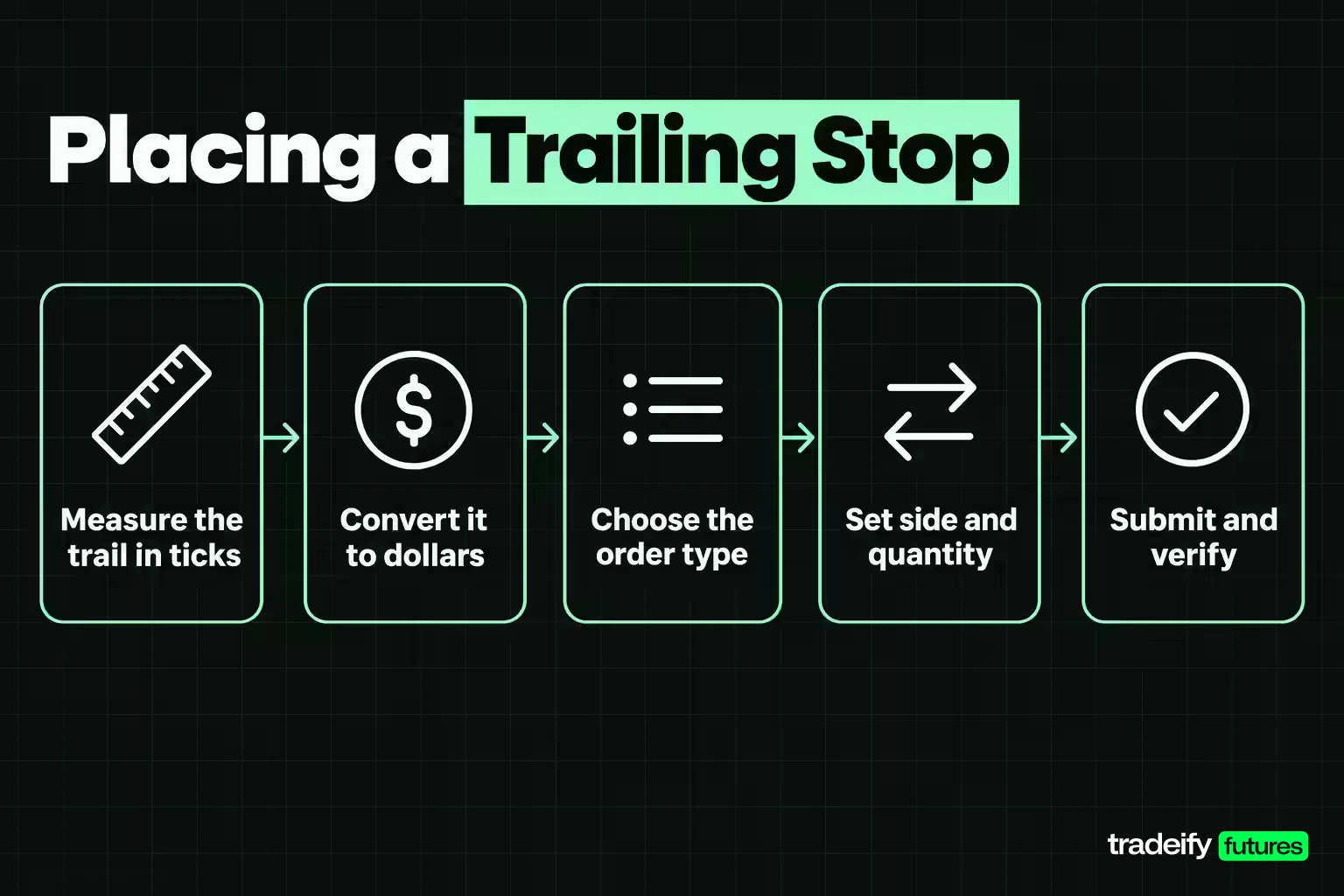
Placing a trailing stop order follows the same steps on most futures platforms, even though the menu names differ.
- Measure the trail first. Use ATR or the size of the pullbacks your setup normally produces, and write it in ticks.
- Convert it to dollars per contract and check it against your maximum risk per trade.
- Choose the order type. On Tradovate's ATM strategy settings, Trail.Stop is a stop market that trails, Trail.Stop Limit is the stop-limit version, and Auto Trail is a stop market that only starts trailing once a Profit Trigger is reached.
- Set the side and quantity to match the position: sell to protect a long, buy to protect a short.
- Set the initial stop if your platform allows it, so the first stop sits where your trade idea is wrong rather than wherever the trail lands.
- Add an activation or profit trigger if you want delayed trailing. NinjaTrader's Auto Trail, for example, uses a Stop Loss offset, a Profit Trigger and a Frequency for how often the stop steps up.
- Submit and verify. Open the working orders panel and confirm the stop exists at the expected price and quantity.
A delayed trailing stop example
Long one MES at 6000.00 with an initial 16-tick stop at 5996.00, an 8-tick profit trigger and an 8-tick trail. Nothing trails until price reaches 6002.00. At that point the stop jumps to 6000.00, your entry, and trails 8 ticks behind every new high from there.
The appeal is that the early, noisy part of the trade has a wider stop, and the trail tightens once the trade has proven itself. The cost is that between 6000.00 and 6002.00 you are carrying the full 16-tick risk.
Trailing stop caveats on copied trades and charts
- On Tradovate, bracket and ATM orders are not supported while Group Trading, so a copied trade will not carry its trailing stop.
- Charting-only views are not the source of truth. The working order at the broker is.
Related lesson: Bracket orders
Trailing Stop vs Trailing Stop Limit
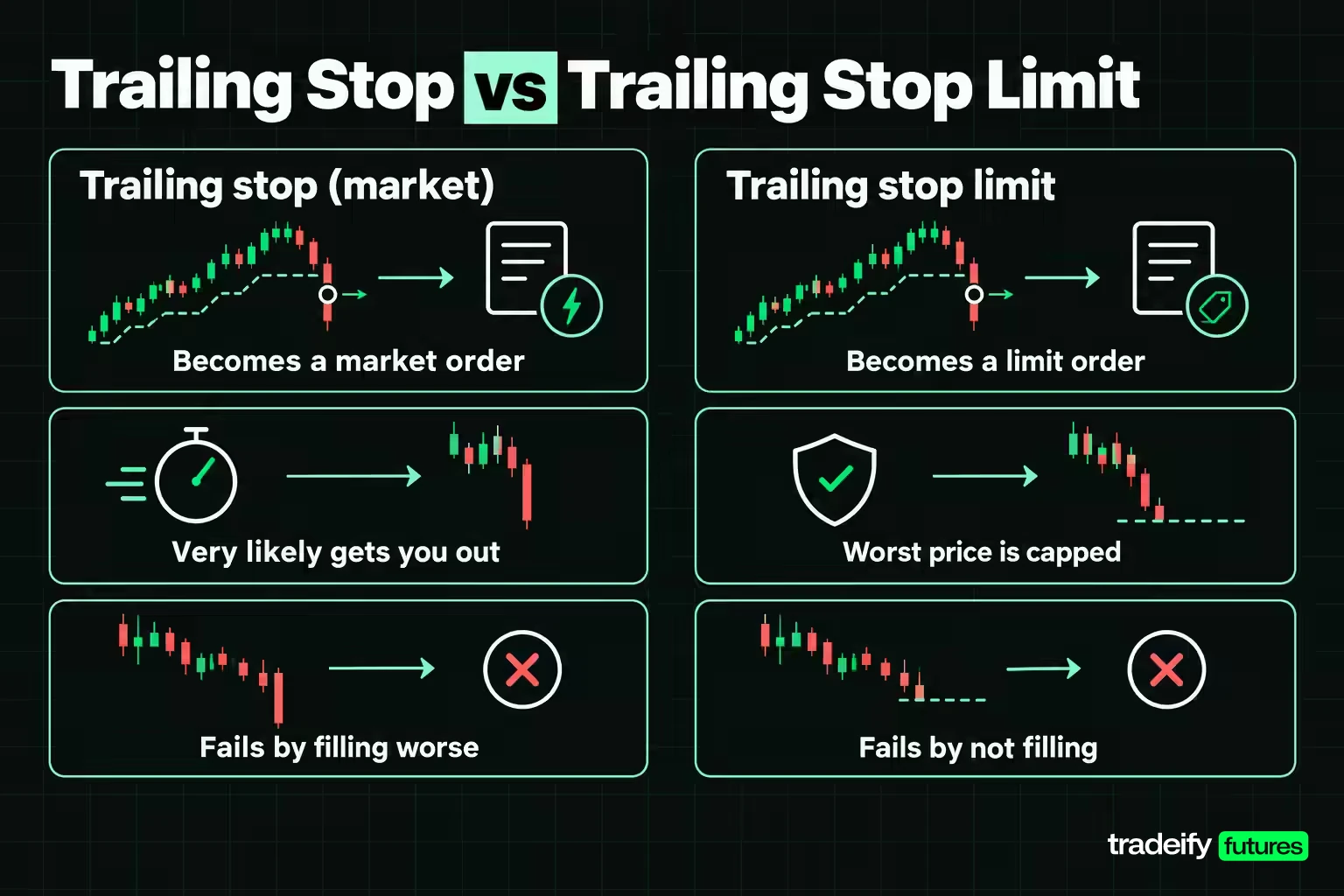
A trailing stop and a trailing stop limit follow price the same way. The difference is what each sends when it triggers.
- Trailing stop (market): becomes a market order. You will very likely get out, but the price is not controlled.
- Trailing stop limit: becomes a limit order at a price you set relative to the trigger. Your worst price is capped, and the order may not fill at all.
CME describes the same behavior for a plain stop-limit on Globex: once triggered, it enters the book as a limit order and any unfilled quantity rests at the limit price.
Here is how that fails, on an illustrative MES long. Your trailing stop limit has ratcheted to a trigger of 6004.50, with the limit 2 ticks lower at 6004.00. Price trades 6004.50, which triggers the order, and the next trades print at 6003.00, skipping 6004.25 and 6004.00. The order triggered but never filled. You are still long at 6003.00 with $15.00 of open profit and no working stop under you.
So the real question is which failure you can accept. A trailing stop market fails by filling worse than you wanted. A trailing stop limit fails by not getting you out. For a protective exit, most traders take the first.
Related lesson: Stop-limit orders
Trailing Stop Orders Compared With Other Order Types
Trailing stop orders sit in the stop family, but they behave differently from every other common order type.
| Order type | What it does | What it guarantees | Main risk |
|---|---|---|---|
| Market | Fills now at the best available price | Execution, not price | Slippage in thin or fast markets |
| Limit | Fills at your price or better | Price, not execution | No fill, or a partial fill |
| Stop | Becomes a market order at a fixed trigger | Execution after trigger, not price | Slippage past the trigger |
| Stop-limit | Becomes a limit order at a fixed trigger | Price cap, not execution | Triggers and never fills |
| Trailing stop | Stop whose trigger follows the best price | Execution after trigger, not price | Shakeouts and slippage |
| Trailing stop limit | Stop-limit whose trigger follows the best price | Price cap, not execution | Triggers and leaves you in the trade |
| Bracket | Stop and target linked so one cancels the other | Both exits are working at once | Linkage often run by the platform, not the exchange |
Trailing stop vs fixed stop and profit target
The choice between exits is really a choice about what you fix in advance.
| Exit method | Fixed at entry | Left open | Typical failure |
|---|---|---|---|
| Fixed stop loss | The loss if stopped | The profit | Gives back the whole move on a reversal |
| Trailing stop | Initial risk equal to the trail | How much of the move you keep | Shaken out of a trend that has not finished |
| Stop plus profit target | Both the loss and the gain | Nothing | Caps the big winners |
| Manual exit | Nothing | Everything | The decision arrives when you are least able to make it |
Related lesson: Stop-loss orders and placement
Common Trailing Stop Problems and Fixes
Most trailing stop problems come from a short list of causes, and nearly all of them are visible in the broker's working orders before they cost anything.
| What you see | Likely cause | Fix |
|---|---|---|
| The stop never moved | Trailing logic runs on your platform and it lost connection or data | Use server-side trailing, keep the platform online, check working orders |
| The platform shows a new stop but the broker shows the old one | A modification was rejected | Confirm the amendment status and resubmit a valid level |
| Stopped out on a wick, then price ran to the target | Trail sits inside normal noise | Set the trail from ATR or measured pullbacks |
| Filled several ticks past the stop | A trailing stop market is a market order on trigger | Accept it as the cost of getting out, or size down |
| Trailing stop limit triggered and you are still in | Price moved through the limit without trading there | Exit manually; use a market version for protection |
| Stop fired earlier than expected | Trigger uses bid, ask or another reference instead of last trade | Match the trigger setting to your plan |
The rejected amendment deserves a note. On CME Globex, a sell stop's trigger must be below the last traded price. If a stop modification lands on the wrong side of the market in a fast move, it is not a valid order, and the broker keeps the previous stop while the platform may still display the new one.
Trailing stop vs trailing drawdown
Prop-firm traders often mix these up. A trailing stop is an order on one position. A trailing drawdown is an account rule: a loss floor that rises as the account balance grows. A trailing stop can help keep a trade from hitting the drawdown floor, but it is a separate tool and the floor does not move with your stop.
On our accounts, the max drawdown trails at end of day but is enforced in real time on net liquidation value, so an open trade can breach it before your trailing stop triggers. All positions must be closed by 4:45 PM ET on regular trading days, so any trailing stop is managing an intraday trade. Platform risk settings and trailing stops are your own tools and do not replace our account rules, and funded accounts are simulated.
Related lesson: Trailing stops
Trailing Stop Orders FAQ
What is a trailing stop loss in trading?
A trailing stop loss is a stop order whose trigger follows price by a set distance as the trade moves in your favor and stays fixed when price moves against you. It locks in open profit without capping the upside. When triggered, it usually becomes a market order.
How does a stop order work?
A stop order waits until price reaches a trigger level, then becomes a market order (or a limit order, for a stop-limit). A sell stop sits below the market and a buy stop above it. The trigger is not a guaranteed fill price.
Are trailing stops a good idea?
They suit trending trades where the move can be much larger than normal pullbacks. In choppy markets or with small targets, they tend to get hit by noise. Test whether your setup's typical pullback is smaller than the trail you can afford.
How do you make a trailing stop order?
Choose a trailing stop type on your order ticket, set the side to the opposite of your position and enter the trail distance in ticks, points or percent. Set an initial stop if your platform allows it. Then confirm in the working orders panel that the stop exists at the expected price.
What is an ATR-based trailing stop?
An ATR-based trailing stop sets the trail at a multiple of average true range, such as 1.5x or 2x ATR. The trail widens when the market is volatile and tightens when it is quiet. Convert it to ticks and dollars before you place it.
What does a 25% trailing stop mean?
It means the stop sits 25% below the highest price reached on a long position. Because the percentage comes off the peak, the stop only climbs above your entry after price has risen by about a third. Until then, a 25% trailing stop can still close the trade at a loss.
This guide is educational and is not financial or trading advice. Futures are leveraged, and losses can be larger than you expect. All prices and fills shown are illustrative examples, not market data. Trailing stop behavior, trigger references and where the order is held vary by exchange, broker and platform, so confirm how your account handles them. Evaluation and funded accounts at prop firms are simulated.


