.svg)

.svg)
.svg)


TL;DR: Prop firm payout psychology is mostly about protecting behavior after profits become withdrawable: avoid revenge trading, hyper-loss aversion, fear of success, oversized recovery trades, and payout-window overtrading. Drawdown structure matters because intraday trailing drawdowns can punish unrealized profit reversals, while end-of-day trailing drawdowns generally let trades breathe until the closing balance updates the floor. Consistency rules are designed to prevent one lucky oversized day from driving a payout, so funded traders need repeatable base-hit gains, hard stop losses, hard take profits, and strict limits such as a one-trade-a-day protocol. Smart payout allocation usually means setting aside 25% to 30% for taxes, 10% to 15% for replacement evaluations, 40% to 50% for a personal brokerage account, and 10% to 15% for discretionary spending. In Tradeify's case, payouts pay 100% of the first $15,000 in profits and 90% thereafter, approved requests can process in 60 minutes or less via Rise, Plane, or Crypto, Growth/Select/Lightning accounts use EOD trailing drawdown, and consistency rules vary by path: 35% on Growth Sim Funded, 40% during Select evaluation with no funded-stage consistency rule, and 20% on the first Lightning payout before scaling to 25% and 30%.
Proprietary Firm Mechanics: Modern proprietary (prop) trading firms, such as Tradeify, have fundamentally changed retail futures trading by shifting capital risk from the individual to the firm.
Psychological Vulnerabilities: The pressures of trading "Other People's Money" (OPM) often trigger specific cognitive traps, including loss aversion, the fear of success, and performance anxiety, which are intensified by strict risk management rules.
Drawdown Models: The specific mathematical model of a trailing drawdown (particularly whether it is calculated on an intraday or end-of-day basis) significantly influences a trader's psychological resilience and strategic execution. Tradeify uses an EOD trailing drawdown across its accounts, which generally provides a more forgiving framework for market participants by ignoring unrealized intraday equity peaks.
Consistency Protocols: Behavioral constraints, such as Tradeify's 35% or 20% consistency rules, serve as pedagogical frameworks that mandate systematic execution over impulsive speculation, effectively mitigating the "lucky fool" phenomenon.
Financial Management: The transition from accumulating virtual profits to managing real-world payouts requires a disciplined financial framework. Strategies for spending wisely emphasize capital preservation, scaling multiple funded accounts, and building a personal financial buffer outside the prop firm ecosystem.
How Prop Firm Payouts Changed Retail Futures Trading
The retail trading sector has undergone a profound structural shift over the last decade. Historically, futures trading was a capital-intensive activity reserved for well-capitalized individuals and institutional participants. Today, the democratization of financial markets has facilitated the rise of the proprietary trading firm evaluation model. Under this framework, emerging day traders can access significant simulated buying power, ranging from $25,000 to $150,000 per account, by successfully completing a structured performance evaluation. Firms like Tradeify offer a meritocratic system where access to capital is contingent upon demonstrated risk management and strategic consistency rather than personal financial wealth.
How the Prop Firm Payout Paradigm Works

For amateur day traders seeking to transition into professional market speculation, the ultimate objective of a prop firm challenge is not merely to pass an evaluation, but to secure consistent, reliable payouts. The mechanics of these payouts, including profit splits, processing delays, and withdrawal rules, profoundly impact trader behavior. Understanding the operational architecture of Tradeify's payout systems, such as retaining 100% of the first $15,000 in profits and 90% thereafter, is as critical as the trading strategy itself.
Trader Psychology and the Behavioral Architecture of Prop Firms
While technical analysis and market mechanics are foundational, long-term success in proprietary trading is overwhelmingly governed by cognitive and emotional regulation. The rigid, binary rules enforced by prop firms (such as hard maximum trailing drawdowns and daily loss limits) create a setup where a single emotional lapse can result in account termination. Mastering prop firm psychology and adopting a mature framework for spending and reinvesting payouts are the primary differentiators between transient participants and career traders.
Introduction to Prop Firm Payout Trading at Tradeify
The modern proprietary trading model offers a compelling proposition: risk a relatively small evaluation fee for the opportunity to manage substantial institutional capital. For an amateur day trader looking to professionalize their operations, firms like Tradeify (tradeify.co) present a formalized pathway to funding. Tradeify distinguishes itself in a crowded marketplace by emphasizing transparency, trader-friendly risk parameters, and highly efficient payout infrastructures.
However, the transition from trading a personal, unconstrained micro-account to managing a highly regulated $100,000 or $150,000 prop firm allocation introduces significant psychological friction. When an individual trades personal capital, the constraints are self-imposed and fluid; a 10% drawdown is merely a setback with an indefinite timeline for recovery. Conversely, in the proprietary trading model, rules are binary and unforgiving. A violation of a 5% daily loss limit or a trailing drawdown threshold results in immediate account revocation, creating a pervasive background radiation of anxiety.
This report explores the intersection of psychological resilience and financial pragmatism required to succeed within Tradeify's ecosystem. By dissecting the cognitive impact of "Other People's Money," the mechanics of trailing drawdowns, the necessity of consistency rules, and the mathematical reality of payout structures, this analysis provides developing traders with a comprehensive blueprint for long-term viability.
The Psychological Trap of Trading Other People's Money

A pervasive myth in the retail trading community is that trading "Other People's Money" (OPM) provides psychological relief. Theoretically, utilizing firm capital should induce professional detachment, allowing the trader to execute their statistical edge without the emotional weight and existential dread associated with personal financial loss.
In practice, the proprietary trading model often induces a distinct and potent form of performance anxiety. This anxiety manifests through several cognitive biases and biological responses:
The Imposter Phenomenon and Heightened Trader Scrutiny
When a trader operates a personal brokerage account, their losses are private. Within a prop firm, every execution, drawdown, and risk metric is continuously monitored by automated algorithmic systems. This surveillance can trigger the "imposter phenomenon," where traders feel an acute fear of judgment and validation loss. The awareness that an external entity dictates their standing in the market forces many traders to abandon their established strategies in favor of perfectionism, which is mathematically unattainable in stochastic markets.
Biological Responses to Financial Threat
Prop firm constraints are interpreted by the human brain as imminent threats. Financial distress activates the amygdala, flooding the physiological system with cortisol and effectively inhibiting the prefrontal cortex, the anatomical center for logic, probability assessment, and rational decision-making. When a trader approaches their daily loss limit or trailing drawdown threshold, their cognitive bandwidth narrows, often leading to a "fight or flight" response. In trading, this biological reaction typically results in revenge trading (increasing position sizing to quickly recover losses) or the "deer in the headlights" paralysis (failing to execute a valid stop loss).
The Endowment Effect and the Fear of Trader Success
The psychological pressure is not limited to managing losses; it is equally prevalent in managing profits. Success rates drop significantly after traders pass the evaluation and receive funding due to the "endowment effect." Once a trader earns a funded account, they subconsciously assign a disproportionate value to their new status. The fear of losing the funded account outweighs the desire to generate profits, triggering hyper-loss aversion. This often leads to micro-managing trades, cutting winners prematurely, and suffering from the "Fear of Success," a trap uniquely intensified by the mechanics of trailing drawdowns.
End-of-Day vs Intraday Drawdown Psychology

The single most critical risk parameter in proprietary trading is the drawdown model. It dictates the maximum allowable decline from an account's peak equity. How a firm calculates this metric profoundly influences the strategic viability and psychological stress of the trader. There are two primary models: intraday trailing drawdowns and End-of-Day (EOD) trailing drawdowns.
How the Intraday Trailing Drawdown Works
An intraday trailing drawdown adjusts in real-time as equity fluctuates during the trading session. Every new equity high (including unrealized gains on open positions) pushes the drawdown floor upward. The floor never moves back down. For example, if a trader is up $2,000 on an open trade, the trailing drawdown threshold immediately moves up by $2,000. If the market reverses and the trader closes the position at breakeven, they have mathematically lost $2,000 of their drawdown buffer, despite their account balance remaining unchanged. This model demands constant awareness of the floor, creating immense friction and punishing traders who hold positions through normal market pullbacks.
Tradeify's End-of-Day Drawdown Advantage
Tradeify implements an End-of-Day (EOD) trailing drawdown across all of its account types, including Growth, Select, and Lightning. This is a massive psychological and mathematical advantage for the developing trader.
The EOD trailing drawdown is calculated solely based on the final daily balance at the close of the market session. Intraday equity peaks do not count toward the calculation.
Mathematical Example of EOD Mechanics
Consider a $50,000 Growth account with a $2,000 EOD trailing drawdown. The initial failure threshold is $48,000.
Day 1: The trader enters a position. The unrealized profit peaks at +$3,000 (Account NetLiq: $53,000). The market pulls back, and the trader closes the day with a realized profit of +$1,000. The EOD balance is $51,000.
Drawdown Calculation: Because it is an EOD model, the drawdown floor trails the closing balance of $51,000, not the intraday peak of $53,000. The new failure threshold becomes $49,000 ($51,000 - $2,000).
Psychological Impact: The trader was not penalized for allowing the trade to breathe. The EOD model absorbs normal intraday volatility and allows for effective swing trading and trend following without the anxiety that every unrealized tick is permanently raising the account's execution floor.
It is vital to note that while the limit updates at the end of the day, it is enforced in real-time. If the account balance touches the current $49,000 limit at any moment during the next session, the account is permanently failed. There is no recovery from a maximum drawdown breach; it is a hard rule.
Tradeify Account Types and Trader Psychology
Tradeify provides a multi-tiered approach to funding, accommodating different risk profiles and psychological temperaments. Understanding these variations is crucial before allocating capital to an evaluation.
The Growth Account
The Growth program is designed for methodical traders who benefit from longer evaluation periods and structural safety nets.
Evaluation: Can be passed in a minimum of 1 trading day.
Drawdown: End-of-Day (EOD) trailing.
Daily Loss Limit (DLL): Soft breach. A daily loss limit (e.g., $1,250 on a $50k account) exists. If hit, trading is paused until the next session at 6:00 PM ET, protecting the trader from revenge trading and catastrophic psychological tilt.
Consistency: During the evaluation phase, there is no consistency rule. However, once in the Simulated Funded stage, a 35% consistency rule applies, meaning no single trading day can account for more than 35% of total accumulated profits.
Payouts: Operates on a 5-day cycle in the Sim Funded stage. Requires 5 profitable trading days between payout requests, with each profitable day meeting the minimum daily profit threshold for the account size ($100/$150/$200/$250 on $25k/$50k/$100k/$150k accounts).
The Select Account
The Select program caters to traders seeking faster pathways and higher flexibility in the funded stage.
Evaluation: Requires a minimum of 3 trading days to pass, enforcing a 40% consistency rule during the evaluation.
Funded Stage Advantage: Once funded, the Select account has no consistency rule. This removes a massive psychological burden, allowing traders to fully capitalize on exceptional "home run" days without fear of violating payout ratios.
Payout Flexibility: Select funded traders have a permanent choice between two payout policies: Select Flex (5-day payouts, no daily loss limit, larger caps) or Select Daily (daily payouts, tighter risk parameters, daily loss limits).
The Lightning Account (Straight to Sim Funded)
The Lightning account is an "Instant Funding" option, allowing experienced traders to bypass the evaluation phase entirely and begin earning withdrawable payouts immediately.
Evaluation: None. Instant access to Sim Funded capital.
Consistency Constraints: Because the trader skips the evaluation, the firm enforces stricter upfront behavioral parameters. Lightning accounts begin with a strict 20% consistency rule for the first payout. This constraint relaxes incrementally, scaling to 25% for the second payout, and 30% for the third payout and beyond.
Psychology: This path is optimal for seasoned professionals who already possess extreme emotional regulation. For amateurs, the absence of an evaluation phase combined with the strict 20% consistency rule can lead to rapid failure if they lack a deeply ingrained, systematic edge.
How Consistency Rules Shape Trader Psychology
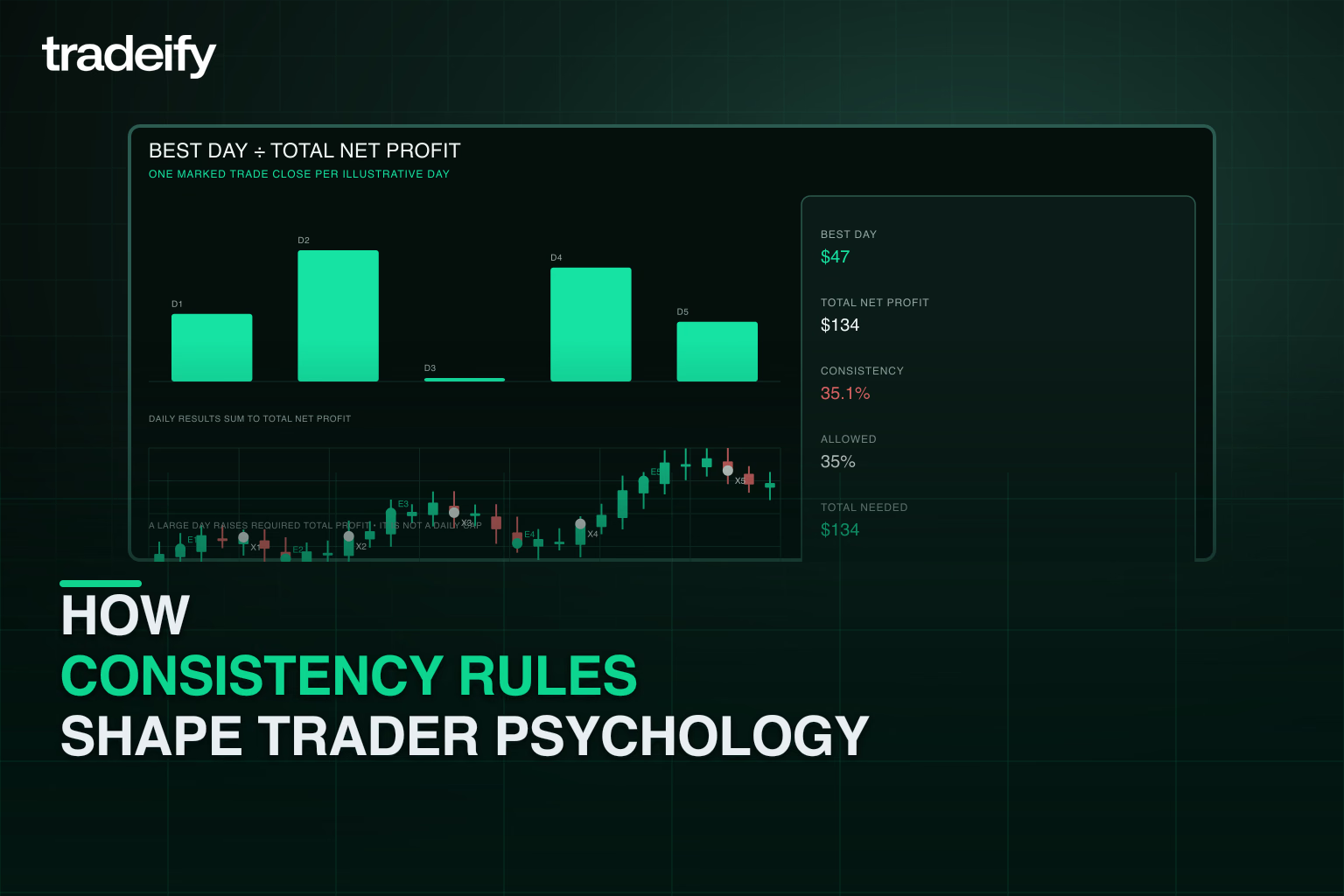
A defining feature of proprietary firm policy is the "Consistency Rule." To the uninitiated amateur, this rule often feels restrictive and punitive. However, the consistency rule is fundamentally a pedagogical framework designed to enforce professional discipline. It acts as a behavioral constraint that actively combats impulsive speculation.
How Consistency Rules Counter the Lucky Fool
In financial markets, random distribution dictates that even a fundamentally flawed trading strategy can yield short-term, spectacular results. A retail trader might risk their entire account margin on a volatile news event (such as Non-Farm Payrolls or CPI) and generate a 500% return in seconds. The prop firm consistency rule ensures that payouts are awarded to traders who demonstrate a statistically robust edge over a series of executions, rather than gamblers who rely on isolated strokes of luck.
The Mathematics of the Consistency Rule
The consistency rule is calculated using the formula:
Consistency % = (Highest Day Profit / Total Profit) x 100
If a trader is managing a Tradeify Growth account with a 35% consistency rule, their single best day cannot exceed 35% of their total accumulated profit at the time of a payout request.
Scenario Analysis
Total Profit Generated: $10,000
Maximum Allowed Best Day (35%): $3,500
If the trader's best day yielded $5,000, they have violated the 35% threshold.
Crucially, violating the consistency threshold does not result in account failure. It simply renders the trader temporarily ineligible for a payout. The psychological remedy is straightforward but testing: the trader must continue to trade with small, systematic risk to dilute the percentage of the outsized day until it falls back below the 35% threshold. This mechanic forces traders to scale down and focus on base hits rather than attempting to force further home runs.
Overtrading and the One Trade a Day Strategy for Prop Firm Traders

The most prevalent cause of evaluation failure and funded account termination is overtrading. Amateur traders mistakenly equate increased screen time and high execution volume with higher profitability. In reality, the margin for error in a prop account is slim. Taking mediocre setups out of boredom, or revenge trading to recover from a minor morning loss, almost invariably leads to a breach of the daily loss limit or trailing drawdown.
Designing a Behavioral Edge as a Prop Firm Trader
As the behavioral researcher Lawrence the Investor notes, prop firms take a long-term probability game and force it into a short-term window with finite rules. The firm's ultimate edge is the predictable human reaction under financial distress, speeding up after losses, sizing up to recover, and trading emotionally.
Therefore, the trader's supreme edge is not a secret moving average crossover, but the ability to do the exact opposite of human nature: to stop early, sit in emotional discomfort, and walk away from the screens.
The One Trade a Day Protocol for Funded Traders
To successfully complete Tradeify's challenges, many professionals adopt the "One Trade a Day" strategy. This is a literal behavioral constraint: the trader is permitted to open exactly one position per 24-hour cycle.
Execution: The trader identifies a high-probability setup (e.g., the Opening Range Breakout between 9:30 AM and 9:45 AM EST).
Parameters: A hard Stop Loss (SL) and hard Take Profit (TP) are placed immediately upon entry.
Outcome: If the trade hits TP, the session is over. If the trade hits SL, the session is over. There are no secondary attempts, no recovery trades, and no end-of-day scalping.
This protocol perfectly aligns with Tradeify's mechanics. By risking a controlled amount (e.g., $250 on a $50k account) on a single setup, the trader remains mathematically isolated from the $1,250 Daily Loss Limit and the $2,000 EOD Trailing Drawdown. Furthermore, placing one systematic trade per day naturally builds out the minimum trading days required for payouts while organically complying with the 35% or 20% consistency rules.
Why Payout Delays Hurt Trader Psychology
One of the most insidious psychological variables in proprietary trading is the timeline between earning virtual profit and receiving physical cash.
How Payout Delays Damage Trader Psychology
In traditional prop firm models, payout cycles often involve multi-week delays. A trader might hit their profit target, wait until the end of the month to submit an invoice, and then wait an additional 7 to 14 days for compliance checks and bank transfers. This delay damages trader psychology. The uncertainty erodes discipline, increases the likelihood of overtrading during the waiting period, and fosters deep emotional dissonance. When a trader expects to be paid and the capital is locked in digital limbo, the execution of their trading plan begins to go off track. If they experience a rough patch in the market before the payout window opens, they may end up giving back their hard-earned profits before they ever have the chance to withdraw them.
Tradeify's Rapid Payout Liquidity Model
Tradeify aggressively mitigates this psychological vulnerability by engineering one of the fastest payout infrastructures in the industry. Payouts are generally processed within 24 hours of submission, and the firm guarantees 60-minute automated payouts for approved requests.
Furthermore, Tradeify offers the Select Daily policy and Lightning accounts that feature daily payout eligibility.
Select Daily Mechanics: Once a trader accumulates a specific profit "buffer" (e.g., a $2,100 buffer on a $50k account), they can request withdrawals every single trading day. The payout is capped at 2x the profit earned between requests (up to $1,000 per day for a $50k account).
Psychological Benefit: True daily payouts transform trading from a speculative endeavor awaiting occasional lump sums into a functional working income. This rapid feedback loop reinforces positive trading behavior. When a disciplined trade results in cash hitting a personal bank account via Rise, Plane, or Crypto within 24 hours, the trader's neurological reward pathways are correctly aligned with risk-averse execution.
Alternatively, the Select Flex option offers a more traditional 5-day cycle. Every 5 winning days (defined by a minimum profit threshold, such as $150/day on a $50k account), the trader can withdraw up to 50% of their total profits with larger caps (e.g., $3,000 per payout on a $50k account). This model is ideal for traders who prefer accumulating larger sums over utilizing daily micro-withdrawals. Both pathways eliminate the agonizing multi-week delays that historically destroy funded accounts.
Withdrawal Methods for Rise and Plane
Tradeify processes payouts through two primary channels. The main payout gateway is Rise (Riseworks), which supports bank transfers, local currency withdrawals, and cryptocurrency. For traders who cannot use Rise due to state restrictions, Plane serves as an alternative bank-to-bank transfer option that can take up to 7 days.
Once Tradeify approves a payout, funds generally appear in the Rise wallet within 24-48 hours. From the Rise wallet, traders withdraw to their linked method: a bank transfer via ACH typically takes 1-3 business days, while crypto token withdrawals can arrive within hours to a day.
The Anatomy of a Prop Firm Payout from Simulation to Reality
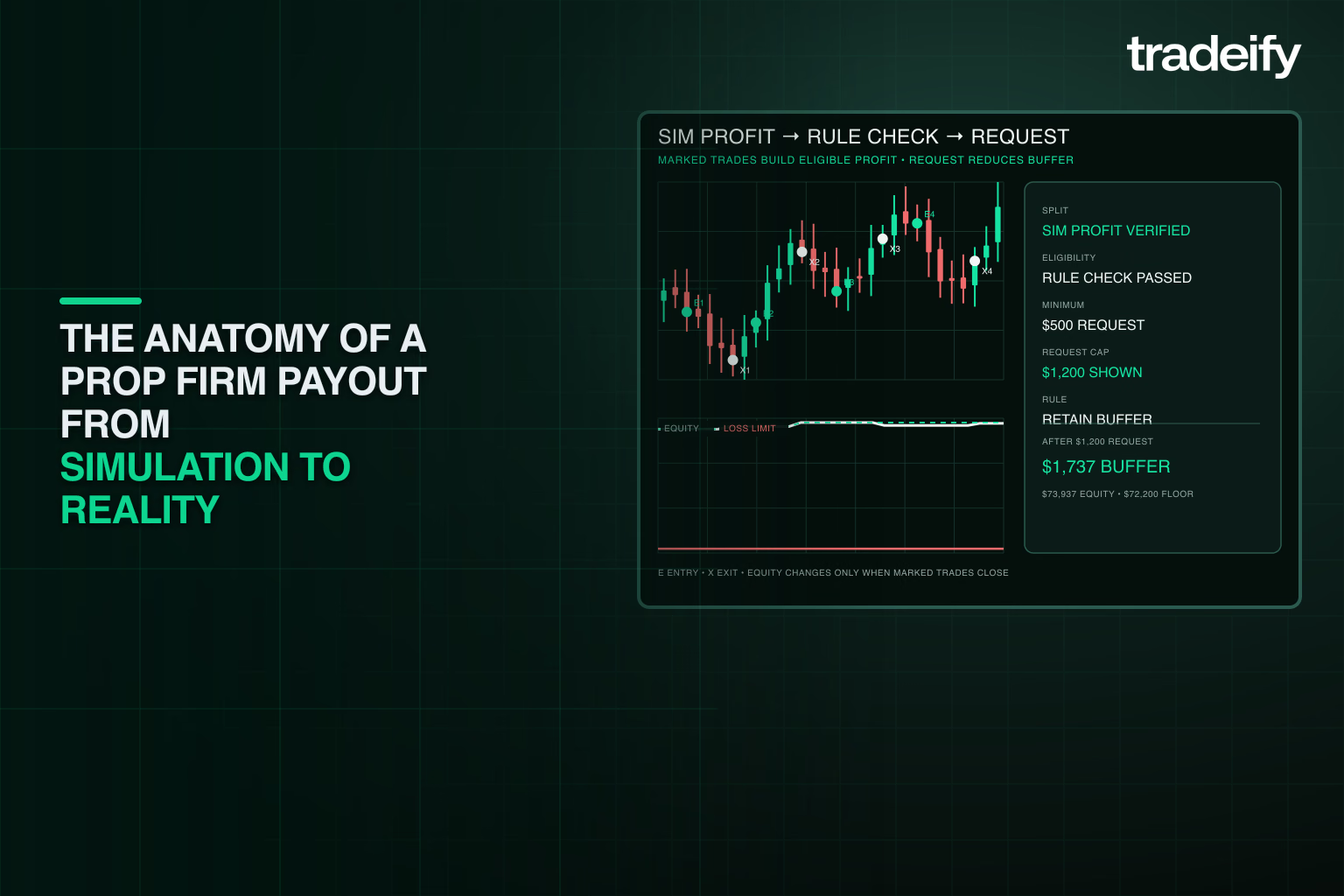
Understanding the strict financial transition from a simulated evaluation to real capital is essential. The prop firm ecosystem operates on a tiered reality.
Prop Firm Payout Profit Splits and Scaling
When a trader successfully secures a payout, the firm applies a profit split. Tradeify utilizes an industry-leading model designed to maximize early trader retention:
First $15,000: The trader keeps 100% of the first $15,000 generated in profits. This allows the amateur trader to rapidly build a personal financial cushion without firm deductions.
Subsequent Profits: Any profits generated beyond the initial $15,000 are split 90% to the trader, and 10% to Tradeify. This remains highly competitive compared to traditional firms that enforce 80/20 splits indefinitely.
KYC and Tax Documentation Requirements
Financial regulations require identity verification (KYC) to prevent fraud, completed once you request a payout. When a trader requests their first withdrawal, they receive an email to sign up with Rise and complete verification. Verification requires a government-issued photo ID (passport, driver's license, or national ID), a clear selfie, bank account or crypto wallet details, and SSN/ITIN for US traders or a tax ID for international traders.
Tradeify does not issue 1099 tax forms because payouts are distributed through Rise, which handles necessary tax documentation. For expense tracking and business deductions, traders can download official transaction receipts from the Tradeify Billing page. Traders are responsible for setting aside funds for self-employment taxes in accordance with IRS self-employment tax guidelines.
Transitioning to Tradeify Elite Live Accounts
Tradeify's architecture includes a pathway from Simulated Funded (where trades do not route directly to the live CME exchange) to the Elite Live program (where trades execute with real, physical capital).
Under the Legacy Live and new Elite Live programs, traders who prove long-term consistency transition to live accounts.
In the Elite Live program, accounts start with a $0 balance. All capital generated above this line is pure profit, subject to an 80/20 split.
Live traders can request payouts daily for any amount above their trading capital. However, withdrawing funds down to a $0 balance will result in the closure of the Live Account. This enforces the psychological necessity of maintaining a substantial cushion to absorb future drawdowns.
Spending Prop Firm Payouts Wisely as a Funded Trader

Generating virtual profit on a screen is only 50% of the proprietary trading equation. The remaining 50% revolves around how a trader handles the physical payout. Amateur traders frequently succumb to the "lottery winner syndrome." Upon receiving their first $3,000 payout, the impulse is to upgrade their lifestyle, buying luxury goods, expensive watches, or a new vehicle.
This behavior is statistically correlated with a rapid return to the evaluation phase. Trading is a high-variance profession; winning streaks are mathematically guaranteed to be followed by losing streaks. If a trader spends their entire payout, they possess no psychological or financial buffer when they inevitably hit the trailing drawdown limit on their funded account and must purchase new evaluations.
The Payout Allocation Protocol
Professional day traders treat their prop firm revenue as gross business income, strictly allocating funds to ensure longevity. A robust spending protocol includes the following divisions.
The Tax Provision (25% to 30%)
Prop firm traders are legally classified as independent contractors (providing a service to the firm by managing its simulated/live risk). Therefore, prop firm payouts are distributed without tax withholdings. The first action upon receiving a payout must be transferring an estimated 25% to 30% into a separate, high-yield savings account designated exclusively for quarterly tax obligations. Ignoring this reality results in catastrophic financial liabilities at the end of the fiscal year.
The Evaluation Replenishment Fund (10% to 15%)
The brutal reality of prop firm trading is that accounts eventually fail. A 10% trailing drawdown is a highly restrictive boundary that even seasoned professionals occasionally breach. A wise trader allocates 10% to 15% of every payout into an "Evaluation Replenishment Fund." This ensures that when an account is lost, the trader possesses the immediate capital to purchase new Tradeify evaluations without utilizing their primary income or personal savings. This eliminates the desperation and emotional anxiety of being "unfunded."
Building the Personal Brokerage Account (40% to 50%)
The ultimate objective of utilizing Tradeify is to extract capital from the prop firm ecosystem and transfer it into a personal, unconstrained brokerage account. Trading personal capital via a standard broker (such as NinjaTrader or Tradovate) means keeping 100% of the profits, adhering to zero daily loss limits, and operating without trailing drawdowns. By funneling the majority of prop firm payouts into a personal account, the trader gradually builds a financial citadel. Over time, the reliance on the prop firm diminishes, transitioning the firm from a primary income source to a supplementary leverage tool.
Discretionary Income (10% to 15%)
Only a small fraction of initial payouts should be utilized for personal enjoyment or lifestyle inflation. The psychological reward of purchasing a tangible item with trading profits is important for reinforcing positive behavior, but it must be kept strictly proportional to the overall financial strategy.
Scaling Prop Firm Capital to $750,000

Tradeify distinguishes itself by offering aggressive capital scaling capabilities, permitting traders to manage up to five funded accounts simultaneously. Given that the maximum single account size is $150,000, a trader can theoretically control up to $750,000 in simulated buying power.
The Mathematics of Multiple Funded Accounts
Through the use of third-party trade copiers, a trader can execute a single transaction on a master account, which is instantaneously mirrored across all connected slave accounts.
The Leverage: If a trader aims to make $1,000 in a single day, attempting to generate this on one $50k account requires significant risk exposure and heavy contract sizing, which dangerously approaches the daily loss limit.
The Base Hit Strategy: Conversely, if the trader manages five $50k accounts, they only need to generate $200 per account. Executing a high-probability, low-risk setup to capture $200 minimizes market exposure and easily satisfies Tradeify's consistency rules. As highlighted by professionals, capturing base hits across multiple accounts is far mathematically superior to swinging for home runs on a single account.
The Danger of Premature Account Scaling
While controlling $750,000 sounds enticing to an amateur trader, premature scaling is a trap. Managing five evaluations requires a significant upfront financial investment (five evaluation fees). If the trader lacks a proven edge, they will simply fail five times as fast, multiplying their financial losses.
The recommended trajectory (often termed "Gradual Scaling") involves passing a single Tradeify Select or Growth evaluation. Once the trader secures their first physical payout, they use a portion of those profits to purchase a second evaluation. They establish consistency with two accounts, secure a payout, and scale to three. This organic compounding method protects personal capital and ensures that the trader is psychologically prepared to handle the exponentially larger dollar fluctuations associated with multi-account operations.
Mixing Tradeify Account Types
Tradeify places no restrictions on blending account types. A strategic trader might run two $150k Growth accounts (utilizing EOD drawdowns for swing setups), one $100k Lightning account (for immediate daily payouts), and two $50k Select accounts. This portfolio diversification allows the trader to exploit various market conditions while maintaining a steady flow of staggered payouts.
Frequently Asked Questions About Prop Firm Payouts
How Do Prop Firm Payouts Work?
Prop firm payouts represent a profit split between the funded trader and the proprietary firm. Once a trader passes an evaluation and trades in a Sim Funded or Live account, accumulated profits above the drawdown floor are eligible for withdrawal. Tradeify processes payouts through Rise and Plane, and approved requests can process in 60 minutes or less.
How Long Does It Take to Receive a Prop Firm Payout?
Once Tradeify approves a payout, funds generally appear in the Rise wallet within 24-48 hours. Bank withdrawals via ACH typically take another 1-3 business days, and crypto token withdrawals can arrive within hours to a day. The alternative bank-to-bank option Plane can take up to 7 days.
What Verification or KYC Is Required for Payouts?
When requesting a first payout, traders must complete identity verification (KYC) via Rise by providing a government-issued photo ID (passport, driver's license, or national ID), a clear selfie, and SSN/ITIN for US traders or a tax ID for international traders.
Are Prop Firm Payouts Subject to Self-Employment Tax?
Yes. Because prop firm traders operate as independent contractors, payouts are distributed without tax withholdings. Traders are personally responsible for setting aside funds for federal and state income taxes as well as self-employment taxes, and Rise issues the 1099 forms for payout income.
Mastering the Inner Game of Prop Firm Trading

Purchasing a Tradeify challenge is an investment in market leverage, but more importantly, it is a crucible for psychological development. The proprietary trading industry is not built on complex algorithmic strategies; it is built on behavioral economics. Firms construct parameters like trailing drawdowns and consistency rules to filter out impulsive, emotional participants, rewarding only those who display ruthless risk management.
For the amateur day trader, success is not found in predicting the market, but in predicting oneself. By understanding the biological reactions triggered by financial stress, embracing the protective nature of End-of-Day drawdowns, and adhering to strict execution protocols like the "One Trade a Day" strategy, a trader neutralizes the psychological traps of "Other People's Money."
Ultimately, the transition from an amateur to a sustainably funded professional is solidified through wise financial spending. Extracting liquidity via Tradeify's 24-hour payout system, protecting 100% of the first $15,000, allocating for tax liabilities, and systematically funding a personal brokerage account transforms trading from a speculative game into a resilient business operation. In the infinite game of trading, survival is the only edge that compounds.
.svg)
.svg)
.svg)
.svg)








.webp)