



TL;DR: Types of trading are best sorted by holding period into scalping, day trading, swing trading and position trading. Scalps last seconds to minutes, day trades close by the session end, swings run days to weeks, positions weeks to months. With $500 of risk on MES, a 5 point stop buys 20 contracts and a 60 point stop buys 1. Costs then eat 6.0% of the risk for the scalper and 0.5% for the swing trader. Strategies like momentum and markets like futures or options run inside those four styles.
Search for types of trading and you will find lists of four, five, eight or more types, each sorted differently. Most of them shuffle the same few ideas, so a newer trader finishes reading with more labels and no clearer decision.
Here is the choice that actually matters: how long you hold a trade. That one decision sets how wide your stop has to be, how many contracts or shares a fixed risk budget allows, what each trade costs relative to the risk, and how many trades you get through before you can tell whether the approach works. This guide sorts the types of trading on that basis, then shows the dollar consequences with one worked futures example.
What Types of Trading Means and How Trading Works
Trading is buying and selling a market to profit from a price change, rather than holding it for the income or long-run growth the asset produces. Every trade has two sides. A long position profits if price rises, because you buy first and sell later. A short position profits if price falls, because you sell first and buy back later. The trade ends when you close it, and the difference between the two prices, minus costs, is the result.
When people talk about types of trading, they are usually describing a package of four decisions that travel together:
- How long you hold the position. This is the decision that defines the style.
- What starts the trade, such as a chart pattern, a price level, a news release or a coded rule.
- How risk is measured, usually as a stop distance in the unit the market is quoted in.
- How often you review results, from every trade to once a month.
Change the trigger and you have a different method inside the same style, which is why two day traders can run completely different systems. Change the holding period and you have a different style, and your position size, costs and daily routine all move with it.
That test sorts most long lists quickly. Momentum, breakout and mean reversion are trading strategies, meaning entry methods. Stocks, futures, options and forex are markets. Technical and fundamental trading are analysis approaches. Only the holding periods are trading styles.
Related lesson: What is trading
The Four Main Types of Trading by Holding Period
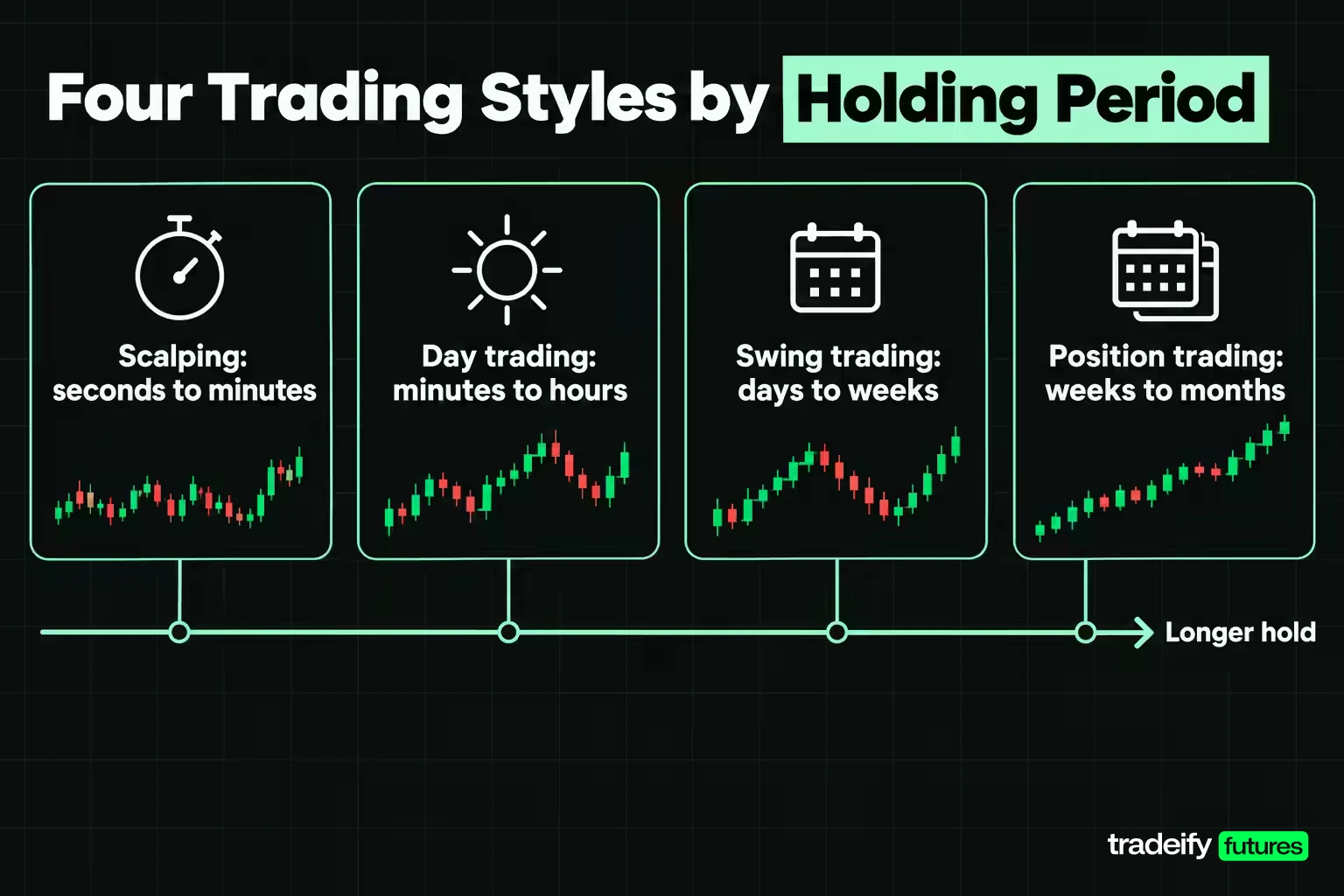
The four main types of trading by holding period are scalping, day trading, swing trading and position trading. The table compares them on the factors that change a trader's day.
| Style | Holding period | Typical chart | Decisions per session | Overnight exposure | What usually ends the trade |
|---|---|---|---|---|---|
| Scalping | Seconds to minutes | Tick to 1 minute | Many | None | A few ticks in either direction |
| Day trading | Minutes to hours | 1 minute to 15 minute | One to a few | None | The stop, the target or the session close |
| Swing trading | Days to weeks | Hourly to daily | A few per week | Yes, including weekends | The stop, the target or a change in trend |
| Position trading | Weeks to months | Daily to weekly | A few per month | Yes, for long stretches | A trend change or a broken thesis |
Read the table as a set of tradeoffs rather than a ranking. Faster styles give you more decisions, more data and no overnight gap risk, and they also give you more costs and less time to think. Slower styles cut screen time and costs per unit of risk, and they ask you to sit through overnight gaps and much larger swings against the position.
None of these four types of trading is the right one in general. The right one is the style whose decision window fits your hours and whose stop width fits your account.
Related lesson: Strategy timeframes
Scalping as the Fastest Trading Style
Scalping is the shortest holding period. A scalper takes many small positions a session, aims for a few ticks on each and exits quickly when the trade does not work. Holds run from seconds to a few minutes.
The appeal is obvious. Each trade risks little in price terms, you get frequent feedback and you are never exposed to an overnight gap. The catch is that every trade pays the full cost of the round trip, and those costs are large relative to a target of a few ticks. On a contract with a $1.25 tick, a scalp that aims for 4 ticks is aiming for $5 per contract before commission. A commission of a dollar or two takes a big share of that.
Slippage matters more here than anywhere else. A stop order becomes a market order when price reaches it, and the fill can differ from the stop price in a fast market. One tick of slippage on a 4 tick target is a quarter of the planned gain.
Scalping tends to suit traders who can watch the screen without interruption, read order flow quickly and accept a long run of small losses as normal. It punishes the trader who widens a stop to dodge the next small loss. One widened stop can erase a dozen winning scalps, and the style only works if losses stay small and fast.
Related lesson: Scalping
Day Trading Explained
Day trading means opening and closing positions within the same session, so nothing is carried overnight. The US Securities and Exchange Commission's investor site describes day traders as rapidly buying, selling and short-selling stocks throughout the day, and warns that day trading is extremely risky and can produce substantial losses in a very short period.
A typical day trader holds for minutes to hours, takes one to a few trades a session and is flat before the close. That routine has three consequences:
- You avoid overnight gap risk, the move that happens while you cannot act.
- You must decide and act inside a fixed window. A slow session with no qualified setup is a normal outcome, and forcing a trade to fill the window is where many day traders give back a good week.
- Daily loss limits are easy to apply, because each session starts flat.
Day trading rules in stock and futures accounts
In US stock margin accounts, day trading has long been governed by the pattern day trader rule and its $25,000 minimum equity. FINRA Regulatory Notice 26-10 replaces those day trading margin requirements with new intraday margin standards. The notice took effect June 4, 2026, and the phase-in ends October 20, 2027, so some brokers may still apply the old rule during the transition. Futures accounts were never subject to the pattern day trader rule.
What the research says about day trading results
The outcome data on persistent day traders is sobering. A study by Chague, De-Losso and Giovannetti followed every individual who began day trading Brazilian equity index futures between 2013 and 2015. Of the 1,551 who kept going for more than 300 days, 97% lost money net of fees. That is one market and one period, not a law of nature, but it is a useful base rate to hold against any claim that day trading is a quick income.
Related lesson: Day trading
Swing Trading Explained
Swing trading holds positions for days to weeks to capture one leg of a move, often from a pullback inside a trend or a break from a range. Swing traders usually read hourly and daily charts, place trades a few times a week and spend far less time in front of the screen than day traders.
The defining risk is the overnight and weekend gap. Your stop sits at a price, but if the market opens beyond it, a stop order becomes a market order and fills where trading resumes. A swing trader has to size positions so that a gap through the stop is survivable, not just the planned stop distance.
Wider stops mean smaller positions at the same risk budget, and that is the part day traders moving to swing trading tend to underestimate. A swing setup may need a stop three or more times wider than a day trade on the same market, which means a third of the size or less. Swing trading also asks for a different kind of discipline. The work is sitting through normal moves against you without closing a valid trade early. The temptation is to check the position every hour and treat each red candle as new information. It usually is not.
Account rules matter before you start. Some brokerage accounts charge higher margin for positions held overnight, and many futures prop firm accounts require positions to be closed every day, which rules swing trading out on those accounts entirely.
Related lesson: Day trading vs swing trading
Position Trading and Long-Term Trading
Position trading holds for weeks to months, sometimes longer, to ride a major trend or a thesis about the economy, a sector or a commodity cycle. Position traders read daily and weekly charts, make a handful of decisions a month and accept large swings against the position as the cost of staying in the larger move.
Position trading sits closest to investing, but it is still trading, and the difference shows up when the thesis breaks. A position trader has an exit plan, a stop or a thesis that would end the trade, and a reason to be in that specific market now. Long-term trading extends the same idea to multi-month trends, and the line between the two labels is loose.
Futures add a mechanical step. Futures contracts expire, and most positions are closed before delivery, so a long-term futures trader has to roll from one contract month to the next. Each roll is a trade with its own cost.
The tradeoffs cut both ways. Position trading needs the least screen time and pays the least in costs per unit of risk. It also needs the widest stops, the most patience per result and the largest account to hold even one contract at a sensible risk level.
Related lesson: Position trading
How Each Trading Style Changes Position Size and Cost
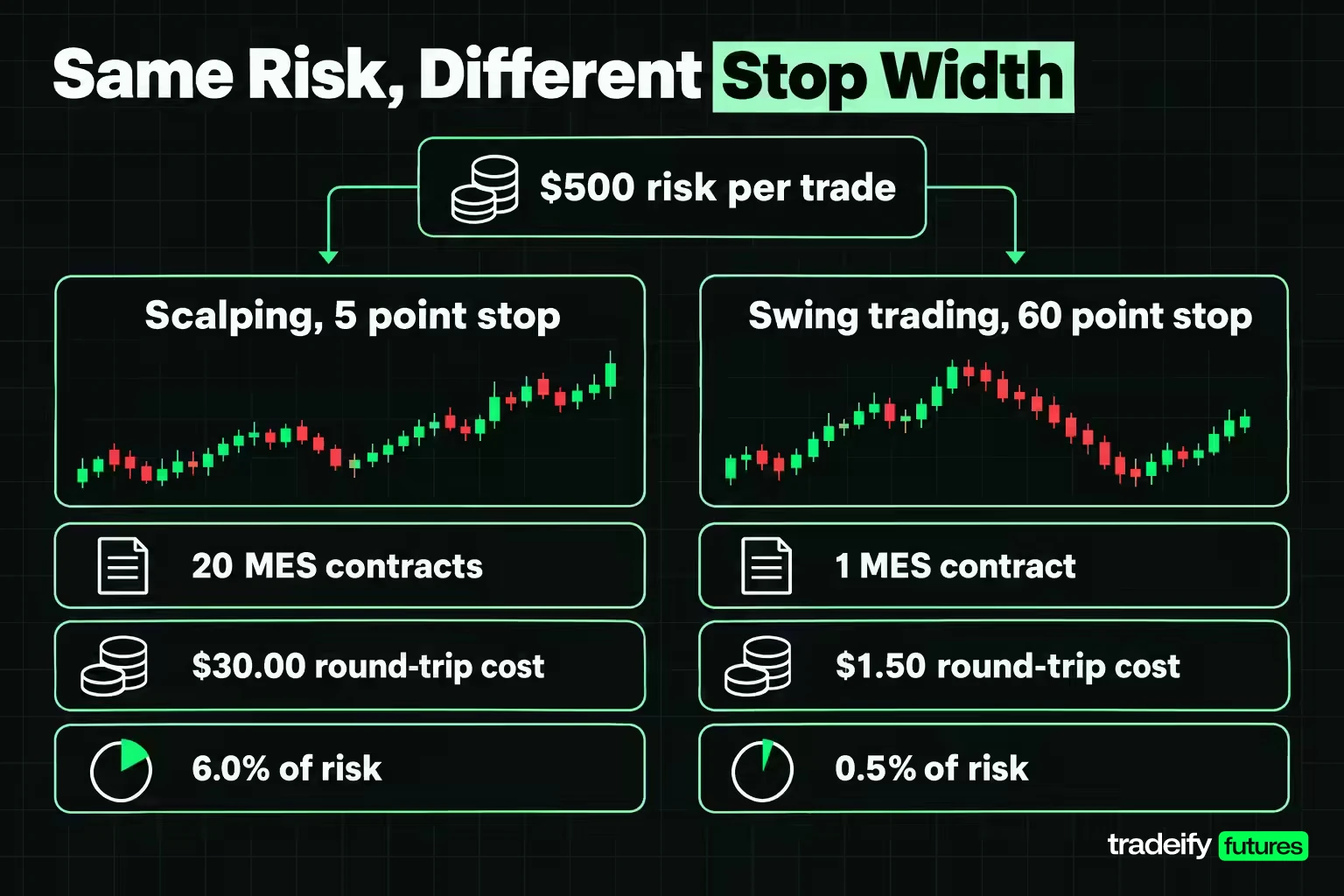
The fastest way to see how different the four styles are is to hold everything constant except the stop width. The example below uses the Micro E-mini S&P 500 futures contract (MES), which pays $5 per index point with a minimum tick of 0.25 points, worth $1.25.
Assumptions for the illustrative arithmetic are a $50,000 account, 1% risk per trade ($500), an index level of 7,000 and a round-trip commission of $1.50 per contract. The index level and commission are round working assumptions, not quotes, chosen so every number can be checked by hand.
| Style and stop | Risk per contract | Contracts for $500 | Actual risk | Notional exposure | Round-trip cost | Cost as share of risk |
|---|---|---|---|---|---|---|
| Scalping, 5 point stop | $25 | 20 | $500 | $700,000 | $30.00 | 6.0% |
| Day trading, 20 point stop | $100 | 5 | $500 | $175,000 | $7.50 | 1.5% |
| Swing trading, 60 point stop | $300 | 1 | $300 | $35,000 | $1.50 | 0.5% |
| Position trading, 200 point stop | $1,000 | 0 | $0 | $0 | Not available | Not available |
Same account, same $500 budget, same contract. The four rows share almost nothing else.
Why scalping carries the most notional exposure
In a $50,000 MES example with $500 of risk per trade, the scalper with a 5 point stop is not risking more than the day trader with a 20 point stop. Both risk $500. The scalper controls $700,000 of notional value, 14 times the account, because a 5 point stop on a 7,000 index is a tiny share of price, so the risk budget buys many contracts. The swing trader controls $35,000, less than the account.
Two details are easy to miss. Commission scales with contracts, not with the account, so the scalper pays $30 a trade against the day trader's $7.50 for the same $500 at risk. And rounding down matters. The swing row takes 1 contract and risks $300, not $500, because the raw size was 1.67 and a fraction of a contract does not exist. Rounding down is what keeps the risk rule honest.
How trading style changes the break-even win rate
Costs raise the win rate each trading style has to clear. With a target twice the stop and no costs, a strategy breaks even at a 33.33% win rate. Add the $1.50 round-trip commission per contract and the required rate rises by what that cost is worth against the target. The break-even rate is the risk plus the cost, divided by the risk plus the target, all per contract.
| Style | Stop and target per contract | Break-even win rate with no cost | Break-even win rate with $1.50 cost |
|---|---|---|---|
| Scalping | $25 stop, $50 target | 33.33% | 35.33% |
| Day trading | $100 stop, $200 target | 33.33% | 33.83% |
| Swing trading | $300 stop, $600 target | 33.33% | 33.50% |
| Position trading | $1,000 stop, $2,000 target | 33.33% | 33.38% |
The same commission moves the scalper's required win rate by two full points and the swing trader's by less than a fifth of a point. Run the frequency out and the gap widens. At 10 trades a day over 250 sessions, the scalper's 20 contract size pays $75,000 in commission in a year, more than the whole $50,000 account. At 2 trades a day the day trader pays $3,750, or 7.5% of the account. At about one trade every three sessions the swing trader pays about $125.
Minimum account size for each trading style
Turn the table around and ask what account can hold one MES contract at 1% risk for each stop width.
| Style and stop | Risk for one contract | Account needed at 1% risk |
|---|---|---|
| Scalping, 5 point stop | $25 | $2,500 |
| Day trading, 20 point stop | $100 | $10,000 |
| Swing trading, 60 point stop | $300 | $30,000 |
| Position trading, 200 point stop | $1,000 | $100,000 |
This is the mechanical reason newer traders often drift into the fastest styles. Scalping is not a beginner style. A small account simply cannot hold a wide-stop trade at a sensible risk level, because one micro contract already risks more than the rule allows. The honest options are a larger account, a market with a smaller minimum position or a different risk rule. Tightening the stop just to fit the size is how a risk plan stops being one.
Related lesson: Position sizing
Types of Trading Strategies Compared With Trading Styles
A trading strategy is the rule set that decides when you enter, how you manage the position and when you exit. The main trading strategies can run inside any of the four holding periods, which is why they belong in a separate list from trading styles.
| Strategy | Entry logic | Typical exit | Where it gets caught |
|---|---|---|---|
| Trend following | Trade in the direction of an established trend, often on a pullback | A trailing stop or a break of trend structure | Choppy, sideways markets produce repeated small losses |
| Breakout | Enter when price leaves a range or clears a key level | A measured target or a failed move back into the range | False breakouts that reverse quickly |
| Mean reversion | Fade a stretched move back toward an average or range midpoint | The average or the opposite edge of the range | A strong trend that keeps stretching |
| Momentum | Join an instrument already moving fast on rising activity | Momentum fading or a fixed target | Late entries near exhaustion |
| News trading | Trade the reaction to scheduled data or unscheduled events | A fixed time window or target | Spreads widening and slippage at the release |
| Algorithmic | Coded rules enter and exit automatically | Whatever the code specifies | Rules fitted too closely to past data |
High-frequency trading belongs to the algorithmic family but is a separate business. It typically relies on servers placed close to the exchange and very fast order handling, and it is not a realistic route for an individual retail account.
Entering, managing and exiting a trade
Every strategy, whatever its label, answers three questions before the order goes in:
- Entry. What has to be true on the chart or in the data for the trade to be valid.
- Management. Where the stop sits, whether it moves and when, and whether you add to or scale out of the position.
- Exit. What ends the trade in your favor, and what ends it against you.
A strategy that cannot answer all three in a sentence each is still an idea, however good the backtest looks. Two traders can both call themselves trend followers and still have completely different results, because their management and exit rules differ.
Related lesson: Momentum trading
Technical, Fundamental and Price Action Trading
Technical, fundamental and price action trading describe how a trader reads the market, not how long the trade lasts. Each can be paired with any holding period, though some pairings are more common.
Technical trading
Technical analysis studies price, volume and patterns on charts to judge where price may go next. Technical traders use tools such as support and resistance levels, moving averages, trendlines and oscillators. The approach suits every holding period, and it dominates the shorter ones, because intraday moves rarely have a fundamental explanation you can act on in time.
Fundamental trading
Fundamental trading bases decisions on economic and business data: earnings, interest rate decisions, inflation reports, employment data, inventories and supply reports. It fits swing and position trading best, because fundamental shifts tend to play out over days to months. Day traders still watch the economic calendar, since scheduled releases can move prices sharply in seconds.
Price action trading
Price action trading reads raw price movement with few or no indicators, focusing on swing highs and lows, support and resistance and candlestick behavior at key levels. It is a strand of technical analysis rather than a separate style, popular with scalpers and day traders who want an uncluttered chart.
Many traders combine the approaches. A common mix uses fundamentals to set the directional bias for the week and technical levels to time entries and place stops. Reading the direction correctly and getting a valid entry are still two separate decisions.
Related lesson: Technical analysis complete beginner guide
Types of Trading by Market
Some lists of types of trading are really lists of markets. Each market in the table can host any of the four trading styles, but its contract design changes how a style works there.
| Market | What you trade | Key mechanic | US regulator |
|---|---|---|---|
| Stocks | Shares of ownership in a company | Short selling needs borrowed shares | SEC and FINRA |
| Futures | Standardized contracts on an index, commodity, rate or currency | Daily mark to market, contracts expire | CFTC |
| Options | The right, not the obligation, to buy or sell at a fixed price for a set period | Time decay and expiration | SEC for stock options, CFTC for options on futures |
| Forex | Currency pairs | Quoted in pairs, trades around the clock on weekdays | Depends on the product and the country |
| Commodities | Energy, metals and agricultural products, mostly through futures | Contract size and delivery terms | CFTC for commodity futures |
Futures and commodity trading
A futures contract fixes the price and quantity of an asset for a future date. Most futures positions are closed or offset before delivery, and some contracts settle in cash instead. Commodity trading for most traders means commodity futures, such as crude oil, gold or corn contracts, because the contract is standardized and cleared centrally. The CFTC regulates futures trading in the United States.
Options trading
Options are contracts that give the buyer the right, but not the obligation, to buy or sell an asset at a fixed price within a specific period. Options add time decay and volatility to the price question, so an options trader can be right on direction and still lose if the move comes too late. A call option gains value when the underlying rises, and a put option gains when it falls. The buyer pays a premium up front, and that premium is the most the buyer can lose. The seller collects the premium and takes on the obligation, which can produce losses far larger than the premium received. Options trading suits traders with a view on timing and volatility as well as direction, and its extra moving parts make it a poor first market for most beginners.
Forex trading
Forex trading means trading one currency against another, quoted in pairs such as EUR/USD. The Bank for International Settlements put global foreign exchange turnover at $9.6 trillion per day in April 2025. Traders reach currencies through spot forex accounts or through exchange-listed currency futures, which have fixed contract sizes and expiration dates. In a pair such as EUR/USD, the first currency is the base and the second is the quote, so a rising price means the euro is strengthening against the dollar. Currency moves tend to be small in percentage terms, which is why forex accounts often allow high leverage, and high leverage is why small moves can produce large losses. Because trading runs almost around the clock on weekdays, forex suits day traders who work outside US stock hours, and swing traders have to plan for the weekend close.
Short selling in stocks and futures
Short selling is selling first and buying back later, aiming to profit if price falls. In stocks, a short sale usually requires borrowing shares through the broker, and the short seller pays interest on the stock loan and any dividend owed on the borrowed shares. If price rises, the short seller has to buy back higher and takes the loss. In futures there is nothing to borrow, so going short is the same order process as going long.
Related lesson: Futures trading complete beginner guide
Trading vs Investing
Trading and investing both buy and sell markets, but they make money in different ways. A trader is paid for being right about a price change over a defined holding period. An investor is paid for owning productive assets over years, through growth, dividends and interest.
| Factor | Trading | Investing |
|---|---|---|
| Holding period | Seconds to months | Years to decades |
| Source of return | Price changes | Growth, dividends and interest |
| Activity | Frequent decisions and exits | Periodic contributions and rebalancing |
| Risk control | Stops and position size per trade | Asset allocation and diversification |
| Cost drag | Commissions, spreads and slippage on every trade | Mostly fund fees and occasional trades |
| US tax treatment | Short-term gains on stocks held one year or less, ordinary income rates | Long-term rates on assets held more than one year |
Tax treatment is a real difference for US traders. Gains on assets held one year or less are short-term and taxed at ordinary income rates. Regulated futures contracts are section 1256 contracts, taxed 60% long-term and 40% short-term regardless of holding period. Tax rules vary by country and situation, so check with a tax professional.
Many people do both. A long-term investment account and a separate trading account with its own risk budget can coexist, as long as each is judged by its own rules.
Related lesson: Trading vs investing
How Many Trades a Trading Style Needs Before You Judge It
Frequency is not an edge, but it does decide how fast you learn whether you have one. Take a measured 35% win rate on a strategy with a target twice the stop. Sampling noise alone gives a margin of about plus or minus 9.3 points around that 35% at 95% confidence over 100 trades. Over 300 trades the margin narrows to about plus or minus 5.4 points. Over 30 trades it is about plus or minus 17 points, which means 30 trades can barely separate a working strategy from a broken one.
Now put a 100 trade sample on the calendar for each trading style:
| Style | Trades per session | Sessions to reach 100 trades | Approximate calendar time |
|---|---|---|---|
| Scalping | 10 | 10 | Two weeks |
| Day trading | 2 | 50 | About two and a half months |
| Swing trading | One every three sessions | 300 | About fourteen months |
| Position trading | One every 20 sessions | 2,000 | About eight years |
"Give it 100 trades" is sound advice. It also means two weeks to one trader and most of a decade to another. Decide the sample you will judge a style on before you start, and write the number down. Otherwise one rough week becomes a verdict, and style hopping starts.
Related lesson: How to keep a trading journal
How to Choose a Trading Style
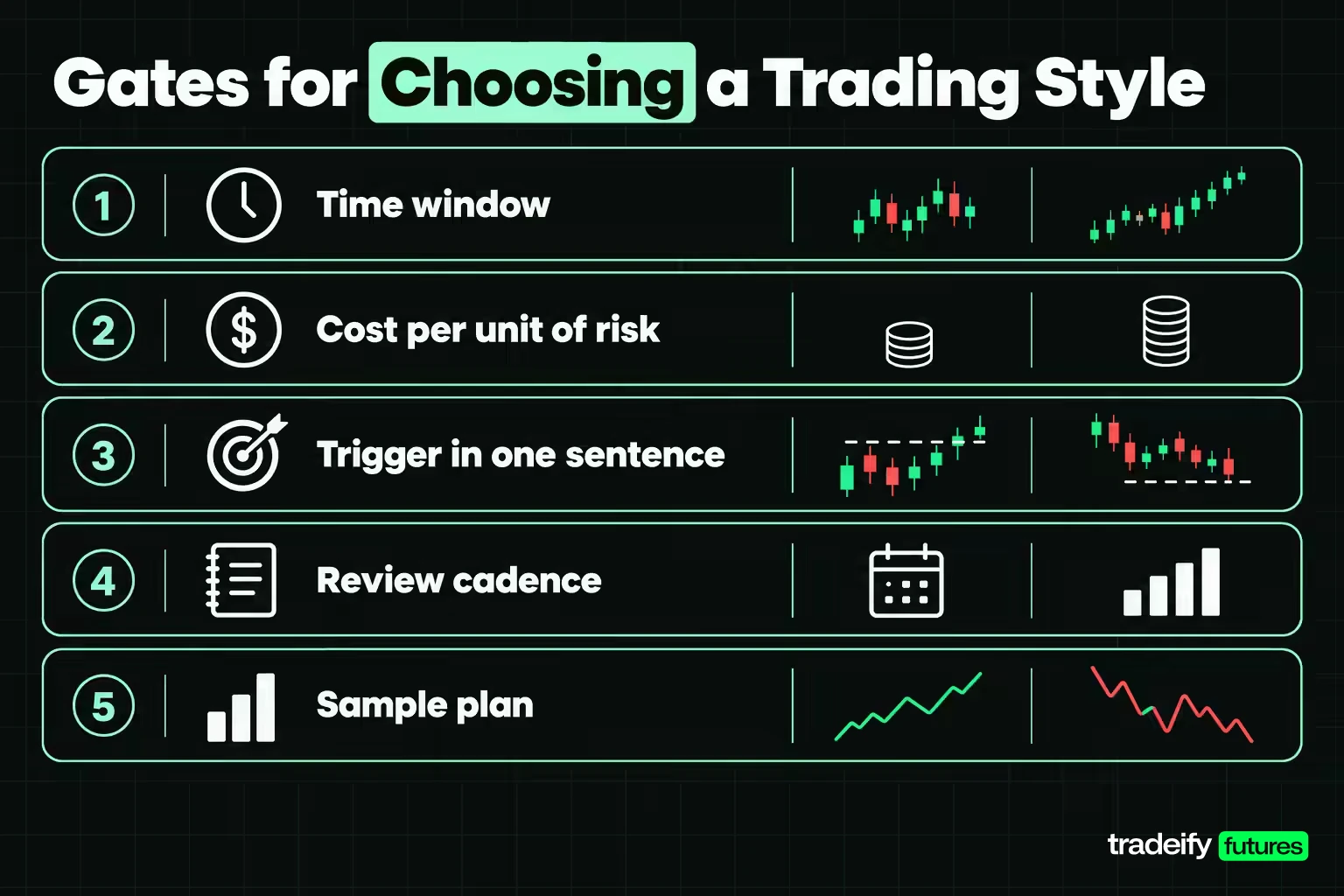
Choosing a trading style works best as a sequence of gates. The first two decide which styles are possible at all, and the rest decide which of the possible ones you can stick with.
- Time window. Name the hours you can watch a screen without interruption. A style whose decisions fall outside that window fails for reasons unrelated to skill.
- Cost per unit of risk. Size one trade with your real risk rule, then divide the round-trip cost by the dollars at risk. A style near 6% has to clear a much higher win rate than the same system at 0.5%.
- Trigger. State in one sentence what puts you in and what takes you out. If you cannot, you have a direction, not a style.
- Review cadence. Match your journaling to the frequency. Ten trades a day means ten journal entries a day.
- Sample plan. Write down how many trades you will collect before judging the style, and the date that implies.
- Patience. Count the qualified setups the style produces in a week. If you will trade the gaps between them out of boredom, the style is too slow for you. If you need ten a day and two qualify, it is too fast.
Setting up the account a trading style needs
Each style needs the right account. Stock day trading runs through a brokerage margin account, futures need a futures account through a registered broker or a prop firm program, and options need options approval from the broker. Check the overnight rules, margin terms and permitted products before choosing a style, because an account that forces positions flat each day rules out swing and position trading regardless of preference.
Practicing a trading style with paper trading
Paper trading means placing simulated trades with live or recorded prices and no real money at risk. It is the cheapest place to test whether you can execute a style's rules, track a sample and keep a journal. Its limit is that simulated fills are often kinder than real ones, and a simulated loss does not test your behavior under pressure. Treat paper results as a test of process, not proof of profit.
Related lesson: Practice with paper trading
Common Mistakes When Comparing Types of Trading
Most mistakes in comparing types of trading come from mixing up labels or skipping the arithmetic.
| The mistake | What it looks like | The correction |
|---|---|---|
| Counting methods as styles | Treating momentum trading as its own time frame | Momentum is a trigger that runs inside any holding period |
| Choosing by feel | Picking scalping because it sounds active | Compare cost per unit of risk and the sample length each style allows |
| Treating frequency as edge | Assuming more trades means more profit | Frequency multiplies costs and noise, not expectancy |
| Fitting the stop to the size | Tightening the stop so the risk rule allows more contracts | The setup sets the stop, and the size follows |
| Ignoring the minimum position | Planning a wide-stop trade on a small account | Check one contract's dollar risk against the budget first |
| Judging on a short sample | Calling a style broken after a losing week | Set the sample before you start and hold to it |
Related lesson: Maximum risk per trade
Which Types of Trading Fit an Intraday Futures Account
Intraday futures accounts, including many prop firm programs, require every position to be closed before the session ends. That rule decides the style question for you. Swing and position trading are off the table, and the choice narrows to scalping or day trading, with the holding period capped at one session.
On our accounts, all positions must be closed by 4:45 PM ET, and no overnight, weekend or swing holds are allowed on any account. A position can be held for the whole trading day, which runs from 6:00 PM to 5:00 PM ET. Scalping is allowed, but on funded accounts a payout request needs more than 50% of trades held longer than 10 seconds and more than 50% of profit coming from those trades. Funded accounts are simulated.
Types of Trading FAQ
What are the four main types of traders?
The four main types of traders are scalpers, day traders, swing traders and position traders, sorted by how long they hold a trade. Scalpers hold for seconds to minutes, day traders close by the end of the session, swing traders hold for days to weeks and position traders hold for weeks to months.
Can you explain what trading is and how it works?
Trading is buying and selling a market to profit from price changes. You open a position long if you expect a rise or short if you expect a fall, then close it, and the difference between the two prices minus costs is your result. A trading style sets how long you hold and how you manage risk while the position is open.
What is short selling?
Short selling means selling first and buying back later, aiming to profit from a price fall. In stocks the shares are borrowed through a broker, which adds borrowing costs and any dividends owed. If price rises instead, the short seller buys back higher and takes a loss.
What is paper trading?
Paper trading is simulated trading with real or recorded prices and no money at risk. It is useful for practicing a style's rules and building a journal habit. Simulated fills and emotions differ from live trading, so treat the results as a process check rather than proof of profitability.
What is technical analysis?
Technical analysis is the study of price, volume and chart patterns to judge likely future price moves. Technical traders use support and resistance, trendlines, moving averages and oscillators to time entries and place stops. It is used across every holding period and dominates intraday trading.
Which type of trading is best for beginners?
The best type of trading for a beginner is the one that fits their hours and account, tested in a simulator first. No single style is best for everyone, because the fit depends on the hours you can watch, the stop width your account can carry and the sample you will sit through. Starting with one style, one market and one risk rule keeps the results readable.
Can you mix trading styles?
Yes, and many experienced traders do, but mixing too early ruins your records. Run one style until you have the sample you committed to, because two at once produce results you cannot attribute. Once each style has its own numbers, combining them is reasonable.
Test One Trading Style Before Risking Money
The useful outcome of comparing types of trading is one decision you can test. Pick one holding period, one market and one risk rule. Write down the stop width the setup needs, the position size that follows, the cost as a share of the risk and the number of trades you will collect before judging it. Then run that plan in a simulator before risking money, and judge it only when the sample is complete.
Related lesson: Build your first trading plan
This page is educational and is not financial advice or a recommendation to trade any style, instrument or market. Futures, options and other leveraged products carry substantial risk, and losses can exceed what you expected or deposited. All prices, commissions and stop distances in the examples are illustrative assumptions, not quotes. Simulated, evaluation and funded accounts are simulated and do not reproduce live market execution.


