



TL;DR: Lot size and contract size differ because the exchange fixes contract size, while lot size is the quantity you choose. In forex a standard lot is 100,000 units and can be split into mini, micro and nano lots. A futures contract cannot be split, so sizing means rounding down to whole contracts. Size every trade from risk, dividing dollars at risk by stop distance times pip or tick value.
Contract size is the amount of the underlying asset one contract controls, and the exchange sets it for you. Lot size is how much you decide to trade. The two terms get used as if they mean the same thing, and in spot forex they nearly do. In futures they do not, and that gap is where a lot of sizing errors start.
Imagine a trader who is comfortable holding two Micro Gold contracts and switches to full-size gold for what feels like the same trade. The chart has not changed. The risk per tick is now ten times larger. Below you will find both terms defined, contract sizes for real futures products, the lot size formula, and the math worked on several accounts so you can see what a given risk budget actually buys.
Lot Size vs Contract Size in Plain Terms
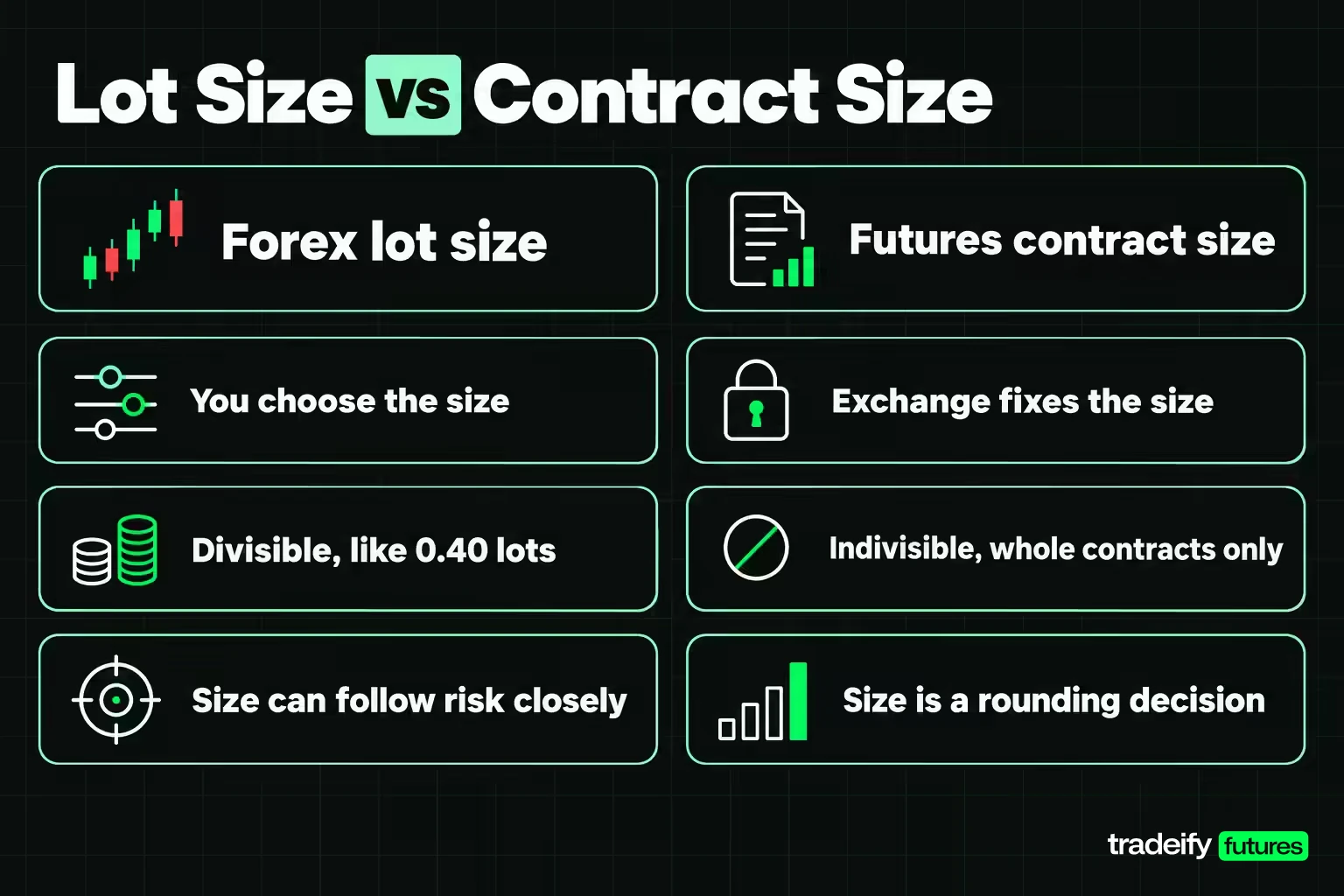
Lot size vs contract size comes down to who sets the number. Contract size is a term of the product. On Micro Gold futures one contract is 10 troy ounces. On Euro FX futures one contract is 125,000 euro. You did not pick those numbers and you cannot change them.
Lot size is your choice. In spot forex the lot is the unit you trade in, and one standard lot is 100,000 units of the base currency. Because the retail forex "contract" is defined in those same units, a standard lot is effectively the contract, which is why the two words blur together.
The difference that matters most is divisibility:
- A forex position can be sized in small steps, such as 0.40 lots (40,000 units) or 0.01 lots (1,000 units).
- A futures contract is indivisible. You can trade one Micro E-mini S&P 500 contract or two, but never 1.4.
- So in forex, size can follow risk closely. In futures, size is a rounding decision, and the rounding pushes your risk above or below plan. That one constraint explains most of the futures sizing advice that follows.
When someone asks "what is your lot size?", they mean the quantity of the position. In forex that answer is a lot figure like 0.50. In futures it is a contract count like 3 MES.
Related lesson: How a futures contract is defined and cleared
What Contract Size Means in Futures and Options
Contract size in derivatives is the quantity of the underlying asset that one contract represents. The exchange fixes it in the contract specification, and every contract of that product is identical.
For physically settled commodities, contract size is a physical quantity. One Light Sweet Crude Oil (CL) contract is 1,000 barrels. One Soybean (ZS) contract is 5,000 bushels. One Gold (GC) contract is 100 troy ounces.
For cash-settled index futures, contract size is expressed as a multiplier. The E-mini S&P 500 (ES) is $50 x the S&P 500 Index, so each index point is worth $50. The Micro E-mini S&P 500 (MES) is $5 x the index.
For a standard listed equity option, one contract generally represents 100 shares. That is why an option quoted at $2.20 costs $220 per contract.
Contract size times price gives notional value, the full market value the contract controls. At an illustrative index level of 7,000, one MES contract controls $35,000 and one ES controls $350,000. With gold at an illustrative $4,000, one GC controls $400,000 and one Micro Gold (MGC) controls $40,000.
Notional is exposure, not money at stake. What you can lose on a trade depends on how far price moves against you, multiplied by contract size and the number of contracts.
Related lesson: Notional value compared with contract size
Contract Size Examples Across Futures Markets
Contract size examples are easiest to compare side by side. The table below lists published CME Group specifications for common equity index, metals, energy, grain and currency futures. Tick value is the contract unit multiplied by the minimum price increment.
| Product and symbol | Contract unit | Minimum price increment | Tick value | Value of a standard move |
|---|---|---|---|---|
| E-mini S&P 500 (ES) | $50 x S&P 500 Index | 0.25 index points | $12.50 | $50 per index point |
| Micro E-mini S&P 500 (MES) | $5 x S&P 500 Index | 0.25 index points | $1.25 | $5 per index point |
| Micro E-mini Nasdaq-100 (MNQ) | $2 x Nasdaq-100 Index | 0.25 index points | $0.50 | $2 per index point |
| Micro E-mini Dow (MYM) | $0.50 x Dow Jones Industrial Average | 1.0 index point | $0.50 | $0.50 per index point |
| Micro E-mini Russell 2000 (M2K) | $5 x Russell 2000 Index | 0.10 index points | $0.50 | $5 per index point |
| Gold (GC) | 100 troy ounces | $0.10 per troy ounce | $10.00 | $100 per $1 move |
| Micro Gold (MGC) | 10 troy ounces | $0.10 per troy ounce | $1.00 | $10 per $1 move |
| WTI Crude Oil (CL) | 1,000 barrels | $0.01 per barrel | $10.00 | $1,000 per $1 move |
| Micro WTI Crude Oil (MCL) | 100 barrels | $0.01 per barrel | $1.00 | $100 per $1 move |
| Soybeans (ZS) | 5,000 bushels | 1/4 cent per bushel | $12.50 | $50 per 1 cent move |
| Euro FX (6E) | 125,000 euro | 0.00005 per euro | $6.25 | $12.50 per 0.0001 |
| Micro EUR/USD (M6E) | 12,500 euro | 0.0001 per euro | $1.25 | $1.25 per 0.0001 |
| Japanese Yen (6J) | 12,500,000 Japanese yen | 0.0000005 per yen | $6.25 | $6.25 per tick |
What the contract size table shows
The contract size table above shows three patterns.
First, micro contracts are usually one tenth of the full-size version. ES is $50 a point and MES is $5. GC is 100 ounces and MGC is 10. CL is 1,000 barrels and MCL is 100. Same price chart, one tenth of the dollars.
Second, the minimum price increment does not tell you the risk. GC and MGC both tick in $0.10 steps, but that tick is $10.00 on one and $1.00 on the other. Contract size is what turns a price move into dollars.
Third, contract size varies wildly across markets. A $1 move in crude oil is $1,000 on one CL contract, while a $1 move in gold is $100 on one GC contract. Carrying the same contract count from one market to another without converting is a quick way to take ten times the risk you meant to.
Related lesson: Reading a contract specification without guessing
What Lot Size Means in Forex
Lot size in forex is the standardized unit of trade volume. One lot represents a fixed number of units of the base currency, which is the first currency in the pair. In EUR/USD the base currency is the euro, so one standard lot is 100,000 euro.
Most forex platforms show lot size as a decimal. An order for 1.00 is one standard lot, 0.10 is a mini lot and 0.01 is a micro lot. When a platform asks for "volume", it is asking for lot size.
Lot size sets notional value. One standard lot of EUR/USD at an illustrative 1.1000 is $110,000 of currency exposure. You do not need $110,000 to open it, because retail forex is traded on margin, but every pip of movement is paid on the full $110,000.
The lot is a convention, not a law of the market. It exists so a trader can scale exposure in fine steps, and that flexibility is the main practical difference between forex lots and futures contracts.
Standard, Mini, Micro and Nano Lot Sizes
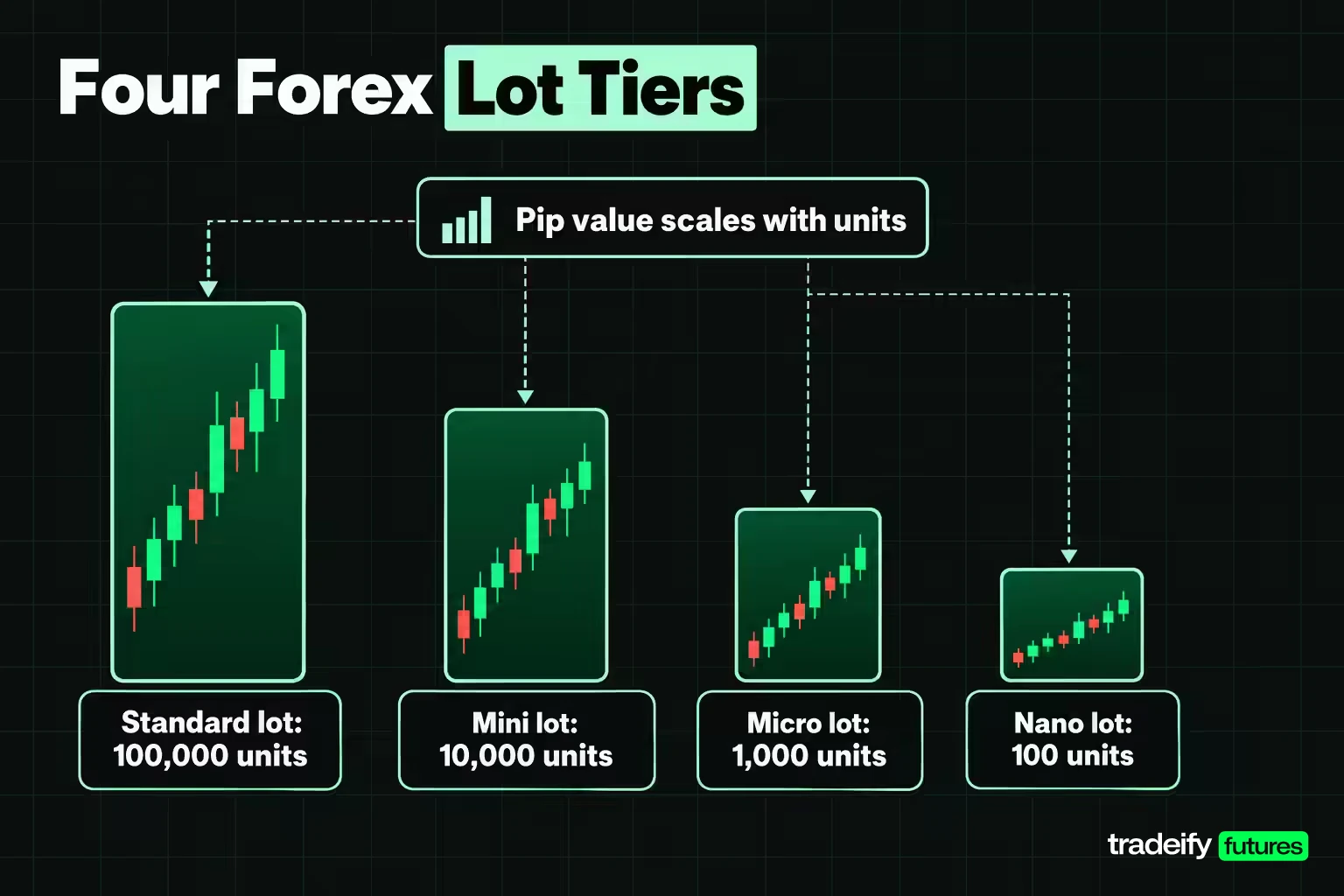
Forex lot sizes come in four common tiers. Each is a fraction of the standard lot, and each tier's pip value on a USD-quoted pair scales by the same factor.
| Lot tier | Units of base currency | Platform notation | Pip value on EUR/USD |
|---|---|---|---|
| Standard lot | 100,000 | 1.00 | $10.00 |
| Mini lot | 10,000 | 0.10 | $1.00 |
| Micro lot | 1,000 | 0.01 | $0.10 |
| Nano lot | 100 | 0.001 | $0.01 |
The pip value column is the one that matters, because it is the number the risk calculation uses. One pip on EUR/USD is 0.0001, so the pip value is units multiplied by 0.0001.
The smaller tiers let a small account size correctly. A $2,000 account risking 1% has $20 to lose. With a 25-pip stop that allows 0.08 lots, which only works because micro lots exist. Nano lots are not offered by every broker, so check your platform's minimum lot step before you build a plan around them.
Pip Value per Lot and Tick Value per Contract
Pip value per lot is the dollar amount one pip of movement is worth on your position. The formula is units multiplied by pip size, which gives a value in the quote currency (the second currency in the pair). If your account is in a different currency, you convert.
The quote currency decides how much conversion is needed:
- USD as quote currency (EUR/USD, GBP/USD). No conversion. One standard lot is 100,000 x 0.0001 = $10 per pip.
- USD as base currency (USD/JPY, USD/CHF). Divide by the exchange rate. USD/JPY at an illustrative 150.00 gives 100,000 x 0.01 = 1,000 yen per pip, which is $6.67. USD/CHF at an illustrative 0.8000 gives 10 francs per pip, which is $12.50.
- Cross pairs (EUR/GBP, GBP/JPY). Convert through a third rate. EUR/GBP pays 10 pounds per pip per standard lot, so with GBP/USD at an illustrative 1.3000 that is $13.00 per pip.
Note the pip size change on yen pairs. A pip on USD/JPY is 0.01, not 0.0001.
Futures use tick value instead, and it is fixed in US dollars for US contracts. Tick value equals contract unit multiplied by tick size. Micro Gold is 10 ounces x $0.10 = $1.00. Euro FX is 125,000 x 0.00005 = $6.25. You never convert a CME tick value for exchange rates, which removes a whole class of forex sizing errors.
Related lesson: Tick size and tick value worked out for each contract
Why Lot Size and Contract Size Matter for Risk
Lot size and contract size matter because they are the dial that turns a price move into a dollar result. The chart can be identical and the outcome can differ by a factor of ten.
Take a 1% move in the S&P 500 at an illustrative 7,000. That is 70 points. On one ES contract it is $3,500. On one MES contract it is $350. Same read, same entry, same exit.
Gold works the same way. An $8 move against you costs $800 on one GC contract and $80 on one MGC contract.
Size also controls how fast an account can fall. A trader who plans to risk $200 per trade but holds a contract that loses $800 at the stop is not taking one bigger trade. They are taking four trades' worth of risk on one decision. Two normal losses in a row and the plan is gone, even if the read on the market was fine.
That is why size should be the last decision, not the first. Market and setup come first, the stop comes from where the idea is proven wrong on the chart, and size is whatever the arithmetic allows. If the arithmetic says zero, that is an answer, not a problem to work around.
Lot Size Calculation Formula

The lot size calculation formula works backwards from what you are willing to lose.
For forex lots:
- Risk amount = account balance x risk percentage.
- Risk per standard lot = stop distance in pips x pip value per standard lot.
- Lot size = risk amount ÷ risk per standard lot.
A $10,000 account risking 1% has $100 at risk. With a 25-pip stop on EUR/USD, one standard lot risks 25 x $10 = $250. Lot size = $100 ÷ $250 = 0.40 lots, or 40,000 units.
For futures contracts:
- Risk amount = account balance x risk percentage.
- Risk per contract = stop distance in ticks x tick value (or points x dollars per point).
- Contracts = risk amount ÷ risk per contract.
- Round down to a whole number.
A $200 risk budget with a 10-point stop on MES risks 10 x $5 = $50 per contract. Contracts = $200 ÷ $50 = 4.
The rounding step is what makes futures position sizing different. Forex platforms let you trade 0.40 lots. No futures exchange lets you trade 2.5 contracts, so the formula ends with a rounding decision, and rounding down is the default that keeps you inside the budget.
Related lesson: The rounding problem worked through in contract terms
Worked Lot Size Examples
Worked lot size examples make the formula concrete. All prices are round illustrative levels, not quotes.
Forex lot size examples
EUR/USD. A $10,000 account risks 1% ($100) with a 25-pip stop. Pip value is $10 per standard lot, so risk per lot is $250. Lot size is 0.40 lots.
USD/JPY. The same $10,000 account risks $100 with a 30-pip stop. At 150.00, pip value is $6.67 per standard lot, so risk per lot is about $200. Lot size is 0.50 lots, or 50,000 units. Using the wrong $10 pip value here would size you at 0.33 lots instead, risking less than planned. On USD/CHF the same mistake runs the other way and risks more.
One risk budget across eight futures contracts
Now hold a $200 risk budget fixed and apply a realistic intraday stop to each market. The question is simple: how many whole contracts does $200 buy?
| Market | Stop distance | Risk per contract | Exact contracts | Contracts to trade | Risk actually taken |
|---|---|---|---|---|---|
| Micro E-mini S&P 500 (MES) | 10 index points | $50.00 | 4.00 | 4 | $200.00 |
| Micro Gold (MGC) | $8.00 per ounce | $80.00 | 2.50 | 2 | $160.00 |
| Gold (GC) | $8.00 per ounce | $800.00 | 0.25 | 0 | $0.00 |
| Micro WTI Crude Oil (MCL) | $0.60 per barrel | $60.00 | 3.33 | 3 | $180.00 |
| WTI Crude Oil (CL) | $0.60 per barrel | $600.00 | 0.33 | 0 | $0.00 |
| Soybeans (ZS) | 12 cents per bushel | $600.00 | 0.33 | 0 | $0.00 |
| Euro FX (6E) | 25 pips | $312.50 | 0.64 | 0 | $0.00 |
| Micro EUR/USD (M6E) | 25 pips | $31.25 | 6.40 | 6 | $187.50 |
Four of the eight rows return zero. One GC, CL, ZS or 6E contract carries more risk at that stop than the whole $200 budget. This is where traders get caught: the setup looks good, the full-size contract is the one on the screen, and tightening the stop until one contract "fits" feels like a fix. It is not. A stop placed to fit the size instead of the chart is just a closer exit for normal noise. The honest options are to use the micro contract, accept a bigger risk budget on purpose, or skip the trade.
Compare that to forex. The same $200 on EUR/USD with a 25-pip stop gives exactly 0.80 lots and $200 of risk. Forex lets size match risk. Futures make you choose between a little less risk and a lot more.
Related lesson: Sizing a position from a fixed fraction of the account
Matching Lot Size to Account Balance
Matching lot size to account balance starts with the same 1% risk per trade, applied to different balances. The table uses the stops from the worked examples: 25 pips on EUR/USD, 10 points on MES and ES, and $8 on MGC.
| Account balance | Risk at 1% | EUR/USD lots | MES contracts | MGC contracts | ES contracts |
|---|---|---|---|---|---|
| $2,000 | $20 | 0.08 | 0 | 0 | 0 |
| $5,000 | $50 | 0.20 | 1 | 0 | 0 |
| $10,000 | $100 | 0.40 | 2 | 1 | 0 |
| $25,000 | $250 | 1.00 | 5 | 3 | 0 |
| $50,000 | $500 | 2.00 | 10 | 6 | 1 |
| $100,000 | $1,000 | 4.00 | 20 | 12 | 2 |
Read it as a guide to which tier fits, not a recommendation. Your stop distance changes every number.
A useful way to flip the table is to ask what balance a single contract needs at 1% risk:
- MES with a 10-point stop ($50): $5,000.
- MGC with an $8 stop ($80): $8,000.
- ES with a 10-point stop ($500): $50,000.
- CL with a $0.60 stop ($600): $60,000.
- GC with an $8 stop ($800): $80,000.
Below those balances, one contract already breaks the 1% rule. On a small account the micro tier is not a preference. It is the only size that fits.
Risk Management With Lot Size and Contract Count
Risk management with lot size means fixing the risk per trade first and letting size absorb everything else.
Set a risk-per-trade cap. Many traders cap risk at a small fixed share of the account, often 1% or less. The exact figure is a personal choice, but it should be decided before the trade and not raised after a loss.
Let volatility change size, not risk. If the chart calls for a 20-point MES stop instead of 10 points, risk per contract doubles to $100. The $200 budget now buys 2 contracts, not 4. Keeping the contract count and tightening the stop to fit is how traders get stopped out by normal noise.
Never round up by habit. If the exact answer is 2.5 MGC contracts and you trade 3, you are risking $240 against a $200 plan, 20% over. Once is survivable. Do it on every trade and your real risk per trade sits well above the number in your plan, which makes your journal stats misleading too.
Add up correlated positions. Two MES contracts with a 10-point stop risk $100. Two Micro E-mini Nasdaq-100 (MNQ) contracts with a 25-point stop also risk $100. Each looks small, but long S&P 500 and long Nasdaq-100 tend to move together, so treat it as $200 on one idea. Split the budget across correlated trades instead of giving each its own full allocation.
Include costs and slippage. Two ticks of slippage on four MES contracts is 8 x $1.25 = $10, which is 5% of a $200 budget before commissions. Short stops make this share larger.
Related lesson: Adjusting size when volatility changes
Lot Size vs Leverage and Margin
Lot size vs leverage is a common source of confusion because the two move together in the account statement but measure different things.
- Lot size or contract count is the quantity you hold.
- Notional value is that quantity multiplied by price.
- Margin is the deposit the broker or exchange requires to hold the position.
- Effective leverage is notional value divided by account equity.
In US retail forex, the CFTC rule at 17 CFR 5.9 sets a minimum security deposit of 2% of notional on major currency pairs and 5% on others. That works out to a maximum of 50:1 and 20:1.
Here is how they combine on a $10,000 account trading EUR/USD at 1.1000:
- 1 standard lot = $110,000 notional, $2,200 margin at 2%, effective leverage 11 to 1.
- 0.40 lots = $44,000 notional, $880 margin at 2%, effective leverage 4.4 to 1.
The key point: leverage changes how much margin you post, not how much a pip costs. The 0.40-lot position still risks $100 on a 25-pip stop whether the broker allows 50:1 or 10:1. Higher leverage only lets you open a bigger position than your risk plan calls for.
Futures follow the same logic. Four MES contracts at 7,000 control $140,000 of notional. The exchange margin to hold them is a small fraction of that, which is why a small deposit can hide a large position. Margins change with volatility, so check the current figure with your broker rather than treating any number as fixed.
Pros and Cons of Standardized Contract Sizes
Standardized contract sizes are what make futures tradable on an exchange, but they come with tradeoffs.
Advantages:
- Every contract is identical, so buyers and sellers can trade with anyone in the same pool of orders. That concentrates liquidity.
- Central clearing works because the clearinghouse guarantees one known product, not thousands of custom ones.
- Price discovery is cleaner when everyone quotes the same unit.
- Tick values are fixed, so risk math does not change with exchange rates or broker settings.
Drawbacks:
- Contracts are indivisible, so size can only move in whole steps.
- Full-size contracts carry large notional value and large dollar risk per tick, which can put them out of reach for small accounts.
- Coarse sizing forces a rounding decision on almost every trade.
Micro contracts are the exchange's answer to the drawbacks. MES is one tenth of ES and M6E is one tenth of 6E, which gives traders ten times finer sizing on the same price.
Related lesson: How mini and micro futures compare
Contract Size Limits and Multiple Positions in Prop Accounts
Contract size in a prop firm account has a second ceiling on top of your risk math: the account's maximum position limit. Most futures prop accounts cap how many contracts you can hold at once, regardless of what the formula says.
That means two checks on every trade. First, the formula gives the number of contracts your risk budget allows. Second, the account limit caps the total. You trade the smaller of the two. The limit is a ceiling, not a target: being allowed four minis does not mean a 10-point stop on four ES fits your drawdown room.
Limits usually count all open positions together. If you hold MES and MNQ at the same time, both count toward the cap, and both add to the same risk on a correlated move. Sizing for a drawdown rule is the same idea as sizing for an account balance, except the number that matters is the room left before the drawdown limit, not the headline account size.
On our accounts, size is capped by contract limits rather than margin: 1 mini or 10 micros on 25K, 4 or 40 on 50K, 8 or 80 on 100K and 12 or 120 on 150K. Ten micros count as one mini, full-size contracts such as GC or CL each count as one mini, and you can hold minis and micros together within the combined limit. Our Help Center also notes that 10 MES cost $18.20 round trip against $5.76 for one ES, so once you are sizing in multiples of ten micros, the mini is cheaper. Funded accounts are simulated.
Lot Size Calculators and Spreadsheet Checks
A lot size calculator automates the formula. Most need the same inputs: account balance or risk amount, risk percentage, stop distance, the instrument, and for forex the account currency and current exchange rate.
A spreadsheet does the same job and shows its work. For futures, one cell can hold the whole calculation:
- Contracts = ROUNDDOWN(risk amount ÷ (stop in ticks x tick value), 0)
For forex, keep two decimals for lots and add a conversion cell for pip value when the quote currency is not your account currency.
Check any calculator once by hand before you trust it with real decisions. The common faults are a hard-coded $10 pip value, rounding up instead of down, and stop distances entered in points when the tool expects ticks. One MES point is four ticks, so that last mistake sizes you four times too small or four times too large depending on which way it runs.
Common Lot Size Mistakes
Common lot size mistakes are predictable, which makes them fixable. Most come from carrying one number from the place it was right to a place where it is wrong.
| Mistake | What it looks like | Why it hurts | The fix |
|---|---|---|---|
| Assuming $10 per pip on every pair | Same lot size on EUR/USD and USD/JPY | USD/JPY at 150.00 is $6.67 per pip and USD/CHF at 0.8000 is $12.50 | Calculate pip value for each pair |
| Fixed lots on every trade | 1.00 lot regardless of stop | A 50-pip stop risks twice a 25-pip stop | Size from the stop distance each time |
| Rounding up contracts | Plan says 2.5, trade 3 | 20% more risk than planned | Round down or switch to the micro |
| Reading margin as size | Small deposit, large position | Margin understates notional exposure | Convert to risk per contract first |
| Carrying forex habits into futures | Expecting to trade 0.4 of a contract | Futures contracts are indivisible | Size in whole contracts from tick value |
| Ignoring costs and slippage | Risk equals stop distance only | Slippage and commissions add to the loss | Add a cost buffer to risk per contract |
The rounding mistake does the most quiet damage, because each instance looks small. The pip value mistake is the most common for forex traders, because the $10 figure is correct on the pair most people learn first.
Frequently Asked Questions About Lot Size
Is lot size the same as contract size?
In spot forex they describe nearly the same quantity, because a standard lot of 100,000 units is the standard contract. In futures they are different: contract size is fixed by the exchange and cannot be split, while "lot" is borrowed forex language.
What does 0.01 lot size mean?
It means one hundredth of a standard lot, or 1,000 units of the base currency. That is a micro lot, worth $0.10 per pip on EUR/USD. There is no 0.01 of a futures contract.
How many contracts is one lot?
One lot is not a fixed number of contracts, because it depends on the product's contract size. One Euro FX futures contract is 125,000 euro, or 1.25 standard lots. One Micro EUR/USD contract is 12,500 euro, or 0.125 standard lots. Convert through units rather than assuming one equals one.
How much is 0.1 lot in Indian rupees?
On USD/INR at an illustrative rate of 85.00, a 0.1 lot is 850,000 rupees of notional value, because 0.1 lot is 10,000 units of the base currency. The margin you post is a fraction of that, set by the broker and the rules that apply to you.
How do I calculate position size?
Divide the dollars you are willing to risk by the dollars at risk per unit of size. For forex that is stop pips times pip value per lot. For futures it is stop ticks times tick value, rounded down to a whole contract.
How do I find the lot size of a property?
Property lot size is the land area of the parcel, usually shown on the deed, plat map or county records. It has nothing to do with trading lot size, which measures the quantity of an asset in a position.
Futures, forex and other leveraged products carry a high risk of loss, and losses can exceed what you expect or deposit. Contract sizes and tick values come from published exchange specifications that can change, so confirm them before you trade. All prices and account examples here are illustrative, not quotes or recommendations. Funded and evaluation accounts are simulated trading accounts, not live brokerage accounts. This article is education, not financial advice.


