

TL;DR: The best futures prop firm for a scalper is the one whose holding-time, simulated-fill, news-trading, drawdown, fee, and payout rules fit the strategy. Tradeify publishes a funded-account holding-time test for payout eligibility, prohibits simulated-fill exploitation, and permits news trading. Topstep also restricts simulated-fill exploitation, while some competitors restrict news trading at particular account stages. My Funded Futures explicitly permits microscalping in its live-account FAQ, which should not be assumed to cover every earlier stage. Compare the exact account path and ask about very short trades before purchase. Small gross targets need especially careful testing after commissions and slippage.
A firm can advertise scalping while your specific method still fails its payout review. The problem is usually hidden in the definition: a trade held for several minutes is different from hundreds of entries designed around favorable simulated fills.
Start with your actual trade record. Holding time, target size, order type, and the source of the apparent edge matter more than the label “scalper.”
This shortlist compares published program conditions. It is not a latency benchmark or a claim that one firm produces better fills. Plan availability and rules should be rechecked before purchase.
Compare scalping rules by account stage

These are conditional candidates, not a ranking of execution speed. Rules checked September 10, 2026; each firm’s published policies support the distinctions below.
Firm and stage | Relevant published condition | Fit limitation |
|---|---|---|
Tradeify funded accounts | Simulated-fill exploitation prohibited; payout test: over 50% of trades AND profit from holds over 10 seconds | Evaluation exempt; funded payout test still applies |
Topstep account path | Simulated-fill exploitation prohibited, as it is at Tradeify | Check order logic; short duration alone does not establish approval |
My Funded Futures live accounts | Live FAQ permits microscalping | Verify evaluation and simulated-funded rules separately |
Define the scalping strategy before choosing a prop firm
Measure the median holding time and the share of trades that close within a few seconds. Also measure how much profit comes from those very short trades.
Write down whether the strategy uses market orders, resting limits, tight brackets, or automated breakeven changes. A backtest dependent on every touched limit order filling may not represent executable behavior.
Identify the session and news exposure. Tradeify permits news trading, while some competing firms restrict it at particular account stages. If the strategy needs the first seconds of a major release, a funded-stage news restriction can disqualify a plan even when the evaluation allows it.
These details let you ask the firm a precise question. “Do you allow scalping?” is usually too broad.
Topstep for scalpers using realistic execution assumptions
According to the firm’s published rules, Topstep’s prohibited-strategies policy addresses simulated-fill exploitation, including scalping algorithms built around unrealistic fills and repeated rapid trades exploiting queue behavior. Tradeify also prohibits simulated-fill exploitation, so this restriction should not be treated as unique to Topstep.
That makes Topstep a candidate to evaluate for a scalper whose method depends on ordinary market behavior rather than simulator advantages. It does not establish that every short-duration strategy is approved.
Before buying, compare your holding-time distribution and order logic with the policy. Ask for clarification if most profits come from seconds-long trades, unusually favorable stop fills, or very tight brackets.
The key buying question is whether the strategy remains viable with realistic fills and fits the program’s conduct rules. A fast platform cannot compensate for a method the program does not accept.
My Funded Futures for traders checking the full account path
According to the firm’s published rules, My Funded Futures explicitly permits microscalping in live accounts while warning about execution and slippage risk.
The stage qualification matters. A live-account answer is not automatic permission for every evaluation or simulated funded plan. Confirm those stages separately before paying for a path intended to reach live trading.
For example, the firm’s published rules for its Rapid EOD 50K plan list different news permissions between evaluation and simulated funding. A scalper who relies on announcement volatility needs to account for that change.
This is a conditional shortlist choice for traders willing to verify the complete route, not a blanket recommendation for all forms of microscalping.
Compare prop-firm costs against a scalper’s target
Small targets are sensitive to costs. Suppose a hypothetical trade aims to capture $20 gross per contract, with $6 in round-trip fees and an average $4 execution shortfall. That leaves $10 before considering losing trades.
If the gross target falls to $12 with the same costs, only $2 remains on a winner. A high win rate may still be insufficient once full losses are included.
Use the actual platform, product, and contract size in the calculation. Micro contracts and mini contracts can have different fee burdens relative to their point values.
Compare commissions, data costs, platform costs, evaluation charges, and any activation or reactivation costs. Do not rank firms by the checkout discount alone.
Check platform and execution setup for scalping
Scalping puts more weight on the order path than slower styles do. Confirm that the platform you plan to use is supported for the exact account, and that it offers the order types your plan needs, such as brackets or OCO exits.
Record your actual fills during testing. Delay between your computer, the platform, and the exchange can shift entries and exits by a tick or more, and one tick matters when the target is only a few ticks.
Some traders run the platform on a VPS to reduce connection delays. Check whether the program’s rules address remote servers, automation, or copied trades before relying on one. A faster connection does not change what the program allows.
Check drawdown rules for a scalping account
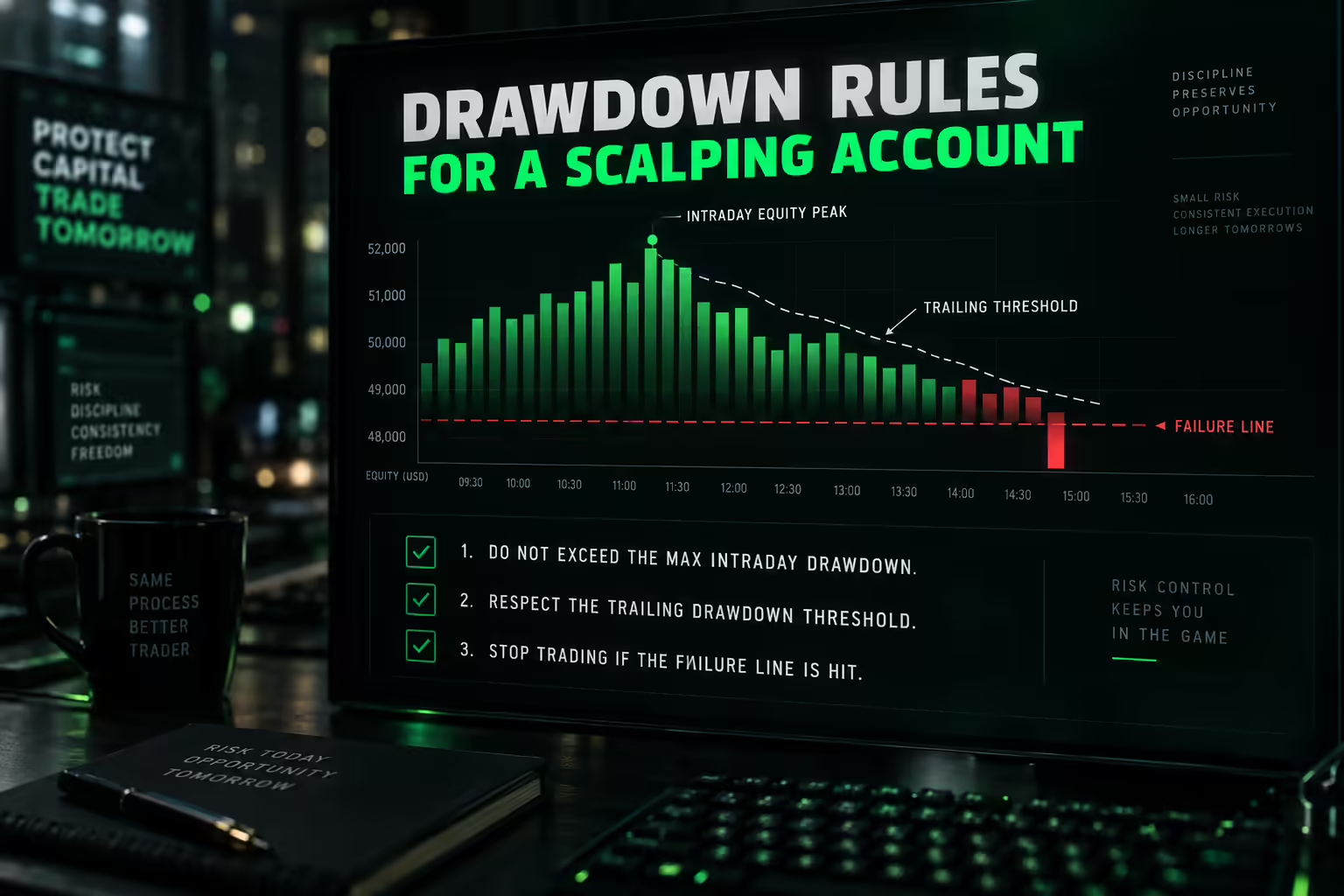
An end-of-day trailing threshold can behave differently from one that follows intraday equity peaks. Both can still be enforced against losses during the session.
For a scalper, frequent entries also mean frequent opportunities to cross a boundary after costs. Track remaining risk room after each complete trade rather than using the starting balance as a rough guide.
Check whether the funded stage changes contract limits, scaling, or the drawdown method. A strategy tested at the evaluation’s maximum size may not fit the funded account’s initial allowance.
Use a personal session stop and a maximum-attempt rule where your testing supports them. The firm’s failure line should not become the ordinary stop for a losing scalp.
Check payout rules before calling a scalping plan suitable
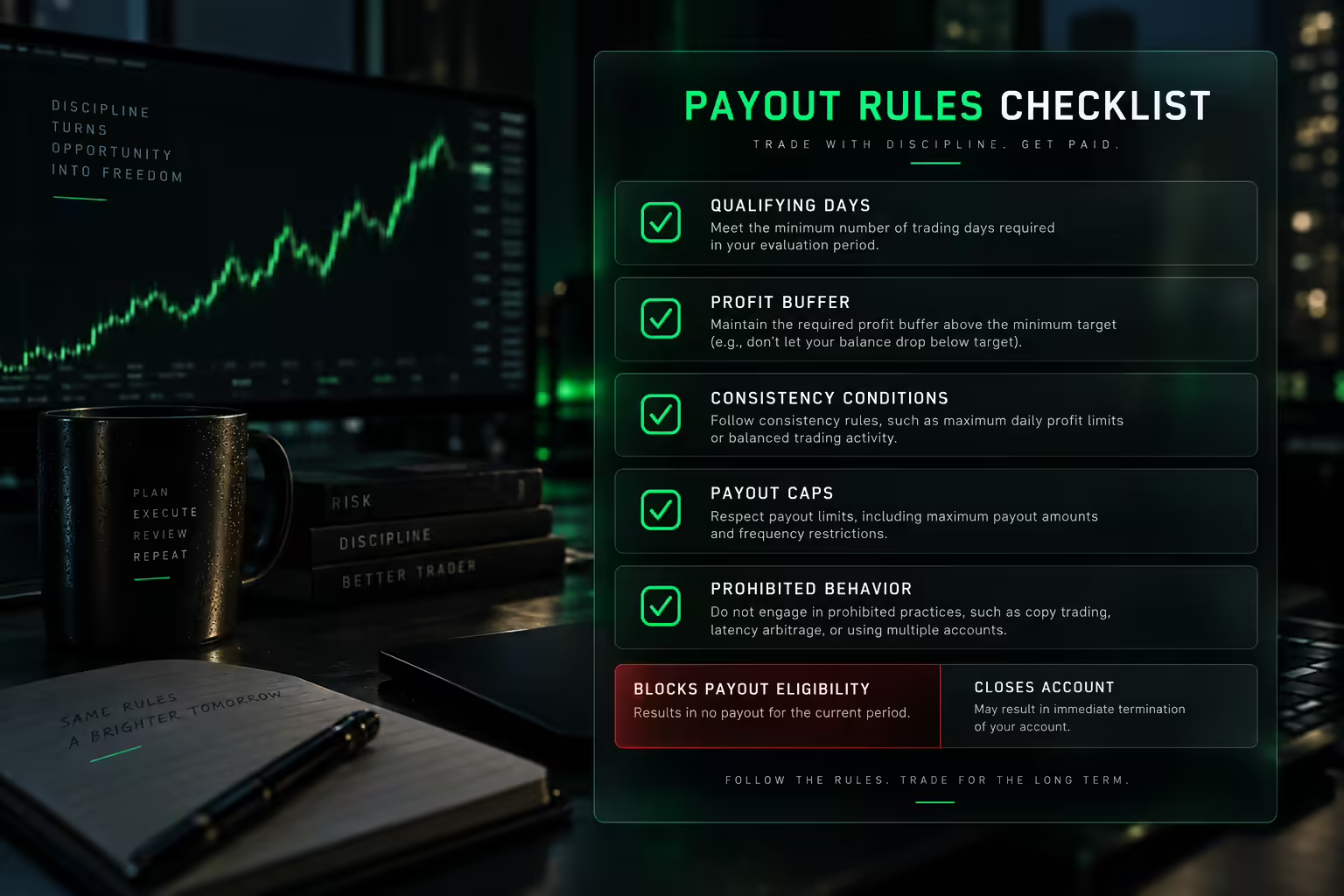
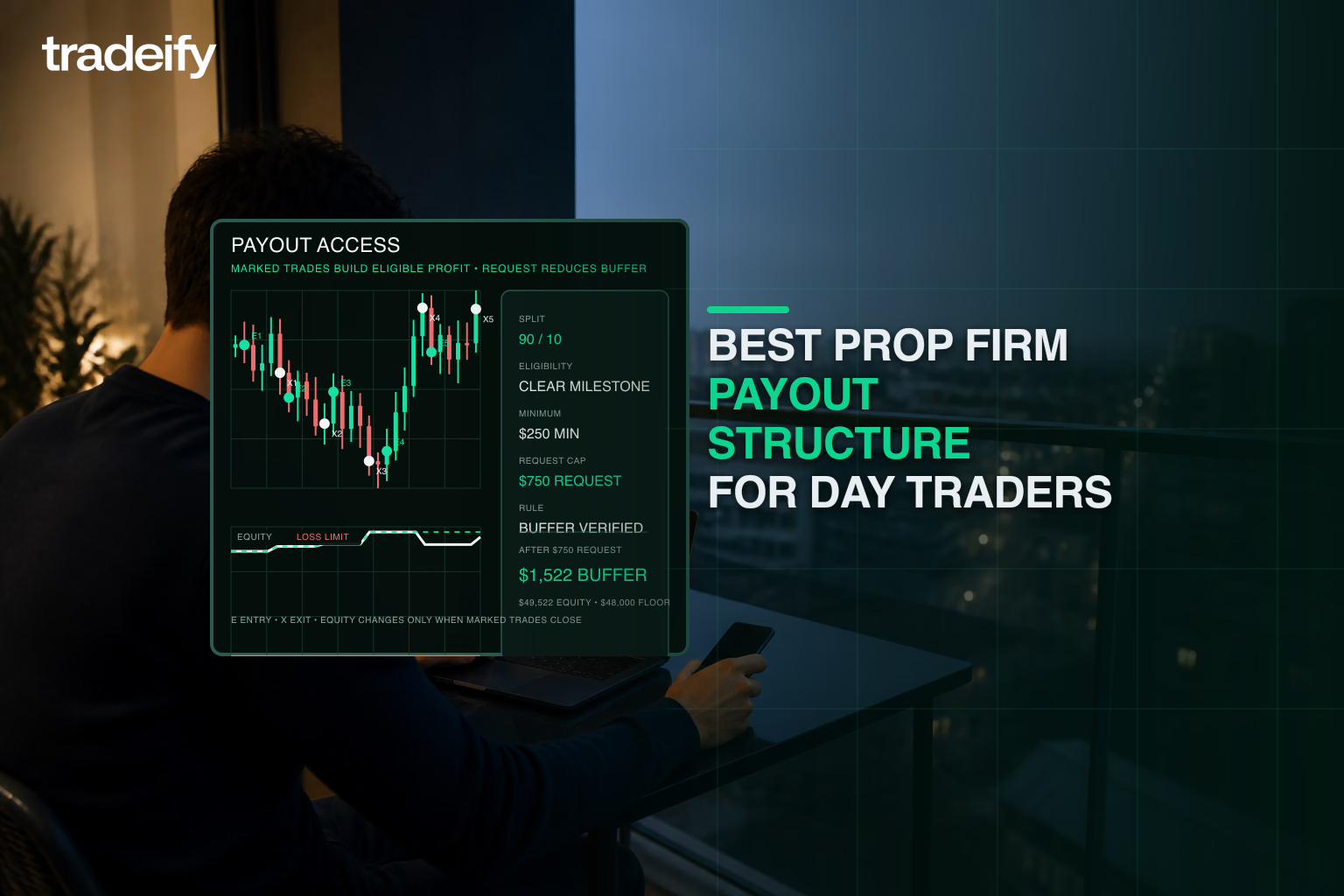
Passing the evaluation is only one part of the purchase decision. Review qualifying days, profit buffers, consistency conditions, payout caps, and prohibited behavior.
Ask whether trade duration is evaluated by trade count, profit contribution, or both. Those measures can differ sharply if a small number of very short trades generate most of the profit.
Keep written clarification for ambiguous strategy questions. A community comment or another trader’s payout screenshot does not establish permission for your account.
Also distinguish a rule that blocks payout eligibility from one that immediately closes an account. Both matter, but the consequences are different.
Pass a prop firm evaluation as a scalper
An evaluation rewards controlled risk more than trade count. Frequent entries add fees and create more chances to cross the drawdown line, so set a daily trade limit that matches your tested sample.
Common scalper mistakes during an evaluation include:
- Trading the maximum allowed size instead of the size your testing supports.
- Adding entries after a loss to win back fees and slippage.
- Changing the holding-time profile only for the evaluation, then finding it does not fit the funded payout rules.
- Judging the plan by gross win rate instead of net results after costs.
Treat the evaluation as a sample of how you will trade the funded account. If the method only passes when you break your own limits, it is not ready for that account.
Tradeify for scalpers whose trades meet funded payout rules
Tradeify’s trader guidelines prohibit simulated-fill exploitation and apply the microscalping condition to funded accounts, not evaluations: more than 50% of trades and more than 50% of profits must come from trades held longer than ten seconds. Tradeify also permits news trading, which can matter to scalpers whose strategy depends on scheduled releases.
That makes the fit test concrete. A strategy can pass an evaluation yet need a different holding-time profile to satisfy funded payout conditions. Do not deliberately hold a losing trade longer just to change its duration statistic; the strategy and its risk rules must be suitable as a whole.
Tradeify can fit a scalper whose strategy meets both holding-time measures without changing its risk rules just to qualify. If most of your trades or profit come from positions held ten seconds or less, our funded payout conditions are a material mismatch. Review a representative trade export against both measures before choosing an account.
Choose a futures prop firm with a written fit check
For each shortlisted plan, record the permitted behavior, stage changes, all-in trading costs, drawdown model, and payout conditions. Eliminate any plan that conflicts with a necessary part of the strategy.
Then test execution assumptions in the available practice setting without treating simulated results as a promise. The best purchase is a program you can trade within its rules using an edge that survives realistic costs, not the one with the strongest scalping headline.
Frequently asked questions
Which prop firm is best for scalping?
No single firm is best for every scalper. The better fit is the program whose holding-time, simulated-fill, news-trading, drawdown, fee, and payout rules match your trade record at every account stage. Compare the exact plan you would buy, not a firm’s general scalping headline.
Do futures prop firms allow scalping?
Many allow short-term trading, but the conditions differ. Common limits include bans on simulated-fill exploitation, holding-time tests for funded payouts, and news restrictions at particular account stages. Permission at one stage does not automatically apply to every other stage.
What is the most effective scalping strategy for futures?
No strategy works for everyone. A scalping method is more likely to hold up when its edge survives realistic fills, round-trip fees, and slippage, and when its holding times fit the program’s payout rules. Test it on the actual contract and platform you plan to use before paying for an evaluation.
How do fees affect a futures scalping strategy?
Fees take a larger share of small targets. In a hypothetical trade with a $20 gross target, $6 in round-trip fees, and a $4 execution shortfall, $10 remains, while a $12 target with the same costs leaves only $2. Run the calculation with your own contract, platform, and size.
Can you trade the news as a scalper at a prop firm?
It depends on the firm and the account stage. Some programs permit news trading, while others restrict it in evaluation or simulated funded accounts. If your strategy needs the first seconds of a major release, confirm the rule for every stage before purchase.