




TL;DR: No activation fee means a program does not charge that specific fee when the qualifying account moves into its funded stage. It does not mean the evaluation, resets, data, commissions, or later reactivation are free. Tradeify Growth uses a one-time evaluation purchase with no funded activation fee. Tradeify Select also has no activation fee, can be passed in two days with the add-on or three days without it, and can provide payout access after one day on the Daily path. Topstep offers a distinct No Activation Fee path, and My Funded Futures documents zero activation fees on Rapid EOD plans. Compare total cost over plausible attempts and billing periods, then check payout access and the exact plan selected at checkout.
You pass the evaluation and expect to start the funded stage. Then another charge appears. Avoiding that surprise is the main appeal of a no-activation-fee account.
But removing one charge does not establish that the whole program is cheaper. A different evaluation price, recurring billing model, or reset policy can outweigh the saved activation fee.
Compare the entire path from purchase to the first eligible payout. That gives you a more useful decision than sorting plans by a single zero on the pricing page.
Compare the no-activation-fee account paths
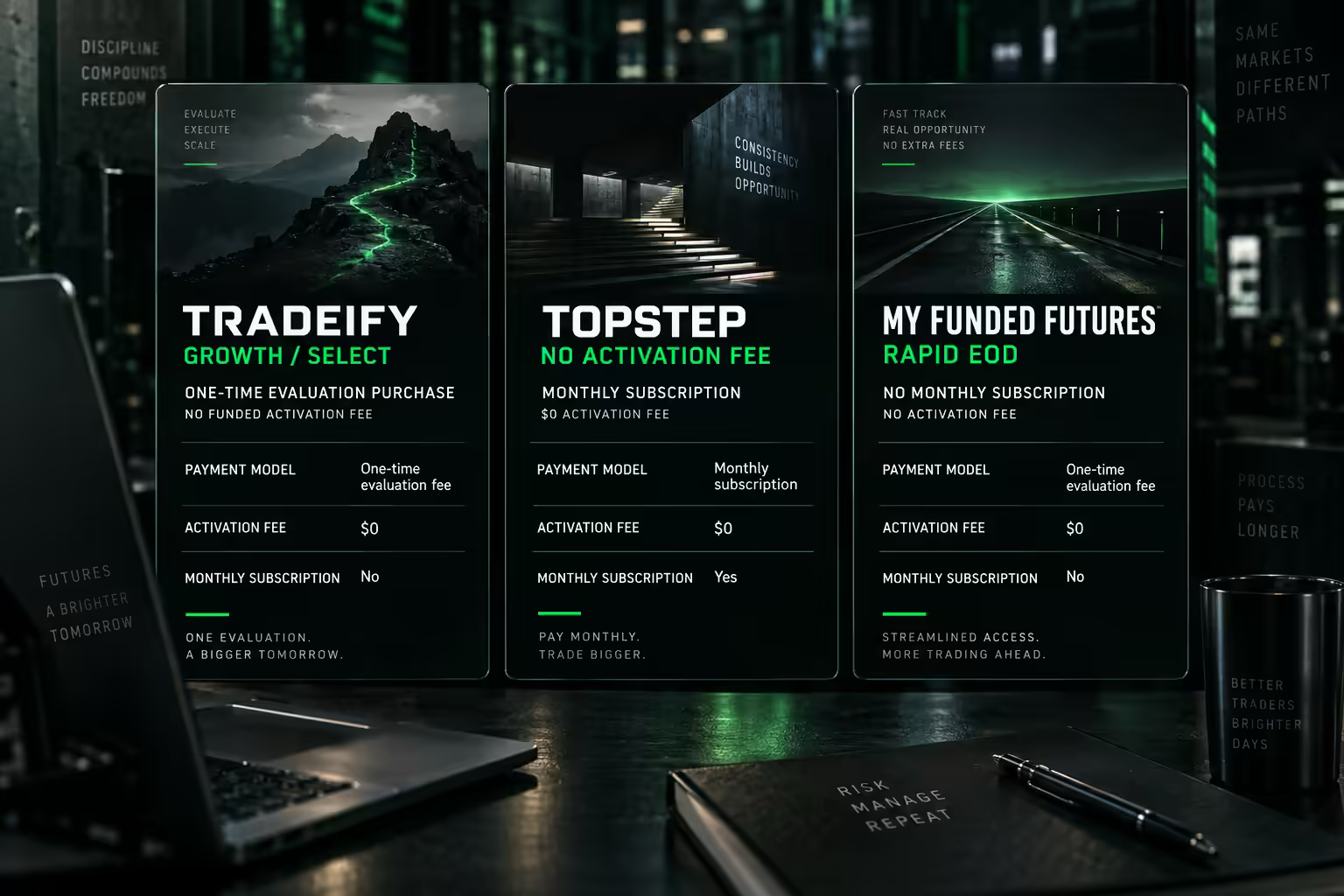
Rules checked September 10, 2026. This table compares billing structures and initial activation; purchase prices, promotions, resets, taxes, and optional services remain separate. Confirm each firm’s current published rules before buying.
Exact path | Evaluation billing and initial activation | Important tradeoff |
|---|---|---|
Tradeify Growth and Select | Growth: one-time evaluation purchase with no funded activation fee; Select: no activation fee, two-day pass with add-on or three days without, and one-day payout access on Daily path | Select’s payout-path and add-on choices require separate review. Growth has a daily loss limit and a fixed payout policy |
Topstep No Activation Fee path | Monthly evaluation subscription; $0 initial XFA activation | Higher monthly cost than Standard; the selected path cannot be switched later |
My Funded Futures Rapid EOD 25K | No monthly subscription or activation fee under its guide | Evaluation consistency and funded news restrictions still apply |
What no activation fee includes
An activation fee is generally a charge associated with opening the next account stage after qualification. A plan advertised without that fee removes that specific step, subject to its terms.
It does not automatically remove the evaluation purchase, subscription renewals, optional data, platform features, commissions, exchange fees, or taxes.
Reactivation is also different from initial activation. A program can charge nothing to activate a newly earned account but charge for restarting an eligible failed account later.
Write those items as separate rows in your comparison. If the plan page does not say whether a cost is included, mark it unresolved and check the official terms before buying.
Compare a no-activation-fee subscription path
According to the firm’s published rules, Topstep distinguishes its Standard path from its No Activation Fee path. The latter uses a higher monthly evaluation charge in exchange for no activation charge when the account qualifies.
That structure creates a time-dependent comparison. A trader who qualifies quickly experiences a different total cost from a trader who pays through several billing periods.
The published rules also treat account reactivation and optional data as separate items. Do not interpret zero activation as zero cost after passing under every circumstance.
Check the selected path at checkout. A brand-level statement that Topstep has a no-activation-fee option does not mean its Standard path has the same terms.
Compare a plan with no separate activation charge
According to the firm’s published rules, My Funded Futures’ Rapid EOD 25K plan has no activation fee or monthly subscription cost. Its Rapid EOD 50K rules separately confirm no activation fee for that plan.
Keep those statements attached to the exact plan rather than extending every detail across the brand. Account sizes and plan families can differ.
For a buyer, the next questions are the purchase price, reset availability, payout buffer, and what happens after a failure. Removing activation expense does not remove the need to qualify or preserve the account.
Confirm current availability as well. A help page for a legacy plan is not evidence that the plan remains open to new purchases.
One-time fee vs monthly subscription billing
A one-time fee covers the evaluation with a single upfront purchase. There is no renewal date, so the cost does not grow while you work toward the target.
A monthly subscription charges again each billing period until you pass, fail, or cancel. A quick pass can make it cheaper, while a slow attempt adds a renewal every month.
Neither model is automatically cheaper. Check what the single payment includes, whether resets cost extra, and whether an activation charge still applies after you qualify.
Calculate the total cost of a prop-firm attempt
Use a simple model:
Total cash cost = Purchases + Subscription renewals + Paid resets + Activation + Required extras + Applicable taxes
Keep trading commissions and profit-share deductions visible separately, because they affect account performance and withdrawals rather than necessarily appearing as the same kind of purchase charge.
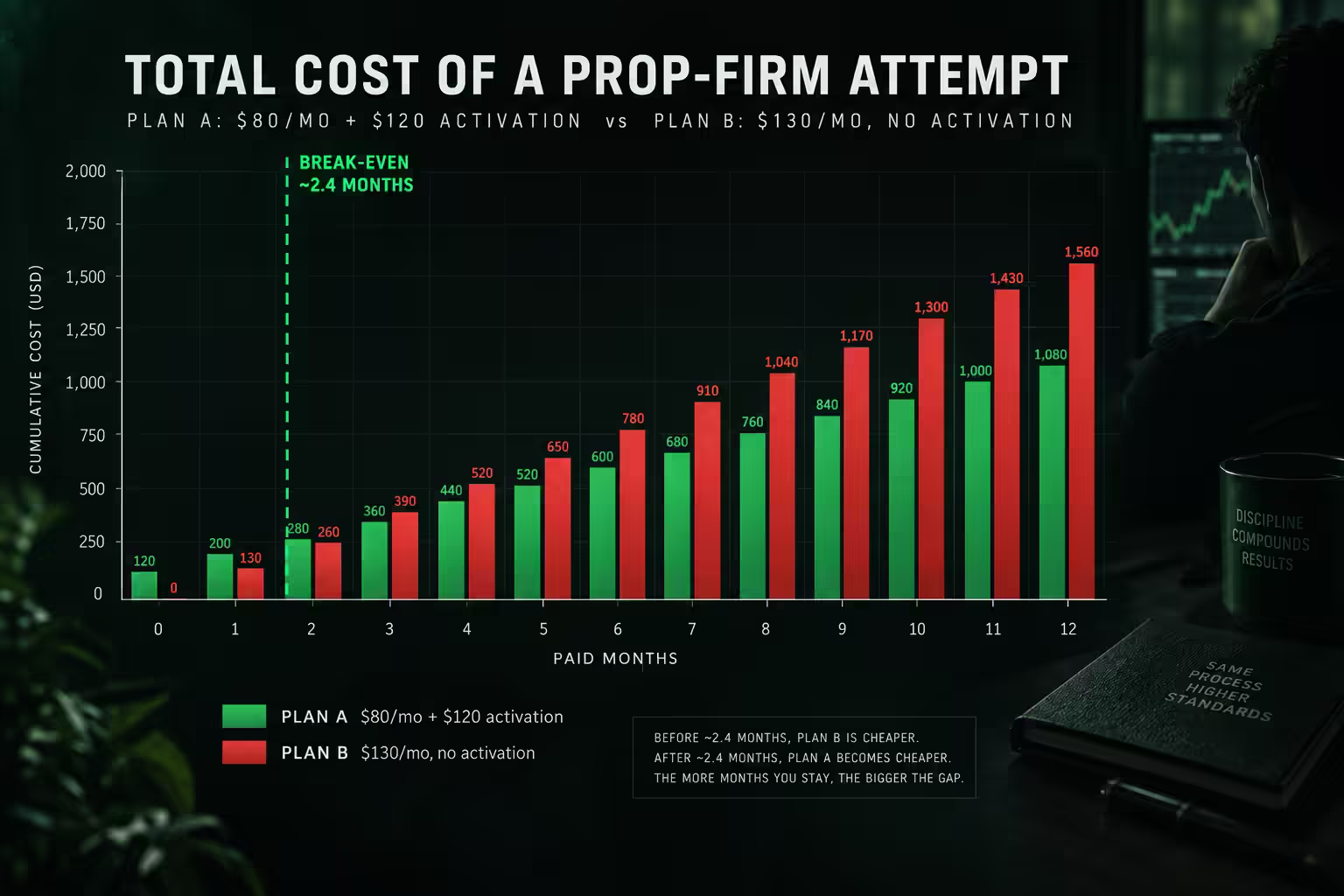
Consider two hypothetical offers, not current firm quotes. Plan A costs $80 per month with a $120 activation charge. Plan B costs $130 per month with no activation charge.
If either qualifies after one paid month, A costs $200 and B costs $130 before extras. After three paid months, A costs $360 and B costs $390. The comparison changes with time.
The break-even point is 120 ÷ (130 − 80), or 2.4 paid months. Real billing occurs in whole periods and can include resets or promotions, so evaluate complete scenarios rather than treating 2.4 as an exact purchase recommendation.
Include failed attempts without normalizing repeated resets
A realistic budget should consider that an attempt may fail. That is different from planning to buy unlimited replacements until one produces a payout.
Set a maximum education and evaluation budget before starting. If an attempt fails, review the cause before deciding whether another purchase is appropriate.
Check whether a reset changes the billing date or simply restarts the trading statistics. Also confirm whether credits expire or apply only to a specific plan.
For a one-time purchase, review inactivity and expiration rules. No recurring subscription does not necessarily mean the account remains available forever under every condition.
Compare payout access after the fee calculation
A cheaper route to funded status can still be a poor fit if the payout conditions conflict with your strategy.
Review the minimum withdrawal, qualifying days, profit buffer, consistency requirement, withdrawal cap, and the effect of a payout on remaining risk room.
Do not subtract a hoped-for payout from the purchase budget as though it were guaranteed. Eligibility depends on performance and compliance, and a simulated account balance is not automatically withdrawable cash.
Compare programs first on costs you can verify and rules you can follow. Treat possible future payouts as conditional outcomes.
Fee red flags in a no-activation-fee offer
A plan can drop the activation fee and still move cost somewhere else. Watch for these signs before you buy.
- A differently named charge at the funded stage, such as a setup or processing fee, that works like activation.
- Data or platform fees that only become required after you qualify.
- A reactivation charge for a failed funded account that the pricing page does not show.
- Payout caps, buffers, or consistency terms that appear only in the funded-stage rules.
- No-activation terms that apply to one plan name but not to a similar plan from the same firm.
If the full fee schedule is not published before checkout, treat that gap as a cost you cannot yet measure.
Tradeify Growth and Select without an activation fee
Tradeify’s Growth Evaluation guide describes Growth as a one-time purchase without recurring subscription charges and without a funded activation fee. Tradeify Select also has no activation fee. Select can be passed in two days with the add-on or three days without it, and traders who choose the Daily payout path can become eligible to request a payout after one day.
Compare Tradeify Growth if you want a one-time evaluation purchase instead of a monthly subscription. Compare Select if you prioritize no activation fee, a two- or three-day minimum evaluation path depending on the add-on, and the possibility of requesting a payout after one day on the Daily path. The cost advantage still depends on the current purchase price and whether you need another attempt; no billing model is cheapest for every trader. Growth and Select have different risk and payout rules, so compare the exact path before buying.
A buyer should therefore compare the initial purchase, available evaluation resets, account restrictions, and consequences of funded failure together. Saving an activation charge does not change those operational requirements.
Check the no-activation-fee offer before paying
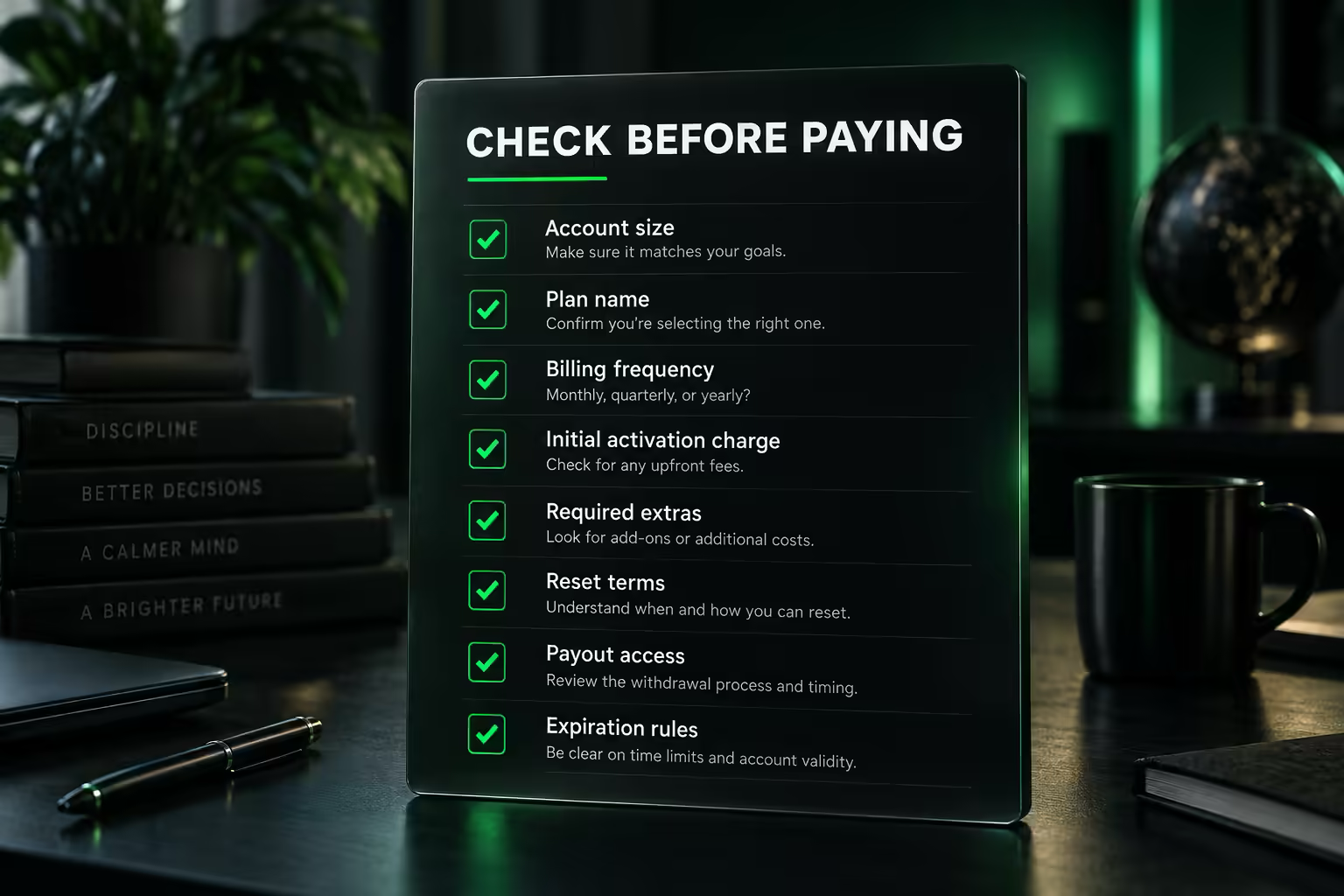
Open the exact checkout path and confirm the account size, plan name, billing frequency, initial activation charge, required extras, and reset terms. Save the applicable terms for your own records.
Run at least a quick-pass scenario and a longer-attempt scenario using current prices. If the apparent savings depend on qualifying immediately, make that dependency explicit.
Choose the program whose total cost and rules fit your tested process and budget. Zero activation is one useful feature. It is not a complete value calculation.
Frequently asked questions
Is there a prop firm that is free?
No activation fee removes one charge at the funded stage, not every charge. The evaluation purchase or subscription, resets, optional data, and commissions can still cost money. Treat any offer described as free as a reason to read the full terms before signing up.
Which prop firms have a one-time fee?
Some futures programs sell the evaluation as a single purchase instead of a monthly subscription. According to the firm’s published rules, My Funded Futures’ Rapid EOD 25K plan has no monthly subscription or activation fee. Check inactivity and expiration terms, because a one-time purchase does not always keep the account open indefinitely.
Which prop firm is the cheapest and legit?
No single prop firm is cheapest for every trader. In the hypothetical example above, a $130 monthly plan with no activation charge beats an $80 monthly plan with a $120 activation charge only if you qualify in under 2.4 paid months. Compare total cost over realistic attempts and confirm that the firm publishes its full fee and payout rules before you pay.
What does an activation fee cover at a futures prop firm?
An activation fee is generally a charge for opening the funded stage after you pass the evaluation. It is separate from the evaluation purchase, subscription renewals, resets, and reactivation of a failed account. A plan with no activation fee removes only that step, subject to its terms.
Is a prop firm with no activation fee always cheaper?
Not always. A plan can offset the missing activation fee with a higher monthly price, paid resets, or required extras. Run a quick-pass scenario and a longer-attempt scenario with current prices to see which plan costs less for you.