


TL;DR: Compare end-of-day drawdown programs by the exact account stage, threshold-update method, intraday enforcement, lock point, and payout effect. Tradeify Select offers EOD drawdown with a choice of funded payout policies; Topstep’s standard Trading Combine and Express Funded paths and My Funded Futures’ Rapid EOD plans are also options to compare. End-of-day describes when the floor moves, not permission to cross it intraday. The best fit depends on your strategy’s equity path and the rules after evaluation.
Your trade runs into profit, pulls back, and eventually closes green. Under an intraday trailing model, the temporary equity high may tighten the account’s loss boundary before you exit. An end-of-day model can handle that path differently.
That difference is why many traders compare EOD drawdown accounts. It is also why vague descriptions such as “more flexible drawdown” are insufficient.
This shortlist uses published program rules, not a prediction of account survival. Compare the exact plan and confirm current availability before buying.
Compare EOD plans and the funded-stage floor
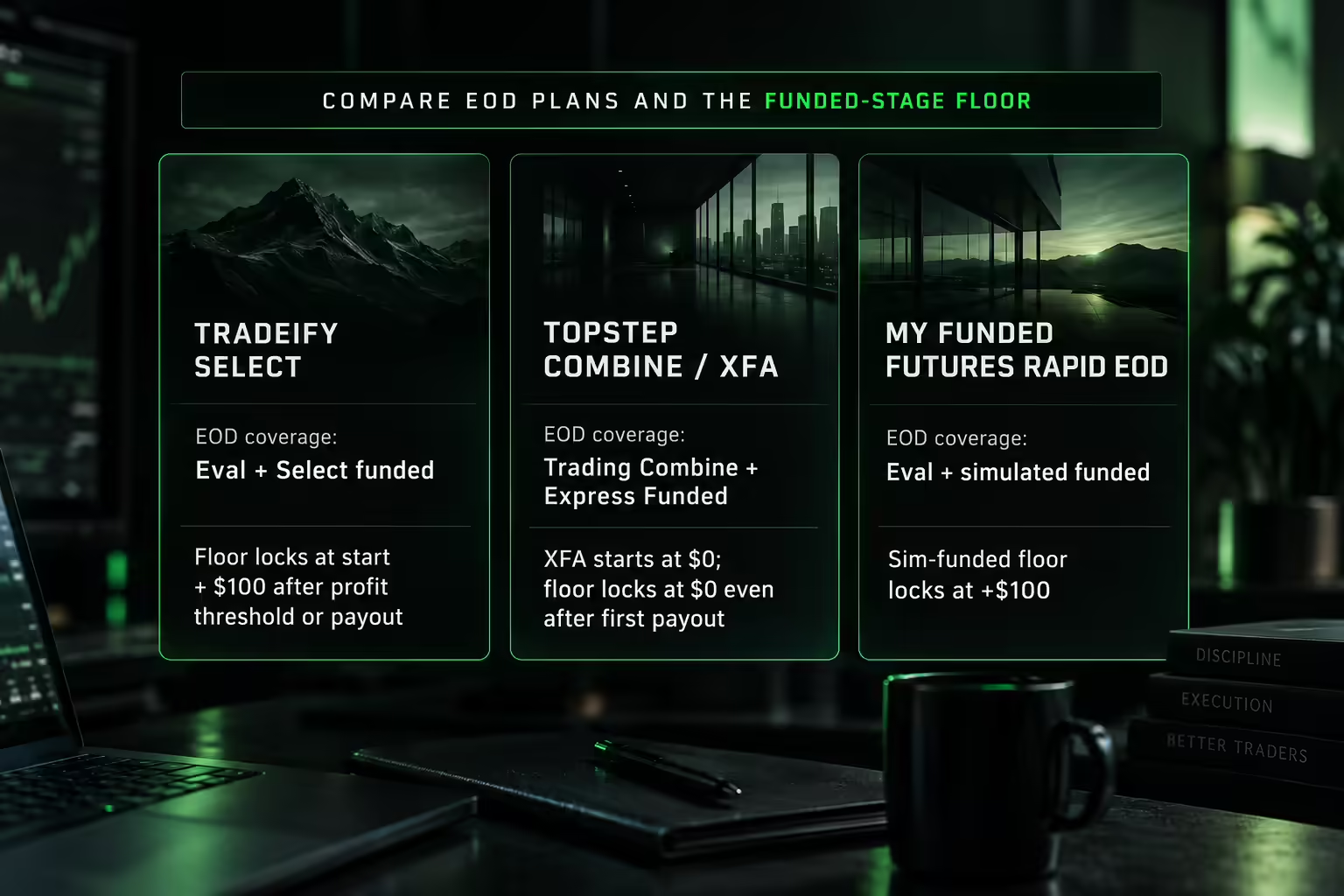
Rules checked September 10, 2026. The table separates account stages because a nominal account label can describe different starting-balance conventions. Confirm each firm’s current published rules before buying.
Plan or path | EOD coverage | Funded lock and key distinction |
|---|---|---|
Tradeify Select | Evaluation and Select funded path | Floor locks at starting balance + $100 only after the profit threshold is exceeded or a payout is requested; Flex and Daily have different payout and daily-loss rules |
Topstep standard Combine / XFA | Trading Combine and Express Funded Account | XFA starts at $0; floor locks at $0, including after the first payout |
My Funded Futures Rapid EOD 25K | Evaluation and simulated funded | Sim-funded floor locks at +$100; standard Rapid is a different drawdown model |
Understand what end-of-day drawdown changes
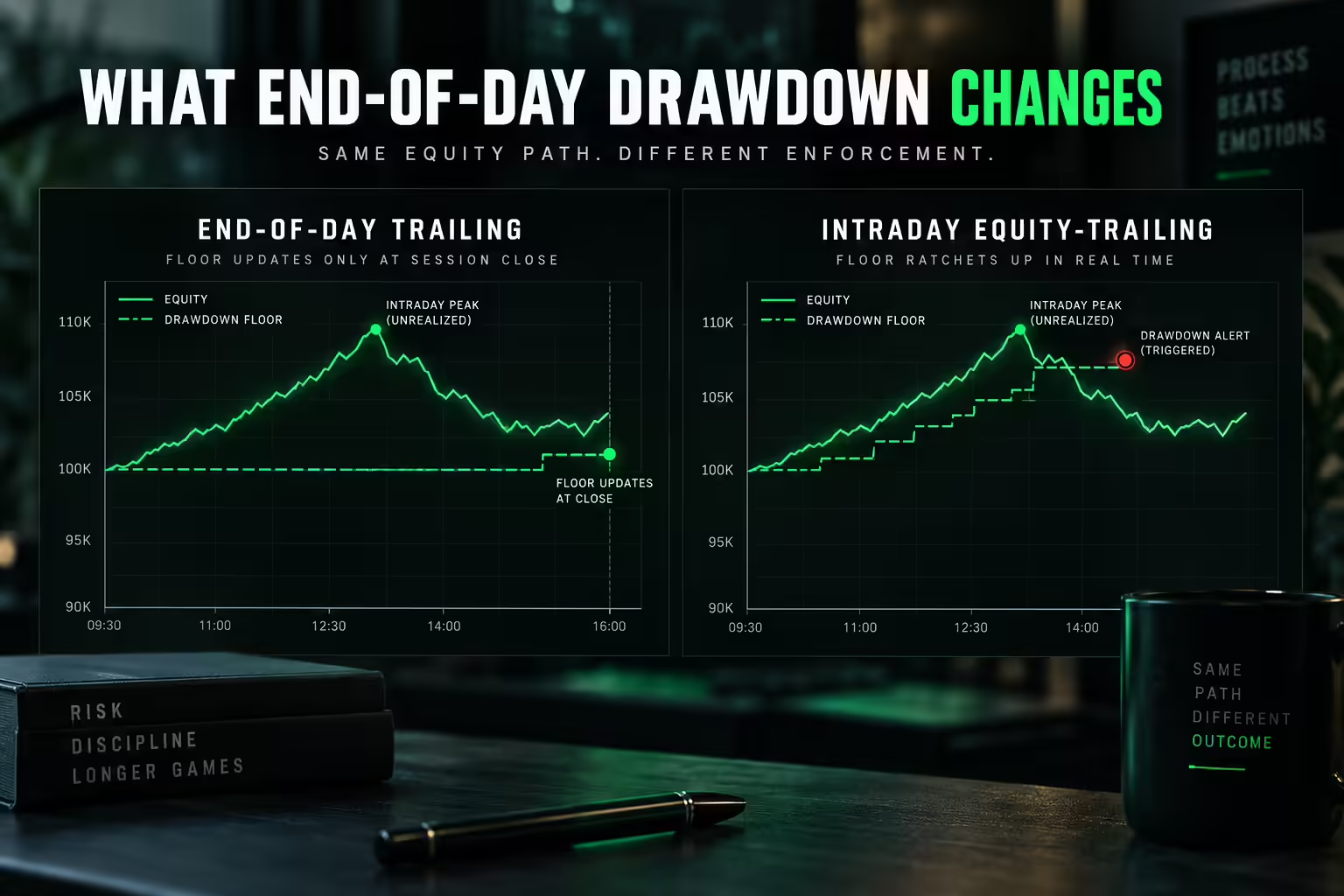
An EOD trailing floor typically updates from the account’s highest qualifying end-of-day value. It does not move upward solely because an open position temporarily reaches a new intraday high.
However, the existing floor can still be enforced during the session. Crossing it with unrealized losses can trigger a breach even if the account later recovers before the close.
Distinguish three questions: when the floor updates, what value it follows, and when it is enforced. A plan must answer all three before you can model its risk correctly.
Also distinguish trailing drawdown from static drawdown. A static floor remains at a fixed level unless another program rule changes it; an EOD trailing floor can still rise after profitable sessions.
Topstep’s standard EOD drawdown paths
According to the firm’s published rules, Topstep’s maximum-loss threshold rises with end-of-day performance and is monitored in real time, including unrealized P&L.
The standard 50K, 100K, and 150K sizes have maximum-loss amounts of $2,000, $3,000, and $4,500. The published rules distinguish evaluation and Express Funded accounting and consequences.
Topstep is a candidate for traders who want a documented EOD method and can work within its qualification and payout rules. Do not extend the standard path’s description to every special offering or live account.
Before purchase, model the funded stage as well as evaluation. The displayed starting balance and lock point can use different accounting conventions across stages.
My Funded Futures’ specifically named Rapid EOD plans
According to the firm’s published rules, My Funded Futures’ Rapid EOD 25K plan uses EOD trailing drawdown in the simulated funded stage and contrasts it with the standard Rapid plan’s intraday trailing method.
That naming distinction is critical. Choosing “Rapid” without confirming “EOD” can mean buying a different risk model from the one you researched.
The 25K EOD plan lists a $1,000 maximum-loss amount and a 30% evaluation consistency requirement. It also changes news permission between evaluation and simulated funding.
This is a candidate for traders prioritizing the specific funded-stage drawdown method, provided the consistency, news, payout, and account-size conditions fit. EOD alone does not establish that the plan is suitable.
Model an EOD drawdown path before comparing accounts
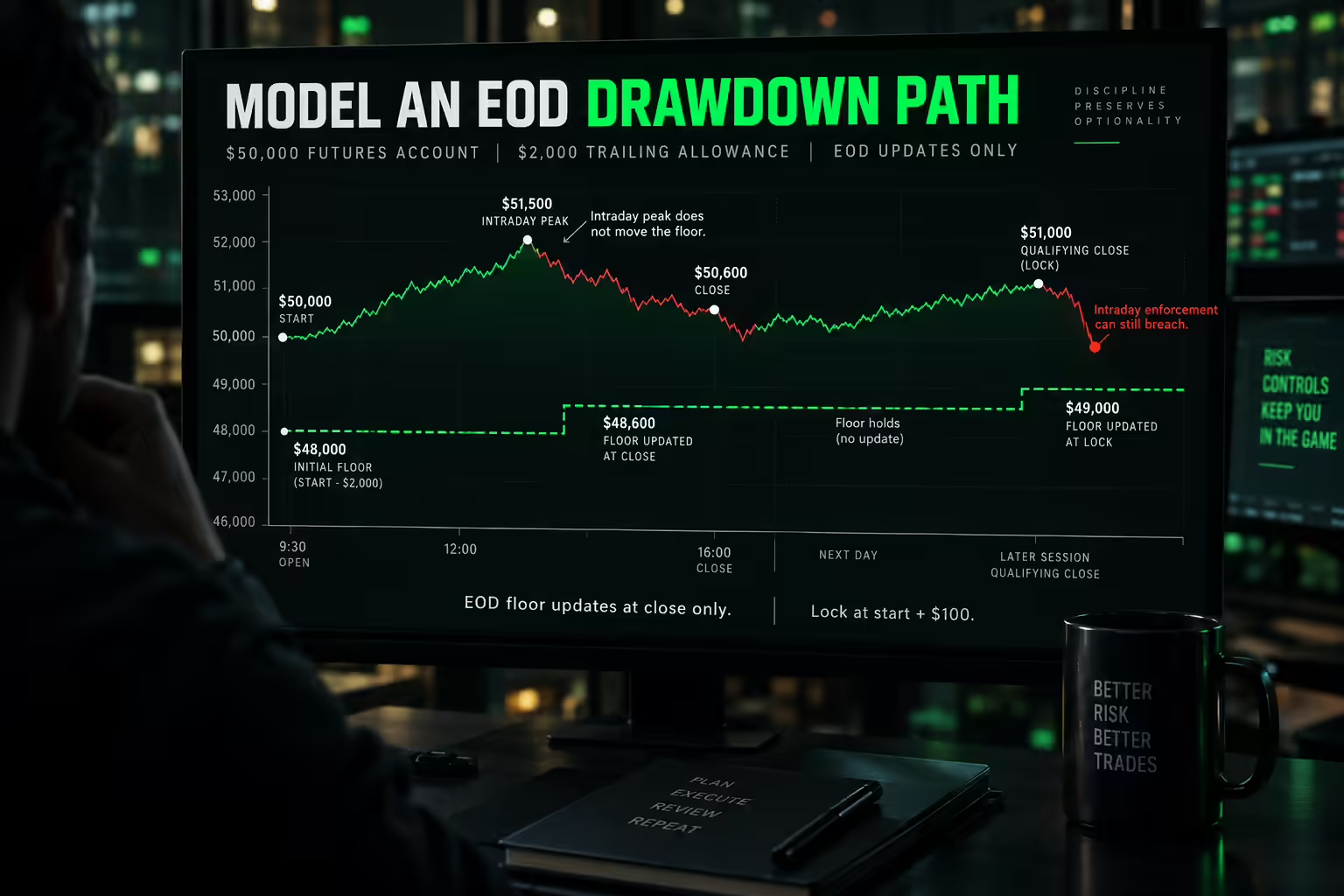
Consider a hypothetical $50,000 account with a $2,000 trailing allowance and no lock reached yet. Its initial floor is $48,000.
During the session, equity reaches $51,500, but the account closes at $50,600. Under a simplified EOD model based on the closing high, the next floor becomes $48,600.
Under an intraday equity-trailing model using the same allowance, the temporary $51,500 peak could have moved the floor to $49,500, subject to that program’s cap or lock rules.
The $900 difference illustrates why path matters. It does not mean the EOD account is free to lose $2,000 at any point regardless of its current floor.
If the next session’s open loss takes equity to the active failure line, intraday enforcement can still end the account. Use the exact firm formula for a real comparison.
A losing day does not move the trailing floor back down
Continue the hypothetical example with a floor of $48,600 after the $50,600 close. If the next session closes at $50,200 without an earlier breach, an upward-only trailing floor stays at $48,600. It does not fall to $48,200. Remaining room has shrunk to $1,600.
A later qualifying close at $51,000 would move the uncapped floor to $49,000 under the same $2,000 allowance. Once a program’s lock point is reached, apply that cap instead of continuing to subtract the allowance forever. This is why the highest qualifying close, the current equity, and the lock rule all belong in an account-risk worksheet.
Common EOD drawdown mistakes that lead to breaches
An EOD rule is easy to misread in ways that end an account. Check your plan against these errors before you trade it.
- Treating the close as the only checkpoint. The active floor can be enforced during the session, so an open loss that touches it may fail the account before the close.
- Measuring room from the starting balance. Remaining room is current equity minus the active floor, and it shrinks after a higher close is followed by a pullback.
- Assuming a red day resets the floor. An upward-only floor stays where the highest qualifying close put it.
- Buying the wrong plan variant. A similar plan name without “EOD” may use an intraday trailing method instead.
- Ignoring the lock point and payouts. A withdrawal can shrink your room when the floor stays fixed.
Before each session, write down the current floor, the remaining room, and the most you plan to lose that day. If the planned loss is close to the remaining room, reduce size first.
Compare EOD lock points and payout effects
Ask when the trailing floor stops rising. A lock at starting balance, starting balance plus a buffer, or a different funded-account reference creates different remaining room.
Then calculate what happens after a payout. If the withdrawal reduces the account balance while the floor stays fixed, usable risk room shrinks.
Suppose a hypothetical funded account has $3,200 of equity above its floor and withdraws $1,000 without moving that floor. It now has $2,200 of room before further costs or market movement.
A large eligible withdrawal is therefore not automatically the amount that leaves the strategy comfortably tradable. Keep payout eligibility and post-withdrawal risk separate.
Compare the rules surrounding EOD drawdown
Review the profit target relative to the allowed loss, consistency requirements, initial contract limits, scaling, trading hours, news permissions, and inactivity conditions.
An account with a favorable drawdown method may still require a trade distribution your strategy does not produce. A larger nominal account can also offer less usable risk per dollar of purchase cost than expected.
Check evaluation and funded rules side by side. Do not spend the entire comparison on the phase that ends when you pass.
If your strategy is automated or uses correlated positions, confirm that the activity itself is permitted. A compatible drawdown model does not override conduct rules.
Daily loss limits alongside EOD drawdown
Some plans add a daily loss limit on top of the EOD trailing floor. The two controls answer different questions: the daily limit caps one session’s loss, while the trailing floor sets the account’s overall failure line.
When both apply, the tighter one governs that session. Early on, the daily limit may stop you first; after a run of pullbacks, the trailing floor may sit closer than the daily limit.
Check what a daily limit breach triggers under the exact plan before you buy. A plan with no daily limit removes that stop, so your own per-session loss cap has to do the same job.
Tradeify Select for EOD drawdown and a funded-policy choice
Tradeify’s Select Evaluation guide describes EOD trailing drawdown and distinguishes Select Flex from Select Daily after qualification. The drawdown floor locks at starting balance plus $100 only after the profit threshold is exceeded or a payout is requested. Flex has no daily loss limit, while Daily adds a separate daily control.
Tradeify Select is a fit to consider when you want EOD drawdown and the ability to choose your funded payout policy after passing. Our Select Flex option suits traders who prioritize having no separate daily loss limit; Select Daily adds a daily control alongside its different payout conditions.
The choice is permanent for that funded account, so compare your typical losing session and intended withdrawals before selecting a policy. EOD drawdown does not permit you to touch the active loss floor intraday. Review Tradeify’s Select guide and both payout policies before purchasing.
Choose an EOD prop firm from the account’s full path
Replay representative sessions against each shortlisted rule set, including open losses, profitable closes, and withdrawals. Record where the account would pause, fail, or become ineligible.
Then compare total purchase costs and the practical restrictions you must follow. The best EOD account is the one whose complete rules fit a strategy you can execute consistently, with enough room for outcomes worse than your average backtest.
Frequently asked questions
What is end-of-day drawdown in a futures prop firm?
End-of-day drawdown is a trailing loss floor that updates from the account’s highest qualifying end-of-day value instead of intraday equity peaks. An open position that briefly reaches a new high does not move the floor by itself. The floor only rises after a profitable qualifying close.
Can you breach an end-of-day drawdown account during the session?
Yes. End-of-day describes when the floor updates, not when it is enforced. Many programs monitor the existing floor in real time, so unrealized losses that cross it can end the account even if price recovers before the close.
Is end-of-day drawdown better than intraday trailing drawdown?
It can leave more room when trades run into profit and pull back before closing. In a hypothetical $50,000 account with a $2,000 allowance, a $51,500 intraday peak and a $50,600 close leave the EOD floor at $48,600, compared with $49,500 under intraday trailing. The better choice still depends on the full rules, lock point, and payout effects.
Does My Funded Futures have an EOD drawdown?
According to the firm’s published rules, its Rapid EOD 25K plan uses EOD trailing drawdown in the simulated funded stage, with a $1,000 maximum-loss amount. The standard Rapid plan uses an intraday trailing method instead, so confirm the exact plan name before buying.
Does Topstep have a trailing drawdown?
According to the firm’s published rules, Topstep’s standard Trading Combine and Express Funded paths use a maximum-loss threshold that rises with end-of-day performance and is monitored in real time, including unrealized P&L. In the Express Funded Account, the floor locks at $0. Check the current rules for the exact account before purchase.