




TL;DR: CHoCH (change of character) is the first close against a trend through the swing that held it, and it is a warning, not a reversal. Across 79 ES and NQ 5-minute CHoCH breaks, 77.0% were closed back through within two hours. The useful filter was time: breaks still holding after six bars were stopped 9.5% of the time, versus 33.3% for contested ones. The structural stop is usually wider than the broken leg, so size from the stop, not the leg.
A CHoCH is the moment a trend stops behaving like itself. Price has been making higher highs and higher lows, and then one candle closes below the higher low that was holding the whole sequence together. The chart suddenly looks different, and the temptation is to flip your bias on the spot.
That is where most CHoCH trading goes wrong. The label describes a change in behavior, not a new trend. Most write-ups stop at the definition and a cleaned-up chart example. This guide gives you a marking rule you can repeat, the difference between CHoCH, BOS, MSS and CISD, and an original measurement of 79 CHoCH breaks on ES and NQ futures that shows how often the break held, when it failed, and where the stop really has to sit.
What CHoCH means in trading
CHoCH stands for change of character. It is a smart money concepts (SMC) and ICT term for the first candle close that breaks market structure against the current trend.
In an uptrend, a CHoCH is a close below the most recent higher low. In a downtrend, it is a close above the most recent lower high. That one swing point is the level the trend had to keep, so closing through it means the sequence of higher highs and higher lows, or lower highs and lower lows, has been interrupted at the smallest scale that counts.
Three things a CHoCH is not:
- It is not a confirmed reversal. A new trend needs a new sequence of swings in the other direction, and that comes later, if it comes at all.
- It is not a wick through a level. A wick is price testing the swing, not leaving it.
- It is not a break of any old swing. Only the swing that ended the latest leg qualifies.
The spelling trips people up because the acronym mixes cases. Traders usually write it CHoCH, with a lowercase o, so the letters read as CH-o-CH for "change of character". You will also see CHOCH and ChoCH. They all mean the same thing, and the name describes an observation rather than a conclusion: price has stopped behaving the way it was behaving.
Related lesson: Market structure highs lows and trends
Swing points and the protected level behind a CHoCH
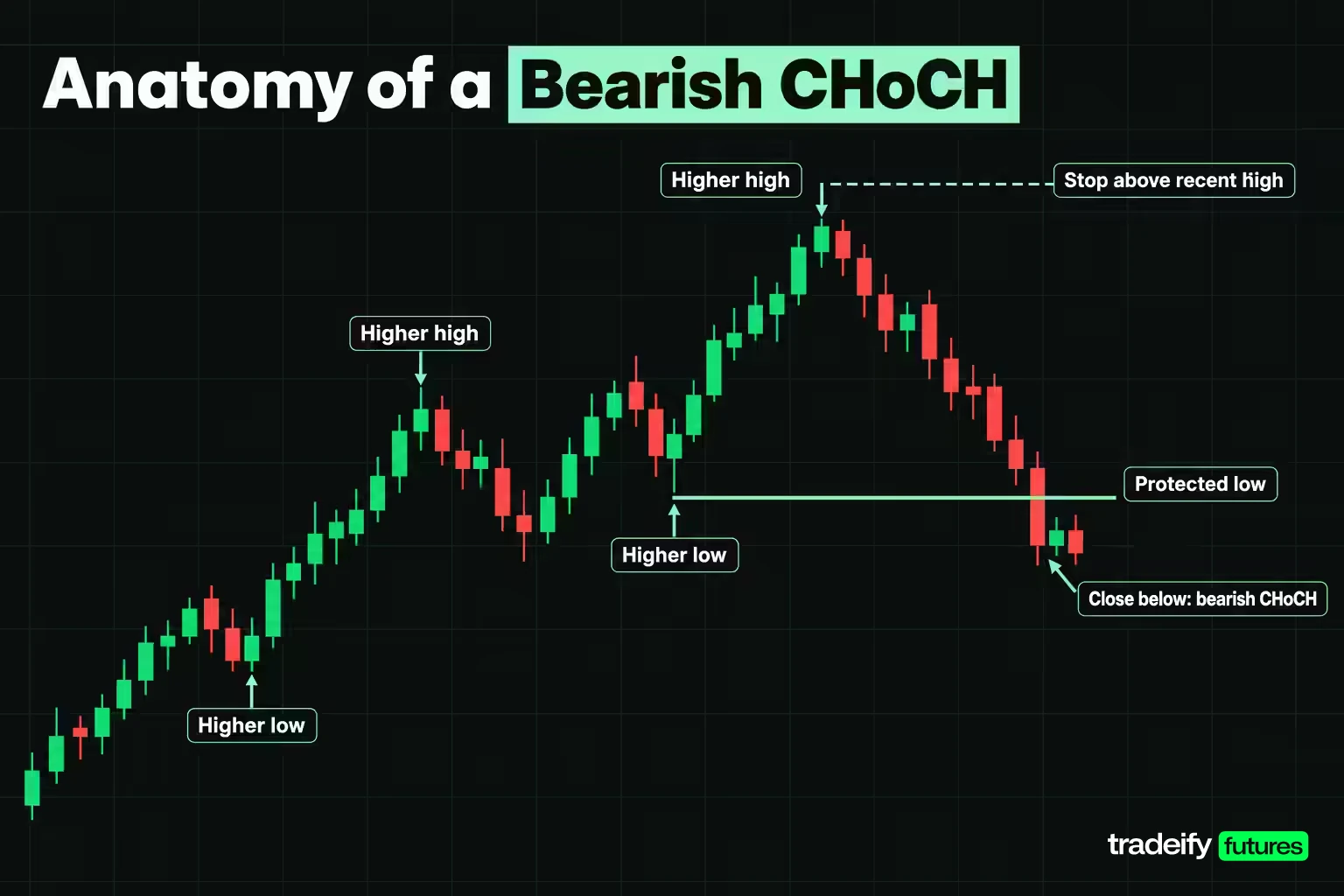
Every CHoCH depends on how you mark swings. If two traders use different swing rules, they will find different CHoCH events on the same chart and both feel right.
A common objective rule, and the one used in the study in this guide, is a 3-bar pivot:
- A swing high (pivot high) is a bar whose high is strictly higher than the highs of the three bars before it and the three bars after it.
- A swing low (pivot low) is the mirror: a low strictly lower than the three bars on each side.
- A pivot only becomes usable once the three bars after it have closed.
That last point is the one that gets skipped. On a finished chart every swing looks obvious. In real time, the low you want to call a swing may still be forming. On a 5-minute chart a 3-bar pivot is confirmed 15 minutes after the bar that made it. Any CHoCH rule that marks swings before they are confirmed is using information you did not have.
Which swing is the protected level
Traders call the swing a trend must keep the protected high or protected low. In an uptrend it is the higher low that launched the most recent higher high. In a downtrend it is the lower high that launched the most recent lower low.
Only that swing can produce a CHoCH. If you keep drawing older swing lows as candidates, every pullback breaks something and the signal turns into noise. When a newer higher low is confirmed, the protected level moves up to it and the older one stops mattering.
Bullish and bearish CHoCH patterns
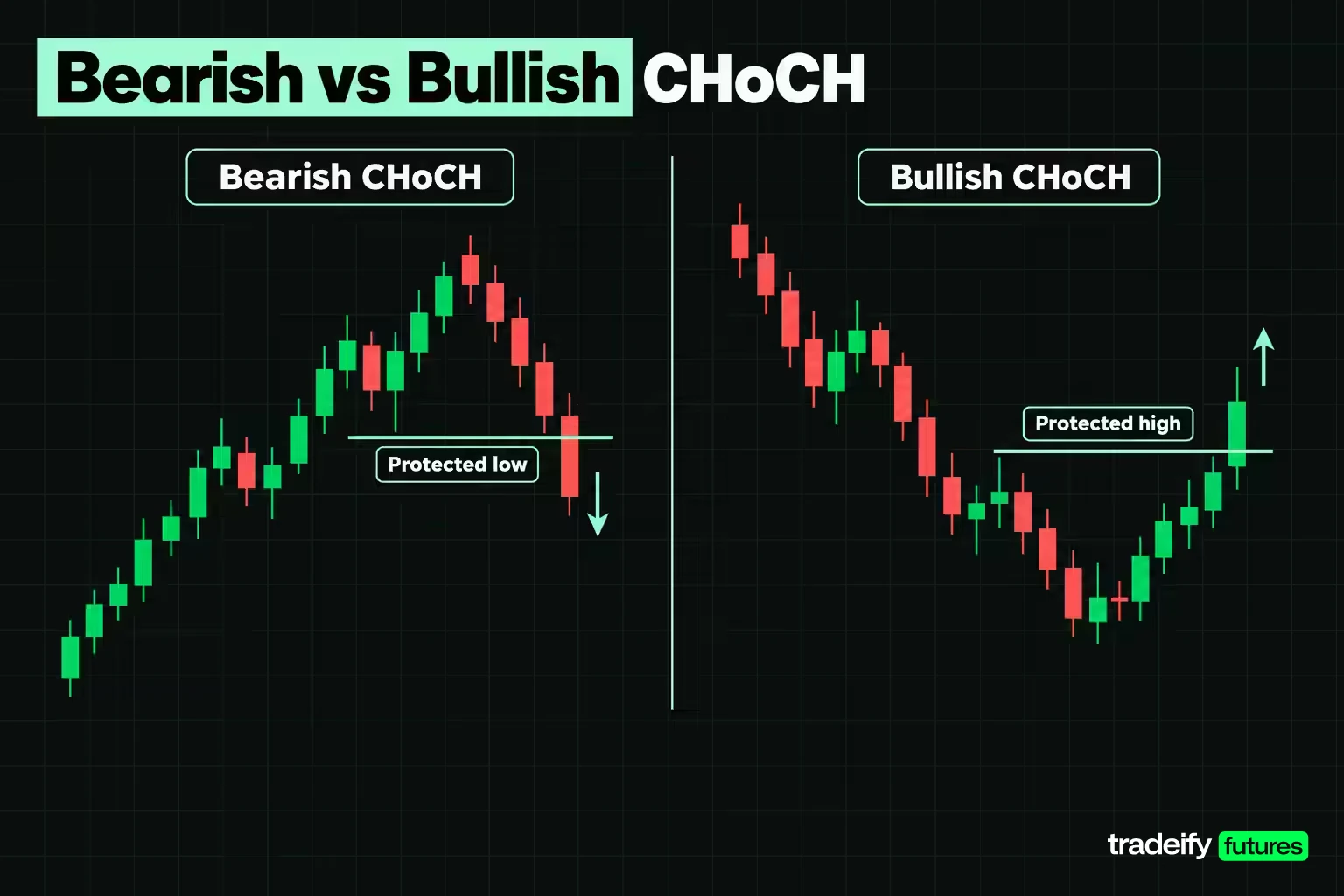
A bearish CHoCH forms inside an uptrend, and a bullish CHoCH forms inside a downtrend. The mechanics are mirror images.
A bearish CHoCH, step by step:
- Price makes at least two higher highs and two higher lows, so the trend is up.
- The most recent higher low becomes the protected low.
- A candle closes below that protected low. That close is the bearish CHoCH.
- The view is invalidated if price closes back above the broken low, which is called a reclaim.
A bullish CHoCH, step by step:
- Price makes at least two lower highs and two lower lows, so the trend is down.
- The most recent lower high becomes the protected high.
- A candle closes above that protected high. That close is the bullish CHoCH.
- The view is invalidated if price closes back below the broken high.
| Feature | Bearish CHoCH | Bullish CHoCH |
|---|---|---|
| Trend before the break | Higher highs and higher lows | Lower highs and lower lows |
| Level that breaks | Most recent higher low | Most recent lower high |
| Confirmation | Candle close below the level | Candle close above the level |
| Invalidation | Close back above the level | Close back below the level |
| Natural structural stop | Above the recent high | Below the recent low |
| What it does not prove | That a downtrend has started | That an uptrend has started |
In this guide's ES and NQ 5-minute CHoCH study, both directions showed up in similar numbers: 39 bullish and 40 bearish events across ES and NQ combined, with no direction holding reliably better than the other once both instruments were included.
CHoCH vs BOS
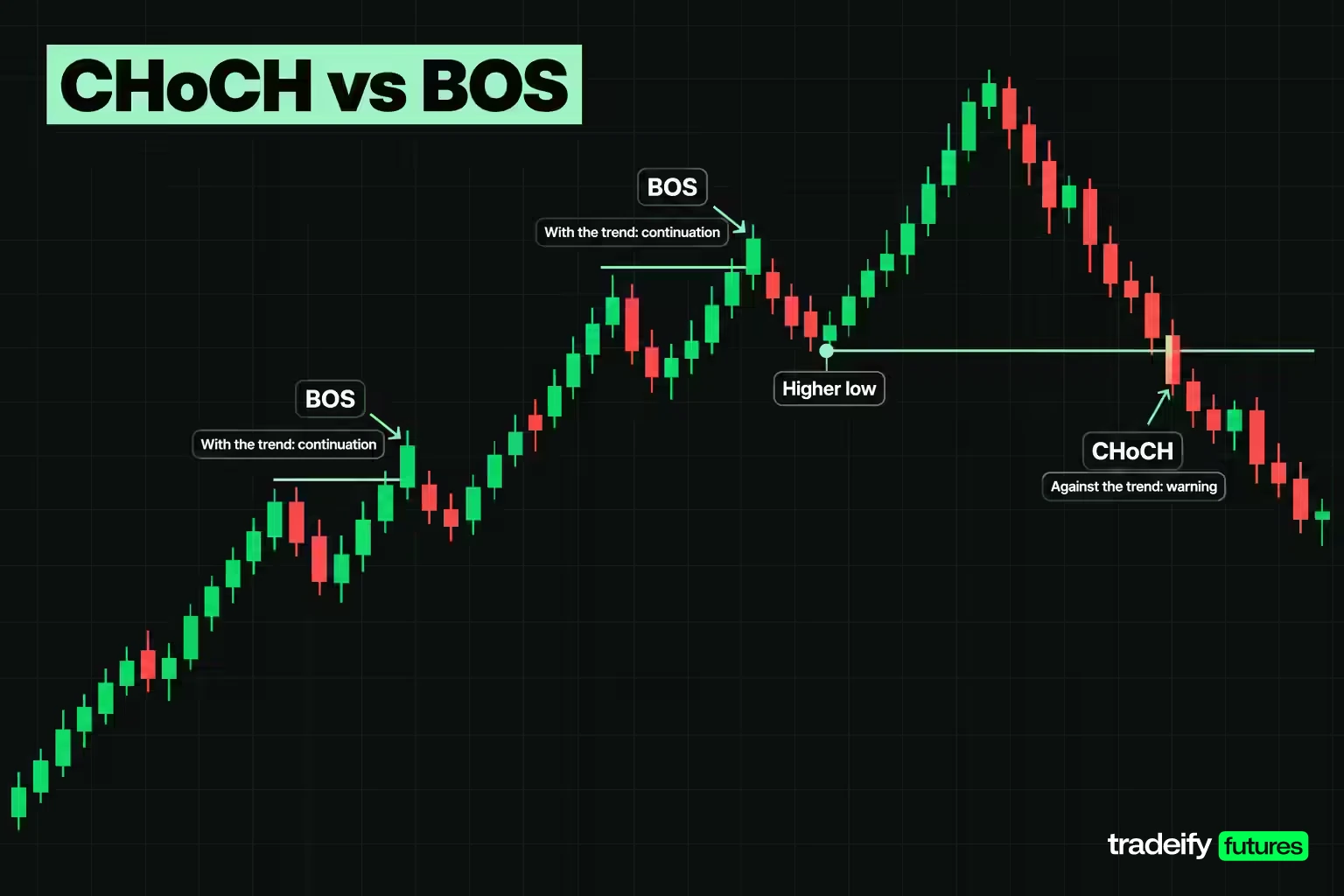
A break of structure (BOS) and a CHoCH are the same mechanical event, a candle close through a confirmed swing, pointed in opposite directions.
- A BOS breaks a swing on the trend side. In an uptrend that is a close above the previous swing high, which says the trend is still intact.
- A CHoCH breaks the protected swing on the counter-trend side. In an uptrend that is a close below the most recent higher low, which says the trend has been interrupted.
If you are unsure which one you are looking at, ask which side of the trend the broken swing sat on. A trend usually prints several BOS events and then one CHoCH, and the CHoCH is often the first BOS of a possible new trend seen from the other side.
| Question | BOS | CHoCH |
|---|---|---|
| Direction of the close | With the trend | Against the trend |
| Swing that is broken | Last swing high in an uptrend, last swing low in a downtrend | Protected higher low in an uptrend, protected lower high in a downtrend |
| What it suggests | Continuation | Possible reversal or deeper pullback |
| How often it appears | Several times per trend leg | Once per trend, at the end |
| Typical use | Join or hold a trend | Stop adding to the old trend and start watching for a new one |
| Main failure mode | Breakout that gets closed back inside | Break that gets reclaimed and the old trend resumes |
Related lesson: Break of structure bos
CHoCH vs MSS and CISD
Market structure shift (MSS) and change in the state of delivery (CISD) are the two other labels that sit close to a CHoCH, and neither has a single agreed definition.
Market structure shift is used two ways:
- Some traders use MSS for any break of a swing point, which makes it broader than a CHoCH.
- Others, especially in ICT teaching, use MSS for a CHoCH that comes with displacement: a fast, large-bodied move that leaves a fair value gap (a three-candle imbalance) behind. That version is narrower and arrives later than a plain CHoCH.
Change in the state of delivery is more mechanical. It is usually defined as a candle body closing through the opening price of the run of same-direction candles that pushed into the extreme. That makes it a candle level, not a swing level, so it often fires a few candles before a CHoCH would.
None of these labels has an official owner, which is why two pages can use identical words for different events. The fix is boring and it works: write one definition for each term in your trading plan and apply it the same way every time. A measured base rate only means something when the definition was fixed before the events were counted.
Related lesson: Ict trading concepts explained
Internal and external structure in CHoCH analysis
Market structure has layers, and a CHoCH means very different things depending on which layer it breaks.
- External structure is the major swing sequence, the highs and lows that define the bigger trend on your chart. An external CHoCH breaks the protected swing of that main leg.
- Internal structure is the smaller swing sequence inside one external leg, usually a pullback. An internal CHoCH breaks a minor swing inside that pullback.
Here is why it matters. During a pullback in an uptrend, price makes its own small lower highs and lower lows. When the pullback ends, the first close above a minor lower high is an internal bullish CHoCH. That is often the signal that the larger uptrend is resuming, not that anything reversed.
So the same label can mean "the trend is over" on the external layer and "the trend is back" on the internal layer. Before you act on any CHoCH, name which layer it broke. A bearish internal CHoCH inside a bullish external trend is a pullback warning, and treating it as a full reversal is one of the most expensive mix-ups in this topic.
Body close vs wick break for a CHoCH
A CHoCH is confirmed by a candle close beyond the protected level, not by a wick.
The reason is practical. A wick through a swing low shows that price traded there and got pushed back. That is a liquidity sweep: resting stop orders under the low get triggered, and the bar closes back above. A sweep is a different event with a different job, and it often happens right before the old trend continues.
Data from this guide's own CHoCH study (Yahoo Finance ES and NQ 5-minute bars, August 27 to November 4, 2026) adds a useful twist. During trends, there were 35 wick-only probes of the protected level, where a bar traded through it and closed back on the trend side. In 25 of those 35, or 71.4%, price did close through the same level within the next 24 bars. So a wick is not a CHoCH, but it is often a warning that one is coming. Mark the probe, do not trade it as the break, and wait for the close.
Some traders also require displacement, a strong full-bodied candle, rather than any close. That makes the rule stricter and fires less often. It is a reasonable filter, as long as you define "strong" in numbers (for example, a body at least as large as the recent average range) rather than by eye.
Related lesson: Liquidity sweeps and stop runs
How the CHoCH study was measured
The CHoCH base rates in this guide come from one fixed rule set applied to ES and NQ futures price data, so you can reproduce them on your own charts. This is an illustrative study, not a backtest.
CHoCH study data and sessions
- Instruments: E-mini S&P 500 (ES) and E-mini Nasdaq-100 (NQ) continuous front-month futures, 5-minute bars from Yahoo Finance.
- Window: 48 regular-hours sessions per instrument, August 27 to November 4, 2026, which is 3,742 bars each.
- Regular hours: bars stamped 9:30 AM to 3:55 PM ET, so the 9:30 AM to 4:00 PM New York session.
- Exclusions: September 14, 2026 was dropped because the continuous series rolled from the September to the December contract mid-session. One corrupted 3:00 PM bar on October 30, 2026 was dropped in both markets.
- Each session was processed on its own, so swings did not carry across the overnight gap.
CHoCH detection rule used in the study
- Swings: the 3-bar pivot rule, usable only three bars after they form.
- Trend: up when the two latest usable swing highs and the two latest usable swing lows both rise, down when both fall, otherwise no trend.
- Event: a bearish CHoCH is a close below the latest usable swing low while the trend is up. A bullish CHoCH is the mirror.
- After each event the swing history resets, so a run of closes beyond one level counts once.
CHoCH outcomes recorded after each break
- A forward window of the next 24 bars (two hours), cut at the session close. Events with fewer than 12 bars left count in the totals but not in the outcome figures.
- Reclaim: the first close back on the original side of the broken level.
- Trade frame: entry at the CHoCH bar close, stop at the extreme of the 12 bars before it, risk (1R) as the distance between them.
- Broken leg: the distance from the broken swing to the latest opposite swing, the leg the CHoCH retraced.
Two limits belong up front. No fills, slippage, commissions or position sizing are modelled, and every dollar figure is arithmetic on price, not a trading result. The sample is two closely related index futures over about ten weeks in one market regime, so treat every number as a description of that window, not a forecast.
How often a CHoCH break holds
Most CHoCH breaks in this guide's own study (Yahoo Finance ES and NQ 5-minute bars, August 27 to November 4, 2026) did not become the new trend. That matters, because the CHoCH candle is exactly where it feels safest to flip your bias and press. The rule found 79 events, 34 on ES and 45 on NQ. Of the 61 events with enough session left to score, 47 were reclaimed within 24 bars. That is 77.0%.
In that CHoCH study the reclaim usually came fast. The median reclaimed event closed back through the level on bar 2, ten minutes after the break.
CHoCH reclaim and stop rates by market and direction, from this guide's ES and NQ 5-minute study:
| Group | Scored events | Reclaimed within 24 bars | Reclaim rate | Structural stop hit |
|---|---|---|---|---|
| ES bullish CHoCH | 13 | 9 | 69.2% | 23.1% |
| ES bearish CHoCH | 11 | 8 | 72.7% | 9.1% |
| NQ bullish CHoCH | 16 | 13 | 81.2% | 25.0% |
| NQ bearish CHoCH | 21 | 17 | 81.0% | 47.6% |
| All events | 61 | 47 | 77.0% | 29.5% |
Two things stand out in those CHoCH results. Reclaim does not mean stopped out: the structural stop was hit in 29.5% of scored events, far fewer than the 77.0% that closed back through the level. Many CHoCH breaks wobbled back across the line and then carried on, which is exactly why a reclaim alone is a poor exit rule and why the timing of the reclaim matters.
And NQ bearish CHoCH breaks were the roughest group in the study window, with the stop hit on 47.6% of them. With 21 events, that is a description of ten weeks, not a trait of NQ.
How the swing rule changes CHoCH counts
CHoCH base rates depend on the swing rule, so this guide's study re-ran its ES and NQ 5-minute data with two other pivot lengths. Using the same code with a faster 2-bar pivot found 122 events, 97 scored, with 75.3% reclaimed. A slower 5-bar pivot found 41 events, 26 scored, with 92.3% reclaimed. No version came close to a low reclaim rate, so the core finding is not an artifact of the 3-bar choice.
Related lesson: Backtesting a trading strategy
Filtering false CHoCH signals with a six bar checkpoint
If most CHoCH breaks get closed back through at some point, the break itself cannot be the whole decision. What happens next carries the information, and in this sample one checkpoint split the outcomes cleanly: did price close back through the level within six bars, half an hour on a 5-minute chart?
In this guide's ES and NQ 5-minute study, events needed at least 18 bars left in the session to test this, which left 54. Three were stopped out inside the first six bars and are counted separately. The other 51 split into two groups.
| Six bar CHoCH checkpoint | Events | Stopped after bar 6 | Average result at window end | Median best move after bar 6 |
|---|---|---|---|---|
| Level still holding at bar 6 | 21 | 9.5% | +0.655R | 0.98R |
| Already reclaimed by bar 6 | 30 | 33.3% | -0.17R | 0.26R |
The split held on both instruments. On ES, breaks still holding at bar 6 were stopped 8.3% of the time and averaged +0.415R, against 30.0% and -0.122R for contested ones. On NQ the holding group was stopped 11.1% of the time and averaged +0.974R, against 35.0% and -0.194R.
Results are in R, measured from the CHoCH bar close to the last close of the 24-bar window, with a stopped event counted as -1R. Small groups, no costs, one regime.
How to use the checkpoint
The checkpoint is a keep-or-cut rule, not a prediction. It exists to answer the question that causes the most damage after a CHoCH: the level just got reclaimed, so do you give it room or admit the read was early? Decide that before the trade, not while the position is red.
Read it like this:
- If price closes back through the broken level within six bars, the CHoCH is contested. In this sample, staying in through that had a negative average. Cutting early or never entering is the measured default.
- If the level is still intact after six bars, the break is uncontested so far. That group had a positive average, but 9 of its 21 events still closed back through the level later in the window. Holding is not the same as winning.
One caution matters. The figures assume entry at the CHoCH bar close and then a decision at bar 6. Waiting until bar 6 to enter is a different trade with a different price, and this study did not measure it.
Break size is a weak CHoCH filter
The intuitive filter is that a big, decisive break beats a marginal one. In this sample, it barely mattered.
| CHoCH close beyond the level | Scored events | Reclaimed | Reclaim rate |
|---|---|---|---|
| 1 tick | 1 | 1 | 100.0% |
| 2 to 7 ticks | 17 | 13 | 76.5% |
| 8 to 15 ticks | 9 | 7 | 77.8% |
| 16 to 31 ticks | 14 | 10 | 71.4% |
| 32 ticks or more | 20 | 16 | 80.0% |
In this guide's ES and NQ study, CHoCH breaks of 32 ticks or more were reclaimed 80.0% of the time, no better than small ones. The widest break in the study, 383 ticks on NQ on October 8, 2026, did hold, but it was one event. Waiting for a dramatic candle mostly makes your stop wider. Time after the break was a better filter than distance.
Confluence and context for a CHoCH
A CHoCH in the middle of a range has no location reason behind it. Location and context decide whether a CHoCH deserves your attention.
Filters that give a CHoCH more weight:
- Higher timeframe location. A bearish CHoCH at a higher timeframe supply zone, an old high, or a resistance level makes more sense than one in the middle of a range.
- Premium and discount. In SMC terms, a bearish CHoCH in the upper half of the recent range (premium) or a bullish one in the lower half (discount) is better placed than the reverse.
- A liquidity sweep first. A sweep of an obvious high followed by a bearish CHoCH tells a coherent story: stops above the high were taken, then the protected low failed.
- Displacement and an imbalance. A CHoCH candle that leaves a fair value gap behind shows urgency, and the gap gives you a defined pullback area.
Filters that should make you skeptical:
- The CHoCH breaks against a strong higher timeframe trend with no location reason.
- The break happens in a tight, overlapping range where swings are tiny.
- The structural stop is wider than your plan allows. Then the setup is not tradeable at your size, whatever it looks like.
Session timing and news around a CHoCH
Timing affects a CHoCH in two ways, and this guide's own CHoCH study (Yahoo Finance ES and NQ 5-minute bars, August 27 to November 4, 2026) shows both.
First, a rule that needs two swings each way cannot fire early. With per-session swings, the first CHoCH in the sample came at 10:55 AM ET. Only 1 of the 79 events fired before 11:00 AM ET, 45 fired between 11:00 AM and 1:59 PM ET, and 33 fired at 2:00 PM ET or later. If you use a CHoCH rule that seems to trigger at the open, check whether it is reading yesterday's swings.
Second, CHoCH reclaim rates in that study moved a little by time of day: 70.0% for scored events before noon (10 events), 80.6% from 12:00 PM to 1:59 PM ET (36 events), and 73.3% after 2:00 PM ET (15 events). The midday group, often the slowest part of the session, was reclaimed most often, though the groups are too small to lean on.
Scheduled news is the other timing risk. A data release such as CPI or an FOMC statement can produce a CHoCH-shaped candle in seconds that says more about the headline than about structure. Know the calendar before the session and decide in advance whether you trade structure breaks around releases at all.
Related lesson: Trade setups and confirmation
Multi-timeframe CHoCH analysis
The CHoCH rule is fractal. It works the same way on a 1-minute chart and a daily chart, but the meaning of the signal changes with the timeframe.
A common top-down routine:
- Higher timeframe (for example 1-hour or 4-hour): define the external trend and mark the zone where a reversal would make sense.
- Middle timeframe (for example 15-minute): wait for price to reach that zone.
- Lower timeframe (for example 1-minute to 5-minute): use a CHoCH as the trigger that price is starting to respect the zone.
The appeal is a tighter stop. A lower timeframe CHoCH inside a higher timeframe zone lets you define risk on small swings while the thesis comes from the bigger chart. The cost is more false signals: lower timeframes print far more CHoCH events, and many of them are just internal noise.
Alignment is the useful idea. A 5-minute bearish CHoCH inside a 1-hour supply zone during a 1-hour downtrend has the timeframes pointing the same way. The same 5-minute CHoCH against a strong 1-hour uptrend is an internal pullback signal until the 1-hour chart says otherwise.
Measured rates do not transfer between timeframes either. With a 3-bar pivot, a 5-minute chart confirms a swing 15 minutes after it forms, while a daily chart confirms the same rule three days later. The base rates in this guide are 5-minute regular-hours figures. Re-measure before you carry them to a different chart.
Related lesson: Multiple timeframe analysis
CHoCH entry triggers and a trading plan
A CHoCH tells you when to start paying attention. The entry is a separate decision, and there are three common ways to make it.
| CHoCH entry method | Entry | Upside | Downside |
|---|---|---|---|
| Break close | At the close of the CHoCH candle | Never misses a move that runs | Takes every break, including the ones reclaimed on bar 2 |
| Pullback to the broken level or imbalance | Limit order at the broken level or inside the fair value gap | Better price and smaller risk | Strong moves often never pull back, so you miss them |
| Checkpoint confirmation | After the level holds for a set number of bars | Filters the fast reclaims | Worse price and a wider gap to the stop |
None of these is right in every market. If you miss the break close, the price ten bars later is not the same entry at a worse fill. It is a new trade with a new stop distance, and it needs its own math.
The point is to pick one method before the session and stop switching after each loss. A trader who uses break-close entries on Monday, pullback entries on Tuesday and checkpoint entries on Wednesday has three tiny samples and no strategy.
A real-time CHoCH checklist
- Mark the trend state: two swing highs and two swing lows in the same direction. No trend, no CHoCH.
- Mark the protected swing, the most recent higher low or lower high. Ignore older swings.
- Note the higher timeframe location. Is the break happening somewhere that makes sense?
- Wait for a close beyond the protected level. A wick is a probe.
- Measure the structural stop before you enter. If it is wider than your plan allows, skip the trade.
- Compare the broken leg with the stop distance. If the leg is smaller, a target at one leg is less than 1R.
- Set the six bar checkpoint. A close back through the level inside it is your cue to cut or stand aside.
- Write down the invalidation, the reclaiming close, and act on it rather than on a feeling.
Related lesson: Smart money concepts smc complete guide
Stop loss and profit target placement for CHoCH trades
The stop that makes structural sense on a CHoCH is wider than most traders expect. The urge is to tuck the stop a few ticks beyond the broken level, because it keeps the dollar risk small and looks precise. The trouble is that a tight stop there sits right inside the zone the market is still arguing about.
Using this guide's own CHoCH study (Yahoo Finance ES and NQ 5-minute bars, August 27 to November 4, 2026), the stop question can be answered with data: how far price traded back through the broken level within 24 bars, and how often a stop at each distance beyond the level would never have been touched.
| Stop distance beyond the broken level | ES events survived | NQ events survived | All events survived |
|---|---|---|---|
| 8 ticks | 33.3% | 16.2% | 23.0% |
| 16 ticks | 45.8% | 16.2% | 27.9% |
| 32 ticks | 50.0% | 21.6% | 32.8% |
| 64 ticks | 91.7% | 29.7% | 54.1% |
| 128 ticks | 100.0% | 37.8% | 62.3% |
| 256 ticks | 100.0% | 62.2% | 77.0% |
In that CHoCH stop data, the two markets are not on the same scale. NQ trades around four times as many index points as ES, so the same tick distance is a much tighter stop on NQ. On ES, a stop 64 ticks (16 points) beyond the level survived 91.7% of events. On NQ, even 256 ticks (64 points) survived only 62.2%.
In the same ES and NQ study, the structural stop, the extreme of the 12 bars before the CHoCH, survived 70.5% of scored events (83.3% on ES, 62.2% on NQ). The median distance from entry to that stop was 63 ticks on ES and 325 ticks on NQ.
Why a leg-sized CHoCH target is smaller than your risk
The broken leg looks like a natural measuring stick for a CHoCH target. In this guide's ES and NQ 5-minute study it was almost always shorter than the stop.
- In 73 of 79 events, the broken leg was at or below the structural stop distance.
- The median leg was 0.91 of the stop on ES (55 ticks against 63) and 0.88 on NQ (273 ticks against 325).
- The median continuation beyond the level was 55 ticks on ES and 206 ticks on NQ, about 0.76 to 0.78 of the broken leg.
- Only 41.0% of scored events traveled a full leg beyond the level.
Measured against the actual stop in that study, the best move before any stop hit reached 0.5R in 55.7% of scored events, 1R in 32.8%, 1.5R in 18.0%, 2R in 9.8% and 3R in 3.3%.
So a target at one broken leg is, on average, a target below 1R before costs. That does not make CHoCH trades untradeable. It means the reward-to-risk math has to use the stop you can actually carry, not the leg that looks tidy on the chart.
CHoCH position sizing in dollars
Contract specs turn those tick distances into money. ES is $50 per index point, so one 0.25-point tick is $12.50; MES is $5 per point ($1.25 per tick). NQ is $20 per point ($5.00 per tick); MNQ is $2 per point ($0.50 per tick).
- The median ES structural stop of 63 ticks is $787.50 on one ES, or $78.75 on one MES.
- The median NQ structural stop of 325 ticks is $1,625 on one NQ, or $162.50 on one MNQ.
Imagine a trader whose plan caps risk at $500 per trade. One NQ at the median stop does not fit, but 3 MNQ ($487.50) does. On ES, 6 MES ($472.50) fits where one ES does not. Size from the stop first, then decide whether the setup is still worth taking.
On our accounts, every position must be closed by 4:45 PM ET, and position size is set by contract limits rather than margin: a 50K account allows up to 4 minis or 40 micros, and 10 micros count as one mini. A Growth 50K evaluation also has a $1,250 daily loss limit. One full NQ at the median structural stop of $1,625 would exceed that limit in a single trade, so on that account micro contracts are the realistic way to take a CHoCH with a structural stop.
Related lesson: Stop loss orders and placement
ES and NQ CHoCH trades printed bar by bar
Here are four real CHoCH events from this guide's ES and NQ 5-minute study (August 27 to November 4, 2026), with every number shown. Entry is the CHoCH bar close and the stop is the extreme of the 12 bars before it. These are price records from the measurement, not trades anyone placed.
| CHoCH trade record | ES held | ES failed |
|---|---|---|
| Date and time (ET) | August 28, 2026, 11:35 AM | October 20, 2026, 1:50 PM |
| Direction | Bearish | Bullish |
| Protected level broken | 7,767.25 | 7,766.25 |
| Entry (CHoCH close) | 7,765.75 | 7,767.50 |
| Structural stop | 7,782.50 | 7,749.50 |
| Risk | 67 ticks, $837.50 per ES | 72 ticks, $900 per ES |
| Broken leg | 61 ticks | 67 ticks |
| Reclaim | Never closed back above the level | Closed back below on the next bar, 7,764.00 |
| Stop | Not touched | Hit on bar 10, low 7,748.75 |
| Result at window end | +50.00 points, 2.99R, $2,500 per ES | -1R, -$900 per ES before slippage |
The ES CHoCH that held
The ES bearish CHoCH on August 28, 2026 at 11:35 AM ET is the clean case. Price closed 1.50 points below the protected low at 7,767.25 and never closed back above it. The next bar's high was 7,766.00, just under the level. The low of the window, 7,711.75, was 222 ticks beyond the broken level, and the position marked +50.00 points two hours later. On MES the same move was $250 against $83.75 of risk.
The ES CHoCH that failed
The ES bullish CHoCH on October 20, 2026 at 1:50 PM ET is more instructive. Price closed at 7,767.50, 5 ticks above the protected high at 7,766.25, with a structural stop at 7,749.50. One bar later it closed back below at 7,764.00, so the CHoCH was contested by bar 1. Price drifted lower and hit the stop at bar 10. A six bar checkpoint, which treats any close back through the level within six bars as a contested break, would have flagged it long before the stop.
NQ CHoCH trades that held and failed
NQ CHoCH events from the same ES and NQ study showed the same held-or-failed split at bigger numbers. A bearish CHoCH on August 28, 2026 at 11:35 AM ET broke a protected low at 29,735.25, entered at 29,721.75 with a stop at 29,811.50. That is 359 ticks of risk, $1,795 per NQ or $179.50 per MNQ. It never closed back above the level and finished 257.25 points lower, 2.87R, or $5,145 per NQ.
A bearish CHoCH on October 28, 2026 broke a protected low at 29,832.75, entered at 29,817.75, 60 ticks beyond the level, with a stop at 29,920.50: 411 ticks of risk, $2,055 per NQ or $205.50 per MNQ. It closed back above the level on the next bar and hit the stop on bar 13. A large break did not protect it.
Nothing on the entry bar separated the winners from the losers, and that is the uncomfortable lesson. Both ES events were small closes through a confirmed protected level inside regular hours with a sensible structural stop. The difference showed up in the bars after the CHoCH.
Common CHoCH trading mistakes
Most CHoCH losses come from a short list of repeat errors. Each one has a concrete fix, and the evidence column draws on this guide's ES and NQ 5-minute CHoCH study.
| CHoCH mistake | Why it hurts | Fix |
|---|---|---|
| Treating every CHoCH as a reversal | In this guide's ES and NQ study, 77.0% of CHoCH breaks were reclaimed within two hours | Treat the CHoCH as a warning and wait for evidence the level holds |
| Marking unconfirmed swings | The swing you broke may not have existed yet in real time | Only use swings whose confirmation bars have closed |
| Breaking an old swing | Every pullback becomes a signal | Use only the protected swing that ended the latest leg |
| Calling a wick a CHoCH | A wick through the level is a probe or a sweep | Require a candle close beyond the level |
| Mixing internal and external structure | A pullback signal gets traded as a trend reversal | Name the layer before acting |
| Stop just beyond the level | Small stops near the level rarely survived in the sample | Use a structural stop and size down to fit it |
| Target of one broken leg | The leg was smaller than the stop in 73 of 79 events | Set targets in R from the real stop |
| Holding a contested break | Breaks reclaimed by bar 6 averaged -0.17R | Use a time checkpoint as a cut rule |
| Ignoring timing and news | Releases can print structure breaks that are pure headline | Check the calendar and session before trading |
| Changing definitions after losses | No sample ever gets large enough to judge | Fix one rule set and journal it |
The last mistake is the quiet one. If the definition changes every week, you never find out whether the setup works for you. Write the rule down, log each CHoCH you see, and review the sample after 30 or 40 events, not after three.
Related lesson: How to keep a trading journal
CHoCH FAQ
What does CHoCH stand for?
CHoCH stands for change of character. It is usually written with a lowercase o, CHoCH, though CHOCH and ChoCH are also common. It describes the first close against a trend through the swing point that was holding that trend together.
What is CHoCH trading?
CHoCH trading means using a change of character as a signal to stop following the old trend and start looking for a reversal setup. Most traders pair the CHoCH with location, such as a higher timeframe zone, and a separate entry trigger. The CHoCH itself is a warning, not an entry by itself.
Does a wick count as a CHoCH?
No. A CHoCH needs a candle close beyond the protected level. A wick through the level is a probe or a liquidity sweep, and in this guide's ES and NQ study it was often followed by a real close-through, so it is worth marking but not trading as the break.
Is a CHoCH a reversal signal?
It is an early warning that a reversal may be starting, not proof. In this guide's ES and NQ 5-minute study, 77.0% of CHoCH breaks were closed back through within 24 bars. A reversal is confirmed only when price builds a new sequence of swings in the other direction.
Which timeframe is best for CHoCH?
There is no single best timeframe. Higher timeframes give fewer, slower signals with wider stops, and lower timeframes give more signals with more noise. Many traders read the trend and zone on a higher timeframe and use a lower timeframe CHoCH as the trigger.
What is the difference between CHoCH and BOS?
A BOS breaks a swing in the direction of the trend and suggests continuation. A CHoCH breaks the protected swing against the trend and suggests the trend may be ending. They are the same type of close-through event pointed in opposite directions.
Futures trading uses leverage, and losses can exceed what you expect or the amount you deposit. Every figure in this guide is an arithmetic measurement of past price data on two index futures over about ten weeks; it models no fills, slippage or commissions and is not a forecast or a performance claim. Evaluation and funded accounts at prop firms are simulated. Nothing here is investment advice or a recommendation to trade any instrument.


