



TL;DR: Scalping futures means taking a few ticks at a time, so round-turn cost and bar noise decide whether a setup can pay. At an assumed $4.00 round turn, a 4-tick ES target with a 2-tick stop needs a 38.67% win rate. The same bracket on MNQ at $1.00 needs 66.67%, because cost takes half the target. Size targets to each contract's typical bar, favour the 9:30 AM to noon ET window, and set daily loss caps first.
Scalping futures means opening and closing a futures position within seconds to a few minutes to capture a small move, then doing it again. The appeal is easy to see. Small targets get hit often, and you are rarely exposed for long.
The catch takes longer to show up. A scalp target is small enough that the fixed cost of each round turn and the random width of a one-minute bar can decide the result before your read of the market does. It can take a few hundred trades to notice, usually when a win rate that feels good still leaves the account flat. This guide to scalping futures starts with that arithmetic, then covers contracts, strategies, indicators, tools, timing, risk and the habits that end most scalping attempts.
What Scalping Futures Means and Who It Suits
Scalping futures is a short-holding style. A scalper enters for a target of a few ticks, keeps a stop of similar or smaller size, and closes the trade within seconds or minutes. A day trader might hold for an hour and aim for a session's range; a scalper wants a slice of the next push and nothing more.
Futures suit the style for structural reasons. Each contract trades on one central exchange order book, so every participant sees the same best bid and offer. Price moves in fixed ticks with fixed dollar values: on the E-mini S&P 500 (ES) one tick is 0.25 index points, worth $12.50. And CME Globex equity index futures trade from Sunday 6:00 PM to Friday 5:00 PM ET, with a daily maintenance break from 5:00 PM to 6:00 PM ET, so there is activity to work with outside stock-market hours.
Scalping futures tends to suit traders who:
- Can watch a screen without interruption for the whole window they trade.
- Make decisions fast and accept being wrong many times a day without arguing with the market.
- Track their costs and results in a journal, because the edge in scalping is measured in fractions of a tick.
Scalping futures tends to punish traders who need time to think through each entry, who cannot sit out a quiet market, or who treat a missed move as a reason to chase.
Is scalping futures legal
Scalping a futures contract is legal. The word has a separate legal meaning in securities law that sometimes confuses searchers. The SEC describes illegal "scalping" as recommending that others buy a security while secretly selling that same security against the recommendation, and it brought a fraud case on exactly that pattern in 2006. Holding a futures contract for ninety seconds has nothing in common with that offence.
The Math Behind Scalping Futures Profitability
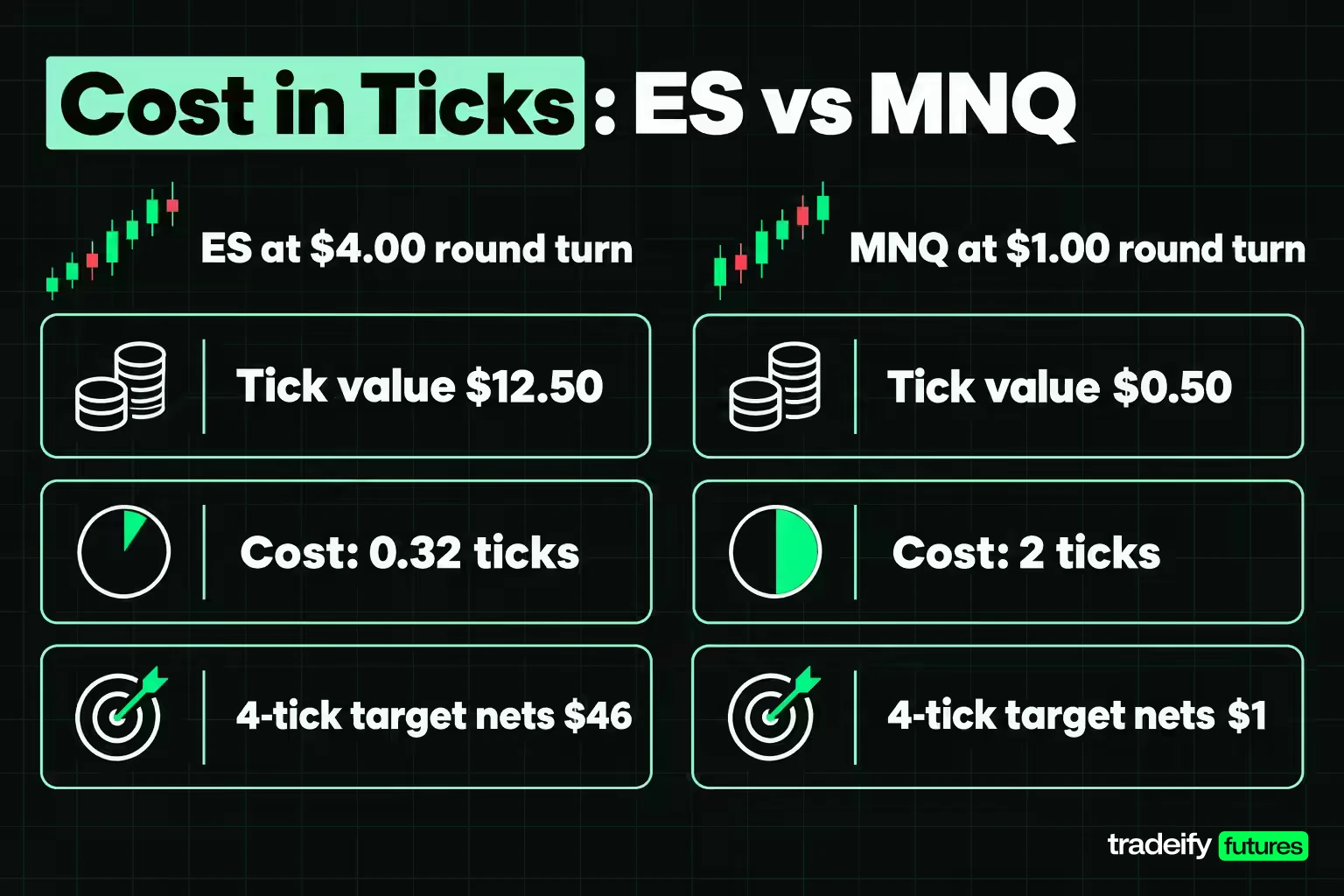
Scalping futures profitability comes down to three numbers: the tick value of the contract, the cost of a round turn, and the win rate your target and stop require. You can work all three out before the session starts.
Converting a round-turn cost into ticks
A round turn is one entry plus one exit, and its cost (commission plus exchange, clearing and regulatory fees) is charged on every trade whether it wins or loses. Divide that cost by the contract's tick value and you get the cost in ticks, which you can compare directly with your target.
This guide uses a stated assumption of $4.00 per round turn on full-size contracts and $1.00 on micros. These are illustrative figures, not a quote from any broker; your own costs will differ, so substitute them.
- ES at $4.00 per round turn: $4.00 divided by $12.50 is 0.32 ticks.
- Micro E-mini Nasdaq-100 (MNQ) at $1.00: one tick is $0.50, so the cost is 2 ticks.
On ES a 4-tick target grosses $50 and nets $46 after cost. On MNQ a 4-tick target grosses $2 and nets $1, so half of every winning trade goes to cost.
The break-even win rate for a scalping bracket
The break-even win rate is the share of trades you must win to finish flat once cost is included. A winning trade nets the target minus the cost, and a losing trade loses the stop plus the cost. Setting the two equal gives:
Break-even win rate = (stop in ticks + cost in ticks) / (target in ticks + stop in ticks)
With the target at twice the stop, a common scalping shape, the ES numbers at $4.00 per round turn are:
| ES target and stop | Cost in ticks | Break-even win rate |
|---|---|---|
| 4-tick target, 2-tick stop | 0.32 | 38.67% |
| 6-tick target, 3-tick stop | 0.32 | 36.89% |
| 8-tick target, 4-tick stop | 0.32 | 36.00% |
| 12-tick target, 6-tick stop | 0.32 | 35.11% |
| 16-tick target, 8-tick stop | 0.32 | 34.67% |
The requirement falls as the bracket widens because the same 0.32 ticks becomes a smaller slice of it, but it never drops to the 33.33% that a 2-to-1 bracket would need with zero cost. On MNQ the same 4-tick target with a 2-tick stop at $1.00 needs (2 + 2) / 6, which is 66.67%. The setup is identical; the contract and its cost changed the job.
A worked ES scalping example over 100 trades
Take one ES contract, a 6-tick target, a 3-tick stop and the $4.00 round-turn assumption. The prices are illustrative.
- A winner grosses 6 ticks x $12.50 = $75.00 and nets $71.00.
- A loser gives up 3 ticks x $12.50 = $37.50 and costs $41.50 all in.
- Break-even is (3 + 0.32) / 9 = 36.89%.
| Win rate over 100 trades | Winning trades | Losing trades | Net result |
|---|---|---|---|
| 35% | 35 x $71.00 | 65 x $41.50 | -$212.50 |
| 37% | 37 x $71.00 | 63 x $41.50 | +$12.50 |
| 40% | 40 x $71.00 | 60 x $41.50 | +$350.00 |
| 45% | 45 x $71.00 | 55 x $41.50 | +$912.50 |
Two points of win rate separate a losing month from a flat one. That is why scalping results need a large sample: over 30 trades, a 35% trader and a 40% trader can easily post the same record by chance, so neither one should conclude much until the journal holds at least 100 trades on the same setup.
Related lesson: How a fixed cost changes the breakeven math
Scalping Costs Measured Against Real Bar Ranges
Scalping costs only make sense next to how far price actually moves in the bars you trade, which is why anyone scalping futures should know the typical bar size on their contract. A useful gauge is the cost-to-noise ratio: the round-turn cost divided by the median one-minute bar range on the contract. It answers a plain question, which is how much of a typical move you hand over before your read of the market matters.
The figures in this section come from an illustrative study done for an earlier version of this guide. It measured every one-minute bar on six front-month continuous futures series from September 10 to September 17, 2026 (6 sessions, 7,860 bars per equity index contract and 47,214 bars across all six), using the Yahoo Finance chart data feed with timestamps converted to Eastern Time. Cost uses the same $4.00 full-size and $1.00 micro round-turn assumption. Treat the figures as a snapshot of one week, not a permanent property of each market.
What the cost-to-noise ratio shows for each scalping contract
The table sets the assumed round-turn cost against the median one-minute bar for each contract in this guide's illustrative study.
| Contract | Tick value | Median one-minute bar | Median bar in dollars | Assumed round turn | Cost as share of median bar |
|---|---|---|---|---|---|
| E-mini S&P 500 (ES) | $12.50 | 5 ticks | $62.50 | $4.00 | 6.40% |
| Micro E-mini S&P 500 (MES) | $1.25 | 5 ticks | $6.25 | $1.00 | 16.00% |
| E-mini Nasdaq-100 (NQ) | $5.00 | 30 ticks | $150.00 | $4.00 | 2.67% |
| Micro E-mini Nasdaq-100 (MNQ) | $0.50 | 33 ticks | $16.50 | $1.00 | 6.06% |
| WTI Crude Oil (CL) | $10.00 | 9 ticks | $90.00 | $4.00 | 4.44% |
| Gold (GC) | $10.00 | 18 ticks | $180 | $4.00 | 2.22% |
The micro S&P contract stands out. It has exactly the same chart as ES, so the median bar is the same 5 ticks, but each tick is worth a tenth as much while the assumed cost is a quarter as much. The result is a cost that eats 16.00% of a typical one-minute bar. A scalper switching from ES to MES to "take less risk" also takes on a much heavier cost burden per tick of movement.
Nasdaq and gold sit at the other end. Their one-minute bars are wide in ticks, so the fixed cost is a small share of an ordinary move. That does not make them easier; wide bars also mean wider stops and bigger swings against you per contract.
How Bar Width Decides Whether a Scalp Bracket Can Resolve
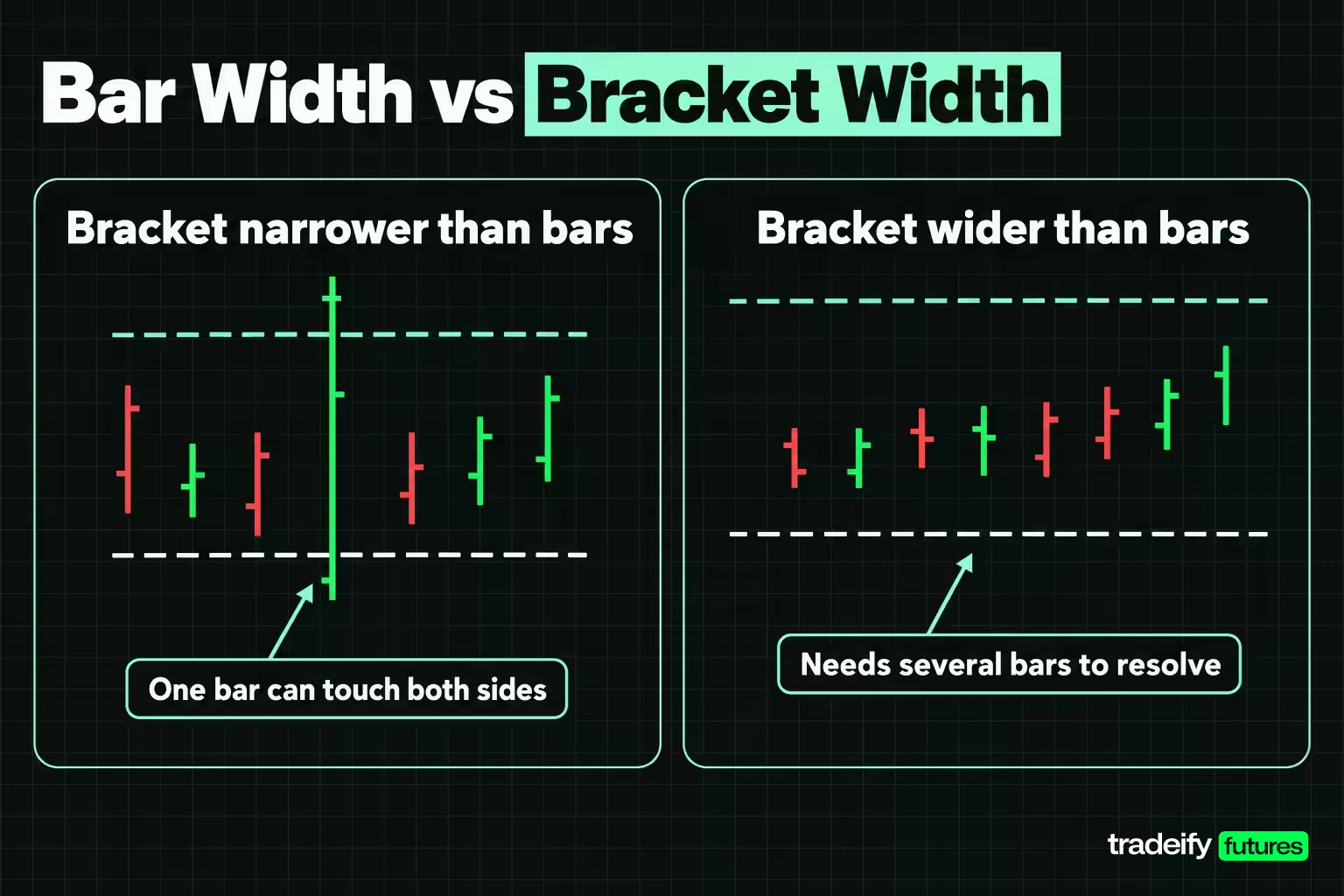
A scalp bracket (the target plus the stop) needs bars wide enough to reach one side cleanly. If the bracket is wider than most bars, the trade usually needs several bars to resolve. If it is much narrower than most bars, a single bar often touches both the target and the stop, and you cannot tell from bar data which came first.
Share of one-minute bars wide enough for a scalp bracket
This guide's illustrative study of one-minute futures bars (Yahoo Finance chart data, front-month continuous contracts, September 10 to 17, 2026) counted the share of bars at least as wide as each scalp bracket.
| ES bracket | Total width | Share of ES one-minute bars that wide |
|---|---|---|
| 4-tick target, 2-tick stop | 6 ticks | 46.30% |
| 8-tick target, 4-tick stop | 12 ticks | 11.88% |
| 12-tick target, 6-tick stop | 18 ticks | 3.99% |
| 16-tick target, 8-tick stop | 24 ticks | 1.76% |
In the same study, MES measured almost identically, at 49.82% for the 6-tick bracket. NQ is a different market: 99.76% of its one-minute bars were at least 6 ticks wide and 95.46% were at least 12 ticks wide. CL came in at 72.80% and GC at 96.39% for the 6-tick bracket.
The practical reading is simple. A 16-tick ES scalp on a one-minute chart is really a multi-bar trade, so judge it by how price behaves over several bars. A 4-tick NQ scalp, by contrast, is smaller than nearly every bar, which means it lives inside ordinary noise.
The same-bar ambiguity problem in scalping backtests
Bar-data backtests of scalping hit a specific problem when one bar touches both the target and the stop. This guide's illustrative study (ES one-minute bars, Yahoo Finance chart data, September 10 to 17, 2026) tested it directly: enter at the close of every one-minute bar, place a 4-tick target and a 2-tick stop, and follow later bars until one level is touched. That produced 6,383 resolved trades.
- 1,491 reached the target first.
- 3,776 reached the stop first.
- 1,116, or 17.48%, ended on a bar that touched both levels, so the bar data cannot say which came first.
Count every ambiguous bar as a loss and the win rate is 23.36%. Count every one as a win and it is 40.84%. Break-even for that bracket is 38.67%, which sits inside the band, so the test cannot say whether the bracket made or lost money. On NQ the same 4-tick bracket ended on an ambiguous bar 67.64% of the time, and the two conventions produced 12.26% and 79.90% from identical data.
That is the most useful lesson in the study. A scalping backtest built on one-minute bars must state how it handled a bar that touched both levels, and the honest answer is often to retest on tick data. A published scalping win rate that skips this point may simply reflect whichever convention flattered it.
Choosing Futures Contracts for Scalping
Choosing futures contracts for scalping starts with three questions: what one tick is worth, what a round turn costs in ticks, and how wide a typical bar is in ticks. Liquidity matters too, because thin books widen the spread and slip your stops, but on the main equity index, crude and gold contracts the bigger daily differences are in tick economics.
| Contract | Tick size | Tick value | Assumed cost in ticks |
|---|---|---|---|
| ES | 0.25 index points | $12.50 | 0.32 |
| MES | 0.25 index points | $1.25 | 0.8 |
| NQ | 0.25 index points | $5.00 | 0.8 |
| MNQ | 0.25 index points | $0.50 | 2 |
| CL | $0.01 per barrel | $10.00 | 0.4 |
| GC | $0.10 per troy ounce | $10.00 | 0.4 |
E-mini or micro contracts for scalping
Micro contracts are one tenth the size of their E-mini parents (MES is $5 per index point against $50 for ES; MNQ is $2 against $20 for NQ). That makes micros the natural way to learn and to size small accounts. For scalping, though, the cost per tick is what bites.
On MES a 4-tick target with a 2-tick stop needs 46.67% at a $1.00 round turn, against 38.67% for the same bracket on ES. If your all-in micro cost is closer to $2.00, the MES break-even rises to 60.00%, and on MNQ a $2.00 round turn equals the whole 4-tick target, so a 4-tick MNQ scalp could not break even at any win rate.
Once you are trading ten micros, you hold the same exposure as one E-mini but pay ten round turns. At that point the full-size contract usually costs less per trade for the same position.
The temptation runs the other way after a rough week. Dropping to micros to "take it easy" is a sensible risk decision, but check the bracket again when you do it, because the same 4-tick target that cleared its cost on ES may not clear it on MES.
Matching the scalp target to the contract
The same tick count means very different things on different futures contracts, so a scalp target should be sized to each contract's own movement. In this guide's illustrative study of one-minute bars (September 10 to 17, 2026), NQ's median bar was 30 ticks, so a 4-tick NQ target is inside routine noise. A bracket scaled to NQ's own movement, say a 30-tick target with a 15-tick stop, has a break-even of (15 + 0.8) / 45, or 35.11%, at the $4.00 assumption. Size the target to the contract's typical move, not to a tick count borrowed from another market.
Related lesson: The micro and full-size versions of the same market
Scalping Futures Strategies and When Each One Fails
Scalping futures strategies differ mainly in where they enter and what tells them they are wrong. Each of the six here works in one kind of market and fails in a predictable way in another. The real skill is deciding which kind of session you are in before choosing the setup, and accepting that some sessions offer nothing worth scalping.
| Scalping strategy | Market condition it needs | Typical entry | What invalidates it |
|---|---|---|---|
| Breakout scalp | A clear level with pressure building against it | Break and hold beyond the level | Price returns inside the level |
| Pullback scalp | A trend with shallow, orderly retracements | First pause at a prior breakout area or short moving average | Pullback breaks the last swing |
| Range fade | A sideways session with defined edges | Rejection at the range high or low | A close outside the range |
| Momentum scalp | A burst of one-sided volume, often after news | Entry with the move after a brief pause | Momentum stalls with no follow-through |
| VWAP reversion | A stretched move away from VWAP in a balanced session | Exhaustion signs far from VWAP | Trend day that keeps price away from VWAP |
| Opening range breakout | A defined first range after the 9:30 AM ET cash open | Break of the opening range high or low | Break fails back into the range |
Breakout and opening range scalps
A breakout scalp aims to capture the first few ticks after price clears a level that has held several times. The observation is the level; the confirmation is price holding beyond it rather than just poking through. The opening range breakout is the same idea applied to the first range after the stock market opens at 9:30 AM ET (the NYSE core session runs from 9:30 AM to 4:00 PM ET). It fails when the break is a single burst into resting orders that then reverses, which is common on low-participation days.
Pullback and momentum scalps
A pullback scalp joins an existing move at a pause instead of chasing it. It needs a trend you can see on a higher timeframe and a retracement that stays orderly. The momentum scalp is its impatient cousin: it joins a fast one-sided burst after a brief hesitation. Both depend on follow-through. If the next bar or two shows no continuation, the reason for the trade is gone, and getting out quickly matters more than the exact stop level.
Range fade and VWAP reversion scalps
A range fade sells near the top of a sideways session and buys near the bottom. VWAP reversion bets that a stretched move snaps back toward the session's volume-weighted average price. Both are counter-trend, so both lose repeatedly on trend days. The filter that saves them is checking whether the session is balanced (price rotating around VWAP) or directional (price holding on one side of it) before taking the first fade.
Related lesson: How VWAP is calculated and read
Price Action Scalping With Candles and Levels
Price action scalping uses the raw chart (bars, levels and how price behaves at them) instead of indicator signals. Its strength is speed: there is no lag from a calculation. Its weakness is that every bar can look like a signal if you want one.
Patterns price action scalpers commonly watch:
- Rejection at a level. A bar pushes through a prior high or low and closes back inside, leaving a long wick. The observation is the wick; the confirmation is the next bar failing to retest it.
- Inside-bar break. A bar forms entirely inside the previous bar's range, and the scalp goes with the break of that small range. It works best in the direction of the larger move.
- Failed breakout. Price breaks a level, finds no follow-through, and returns inside. The trapped breakout traders' stops can fuel a quick move the other way.
- Higher lows into a level. Each dip stops a little higher as price presses on resistance, which can signal a breakout scalp is building.
The discipline is separating observation from confirmation. A wick is an observation. A wick at a level you marked before the session, followed by a bar that fails to retest, is a setup. Write down where the scalp is wrong (usually just beyond the wick or the inside bar) before you enter, and if that distance does not fit your bracket, skip the trade.
Indicators That Help Scalping Decisions
Indicators help most when scalping futures as context filters: they tell you which kind of session you are in and where price is relative to average, while the entry itself comes from price at a level. Using an indicator crossover as the trigger on a one-minute chart usually means entering late into a small move.
- VWAP. The volume-weighted average price is the sum of price multiplied by volume, divided by total volume, and it resets each session. Price holding above a rising VWAP suggests buyers control the session; price rotating around a flat VWAP suggests balance, which favours fades over breakouts.
- Short moving averages. Many scalpers keep one or two short exponential moving averages to judge whether a pullback is still orderly. The specific lengths matter less than using the same ones every day so you learn how price behaves around them.
- Volume and volume profile. A breakout on rising volume is more convincing than one on thin volume. A volume profile shows the price levels where the most contracts traded, which often act as magnets or barriers.
- Average true range. ATR measures typical bar size, including gaps. For a scalper it is a noise gauge: if your stop is smaller than a fraction of the current ATR on your chart, routine movement will hit it.
- Tick and range charts. These build a new bar after a set number of trades or a set price range, rather than after a set time. Some scalpers prefer them because bars form faster during activity and slower during lulls.
Keep the chart lean. Three or four tools you understand will help more than a stack of overlapping oscillators that all describe the same price.
Related lesson: How tick charts build bars
Order Flow and DOM Scalping
Order flow scalping reads the depth of market (DOM), a ladder of resting buy and sell orders at each price, together with time and sales, the list of completed trades. Instead of waiting for a bar to close, the scalper watches how orders behave at a price right now.
What order flow scalpers look for:
- Absorption. Aggressive sellers keep hitting a bid, but the price does not drop, because a large buyer keeps refilling it. If the selling dries up, a quick move up can follow.
- Stacked size that gets pulled. Large resting orders can be cancelled before price reaches them. Displayed size is information, not a promise, and the CFTC treats placing orders with intent to cancel them before execution (spoofing) as illegal, which is exactly why traders do not take displayed size at face value.
- Speed of the tape. A sudden burst of trades at the offer, visible in time and sales, often marks the start of a momentum scalp. A tape that slows near a level suggests the push is tiring.
Order flow has real limits. It needs full depth data, which some data feeds and accounts provide only as level 1 (best bid and offer), and it takes many hours of screen time to read reliably. It also works best on contracts with deep books, where a few large orders cannot dominate the ladder.
Related lesson: How order flow analysis works
Scalping Tools and Platform Setup
Tools for scalping futures matter more than they do for slower styles, because a second of delay or one mis-click can cost more than the whole target. A practical futures scalping setup covers execution, risk controls and charting.
Execution setup for scalping
- A DOM or price ladder with one-click entry and the ability to drag orders. Most scalpers execute from the ladder rather than the chart.
- Bracket orders. An entry that automatically places a linked stop and target (an OCO pair: one cancels the other). Setting brackets in advance removes the need to type a stop while price moves.
- Server-side stops where available. Some platforms keep stops and brackets on the broker's or data provider's servers, so they stay working if your internet drops. Check how your own platform handles a disconnect before you rely on it.
- Hotkeys, carefully. Keyboard shortcuts for flatten-all or reverse save time, but a wrong key is fast too. Test them in simulation and disable any you do not use.
- Correct contract month. Make sure you are trading the active front-month contract, not a chart-only continuous symbol or a thinly traded back month.
Risk controls and charting for scalping
- Platform loss limits or lockouts. Many platforms let you set a personal daily loss limit or a lockout timer that blocks trading once hit. For a scalper prone to fast revenge trades, this is one of the most useful settings available.
- A real-time data feed. Delayed data is unusable for scalping. Confirm your chart shows live data on the contract you trade.
- Chart types and timeframes that match your bracket: a one-minute or tick chart for entries, and a slower chart for the session's direction.
- A trade log export. You need every fill with time, price and cost to measure win rate and cost honestly.
Before scalping futures with real risk on a new setup, run it in simulation for at least a few sessions, specifically testing a bracket entry, a manual flatten, and what happens to your working orders if you close the platform.
Related lesson: How bracket orders link a stop and target
Best Times to Scalp Futures
The best times to scalp futures are when price moves enough to pay the cost and clear the noise, which is not spread evenly across the day. An illustrative study done for an earlier version of this guide grouped every five-minute ES bar into 30-minute windows across 59 sessions from July 9 to September 17, 2026 (81,690 five-minute bars across six contracts, Yahoo Finance chart data, Eastern Time) and measured each window's share of the day's total absolute bar movement.
| ES time window (ET) | Share of daily movement in the study |
|---|---|
| 9:30 AM to 10:00 AM | 5.63% |
| 10:00 AM to 10:30 AM | 4.71% |
| 10:30 AM to 11:00 AM | 4.32% |
| 9:30 AM to noon | 22.19% |
| 9:30 AM to 4:00 PM | 43.85% |
| Midnight to 9:30 AM | 34.54% |
| 6:00 PM to midnight | 18.24% |
In that study, the first three windows after the cash open carried 14.66% of the day's movement in three of the 46 half-hour windows in the Globex day, and the 9:30 AM window was the single most active. NQ showed almost the same shape, with 22.15% in the 9:30 AM to noon block and a top window of 6.31%.
Choosing scalping windows around the open, overnight and news
Choosing when to scalp futures comes down to three practical points from the study and the economic calendar:
- The morning session is the main window. It has the most movement and usually the deepest books. It is also the most crowded and the fastest, so it is not automatically the easiest.
- The overnight session is not dead. In the study, over a third of the measured ES movement (34.54%) happened between midnight and the cash open, though books are often thinner then, which widens fills.
- Scheduled data releases change the market for a few minutes. Major US reports such as CPI come out at 8:30 AM ET. Spreads can widen and stops can slip right at the release, so many scalpers either stand aside for the first minutes or trade smaller.
The midday period often quiets down. When bars shrink toward the size of your cost, that is a reason to stop for the session, even if you feel you have not "done enough" yet.
Related lesson: How futures sessions and the daily maintenance break work
Risk Management for Futures Scalping
Risk management when scalping futures has the same goals as any style (survive losing streaks and keep any single loss small), but the trade frequency changes the details. A scalper may place more trades in a morning than a swing trader places in a month, so small leaks add up fast.
Stop placement and position sizing for scalps
Place the stop where the scalp is wrong, not where the dollar amount feels comfortable, and then size the position to that stop. Include the round-turn cost in the risk per contract.
Illustrative example with a $200 risk budget per trade:
- ES with a 3-tick stop: 3 x $12.50 = $37.50 plus $4.00 cost = $41.50 per contract. Four contracts risk $166.00.
- MES with an 8-tick stop: 8 x $1.25 = $10.00 plus $1.00 cost = $11.00 per contract. Eighteen contracts risk $198.00.
If the stop the setup needs does not fit the budget at one contract, the answer is to skip the trade or use a smaller contract, never to shrink the stop until it fits.
Related lesson: Sizing a futures position from the risk side
Daily limits and losing streaks in scalping
Losing streaks are normal for a scalper, even with a positive edge. At a 40% win rate, the chance that any particular run of three trades are all losers is 0.6 x 0.6 x 0.6, or 21.60%, and for five in a row it is 7.78%. Across a few hundred trades, long losing runs will show up.
Precommit to limits that stop a bad day early:
- A daily loss limit in dollars, set in the platform's lockout if it has one.
- A maximum number of trades per session, which caps overtrading on a choppy day.
- A rule to stop after a set number of consecutive losses (for example three) and review before trading again.
How the 3-5-7 rule applies to scalping
The 3-5-7 rule is an informal risk rule of thumb, not an exchange or regulatory rule. The common version says risk no more than 3% of the account on one trade, keep total open risk at or under 5%, and aim for winners at least 7% larger (some versions treat the 7 as a win-to-loss ratio instead). For scalping the 3% ceiling is far too loose: on a $50,000 account, 3% is $1,500 per trade, while the ES example risks $41.50 per contract, about 0.08% of that account. The rule's spirit (cap single-trade risk and total exposure, and make winners count) still applies, but scalpers usually set much smaller numbers.
The Psychology of Scalping Under Speed
The psychology of scalping futures is shaped by speed and repetition. You make many small decisions with little time to think, and each loss is followed almost immediately by the next opportunity. That combination makes some mistakes very easy.
- Chasing a missed scalp. Price leaves without you and the urge is to jump in late. A late entry has a worse location and the same stop, so the bracket's break-even gets worse. Precommitted rule: if the entry price has gone, the trade has gone.
- Revenge trading. After a stop-out, the next trade feels like a chance to get it back. It is usually larger and less selective. Precommitted rule: after a loss, wait for the next full setup on your list, and after a set number of losses, lock the platform.
- Freezing after losses. The opposite reaction is hesitating on valid setups, then taking a worse one later. Writing the setup criteria down before the session gives you something to check against instead of a feeling.
- Overtrading a quiet market. When bars shrink toward the size of your cost, every trade has a worse expectancy. A trade cap per session stops boredom from becoming activity.
None of this is a character flaw. It is how fast, repeated feedback affects most people, which is why scalpers lean so heavily on rules set before the open and on the journal reviewed after it.
Related lesson: Spotting and stopping revenge trading
Common Scalping Mistakes in Futures
Common mistakes when scalping futures fall into two groups: arithmetic mistakes that make a setup unprofitable before it starts, and behaviour mistakes that turn a workable setup into a losing day.
Arithmetic mistakes:
- Using the wrong contract for the target size. A 4-tick target needs 66.67% on MNQ at a $1.00 round turn and 38.67% on ES at $4.00. The setup did not change; the instrument did.
- Measuring results in gross ticks. A 4-tick ES winner is $46 net, not $50, at the assumed cost. Every journal figure should be net.
- Scaling up micros instead of moving to the mini. Ten micros carry the same exposure as one E-mini but ten round turns of cost.
- Trusting a bar-data backtest without a tie-break rule. In this guide's illustrative ES study of one-minute bars, the handling of ambiguous bars moved the win rate between 23.36% and 40.84% on identical data.
- Judging a setup on too few trades. Thirty trades cannot separate a 35% trader from a 40% trader.
Behaviour mistakes:
- Moving a stop further away mid-trade. It turns a small planned loss into a large unplanned one and breaks the bracket math.
- Trading every window. Scalping a slow midday market with a morning-sized target means more trades in bars too small to pay.
- Trading through scheduled news without a plan. Spreads and slippage around a release can exceed a whole scalp target.
- No daily stop. Without one, a bad hour can erase a good week.
Related lesson: Keeping the trade record that settles these questions
Prop Account Rules That Affect Scalping
Prop account rules can affect a scalping plan in ways a personal brokerage account does not. Typical rule books include contract caps, daily loss limits, trailing drawdowns, a time by which every position must be flat, and in some cases conditions on very short holding times for payouts. Read the rule book before choosing your target size and trade frequency, since a style that is legal on the exchange can still conflict with an account's terms.
On our accounts, scalping is allowed, but microscalping affects payouts on funded accounts (not evaluations): to request a payout, over 50% of your trades must be held longer than 10 seconds and over 50% of your profit must come from those trades. Missing it blocks the payout request; it does not fail the account. Our contract limits count 10 micros as 1 mini, and our commission table shows why that matters for scalpers: 10 MES cost $18.20 round trip against $5.76 for 1 ES. All positions must be closed by 4:45 PM ET, and funded accounts are simulated.
A Pre-Session Scalping Checklist

A pre-session checklist turns the arithmetic and rules of scalping futures into a routine you can repeat every day. Work through it in order before the first trade.
- Write down your all-in round-turn cost per contract in dollars, then convert it into ticks on the contract you will trade.
- Calculate the break-even win rate for your planned target and stop with that cost included.
- Compare that break-even rate with the win rate your journal shows for this setup over at least 100 trades. If the journal is below it, widen the bracket or change contracts before trading.
- Check today's typical bar size (ATR or recent bars) on your entry chart against your bracket width.
- Mark the levels you will trade and the windows you will trade them in, including any scheduled data releases to avoid.
- Set your daily loss limit, maximum trade count and consecutive-loss stop in the platform where possible.
- Confirm the contract month, the data feed and that bracket orders are working.
If step 3 fails, the setup is not ready for real risk at this target size, however good the chart looks.
Scalping Futures FAQ
Is scalping futures profitable?
It can be, but only when your measured win rate clears the break-even rate for your target, stop and contract with costs included. On ES at a $4.00 round turn, a 4-tick target with a 2-tick stop needs 38.67%. On MNQ at $1.00 the same bracket needs 66.67%.
What is scalping trading?
Scalping is a trading style that opens and closes positions within seconds or minutes to capture small price moves many times a day. In futures, targets are usually a few ticks, so costs and execution matter more than in slower styles.
Is scalping futures illegal?
No. Closing a futures position within seconds or minutes is ordinary, legal trading. Illegal "scalping" in securities law means recommending a security to others while secretly selling it, which has nothing to do with holding time.
What is the 3-5-7 rule in trading?
It is an informal risk rule of thumb: risk up to 3% per trade, keep total open risk under 5%, and aim for winners at least 7% larger. It is not an exchange or regulatory rule, and scalpers usually use far smaller per-trade risk.
Who is the no. 1 scalper?
There is no official ranking of scalpers, and claims of a "best" scalper usually come from marketing rather than audited records. A more useful benchmark is your own journal: net win rate against break-even over a meaningful sample.
What is the best strategy for options scalping?
There is no single best options scalping strategy; the workable ones stick to the most liquid, near-the-money options where spreads are tightest. Option prices also move with time decay and implied volatility, not just the underlying, so a scalp can lose value while the underlying stands still. Wide bid-ask spreads can exceed a small target, which is why the cost-and-spread arithmetic used for scalping futures applies even more strictly to options.
What is the best timeframe for scalping futures?
There is no single best timeframe. Pick one whose typical bar is close to your bracket width: if most bars are much wider than the bracket, outcomes become noise, and if most are much narrower, the scalp turns into a multi-bar trade.
Trading futures involves substantial risk of loss and is not suitable for everyone. Leverage means losses can exceed what you expected and, in a brokerage account, your deposit. The study figures in this guide are illustrative measurements of historical bar data from a stated sample, and the costs are assumptions, not quotes. Simulated and funded prop accounts are simulated trading, and simulated results do not represent live trading. Nothing here is investment advice or a recommendation of any contract or strategy.


