




TL;DR: Entry and exit rules define when a trade is allowed, how it is opened, what invalidates it, and how it ends. Specify the market, session, setup, confirmation, order type, initial stop, target or trailing method, and time-based exit before trading. Size the position around the planned risk and include costs. Test the complete rule set without using information unavailable at entry, then review rule adherence separately from the trade’s profit or loss.
You can identify a setup and still have no clear trade. The missing pieces are often the exact trigger, the point where the idea is wrong, and what you will do if price stalls.
Entry and exit rules turn an observation into an executable plan. They reduce the decisions you must improvise while money is at risk.
The rules do not need to predict every path. They need to make your response to the important paths clear enough to follow and test.
Separate a setup from an entry rule
A setup describes the conditions that make a trade worth considering. An entry trigger describes the event that actually permits an order.
For example, a pullback in an uptrend is a setup description. A completed bar breaking a defined pullback high may be an entry trigger. The trend definition, bar interval, and acceptable pullback still need to be specified.
Without that separation, “the setup was there” can become an excuse for entering at almost any point in the move.
Write the context first, then the trigger. If the trigger never occurs, no trade has been missed under that rule set.
Build complete entry rules

A complete entry rule should cover the instrument, contract, session, market condition, trigger, and order type. Include any spread, liquidity, or event restriction that affects whether the trade can be executed sensibly.
Decide whether confirmation requires a completed bar or can occur intrabar. A rule using the final high, low, and close of a bar cannot act as though those values were known earlier.
Order type matters too. A market order prioritizes execution, while a limit order controls the acceptable price but may not fill. A stop entry can trigger into changing liquidity.
Schwab’s thinkorswim entry and exit strategy documentation illustrates the distinction between defined strategy conditions and the orders they represent. Your live platform’s order behavior needs its own verification.
Define exit rules before position size
The initial stop should connect to invalidation or another explicitly tested risk rule. It should not be moved farther away because the position is larger than the account can support.
After defining the stop distance, calculate the dollar risk from contract value and quantity. Add a realistic allowance for costs and execution differences.
If the minimum available position is still too large, the setup does not fit the account at that moment. Skipping it is a complete decision.
Never treat a prop firm’s account-failure threshold as the planned stop for an ordinary trade. The trade should have its own risk boundary, with room remaining before an account-level breach.
Choose a profit exit that matches the hypothesis
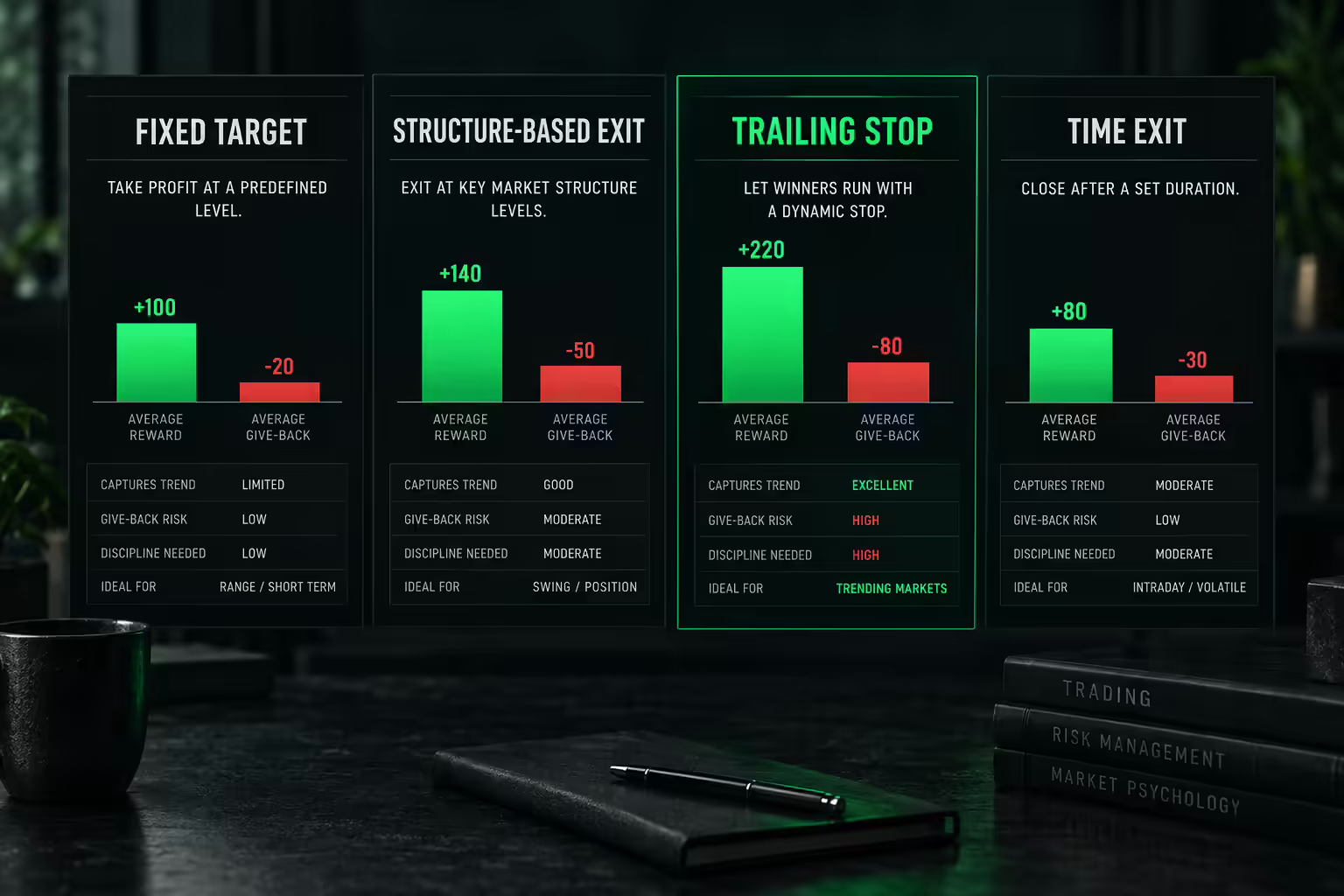
A fixed target, a structure-based exit, a trailing stop, and a time exit test different ideas.
A fixed target asks whether the setup can reach a specified reward before the stop. A trailing method asks whether staying with directional movement compensates for giving back part of open profit. A time exit asks whether the opportunity loses value after a defined interval.
The table below compares the four exit rules side by side, so you can match the method to the idea you are testing.
| Exit method | What the exit rule tests | Main tradeoff |
|---|---|---|
| Fixed target | Whether the setup reaches a set reward before the stop | Can close the trade before a larger move |
| Structure-based exit | Whether price keeps respecting the level or swing that defined the trade | Needs a written definition of the structure |
| Trailing stop | Whether staying with directional movement pays for giving back open profit | Gives back part of open profit on the exit |
| Time exit | Whether the opportunity loses value after a defined interval | Can close a trade shortly before it moves |
Partial exits add another decision. They can reduce exposure, but they also change average win size, costs, and the remaining position’s behavior.
Specify which method applies before entry. Switching from a fixed target to a trailing exit because price is moving quickly creates a different strategy whose results should be tracked separately.
Write a hypothetical entry and exit plan
Consider a practice setup built around a clearly defined session range. The following is a test structure, not a claim of profitability:
- Trade only the specified futures contract during the planned session window.
- Require a completed bar above the range, followed by a pullback that meets the written condition.
- Enter only after the defined confirmation trigger.
- Place the initial stop beyond the invalidation level identified before entry.
- Use a target or trailing rule chosen during strategy development.
- Exit at the time cutoff if neither price-based exit occurs.
Now add a hypothetical numerical check. If the stop is six points away and the contract is worth $5 per point, one contract carries $30 of price risk before costs. Three contracts carry $90.
Those figures are illustrative. Use the actual contract specification and your own tested rules when calculating a real order.
Set order handling rules for entries and exits
An exit rule is incomplete without an order-handling rule. A stop-market order can fill beyond its trigger in a fast market. A stop-limit order can remain unfilled when price moves past its permitted range. Choose the behavior you can manage rather than assuming a displayed stop guarantees a maximum loss.
Define how long an entry order remains valid and cancel it when the setup expires. If the order fills only partly, decide how protection and targets adjust to the filled quantity. After a manual exit, confirm that leftover orders cannot open an unintended position.
For a bracket or one-cancels-other arrangement, test the platform and connection you actually use. Verify where the orders are held and what happens after a disconnect. Rehearse the emergency flatten procedure in simulation, including the follow-up check that the account is flat and no entry orders remain. These operational rules belong beside the chart trigger because they determine how the plan reaches the account.
Add entry rules for when to stand aside
Exclusion conditions are part of a strategy. They might cover scheduled announcements, unusual spreads, insufficient data, a disconnected platform, or a completed daily loss budget.
Do not create exclusions retrospectively to remove losing trades. Define them in advance and apply them to winners as well.
For example, if your rule avoids a release window, a profitable trade during that window still violated the plan. Counting it as proof that the rule should disappear confuses outcome with process.
Review potential changes on a broader sample outside the trading session.
Test entry and exit rules without hindsight

Use information available at the decision time. If a bar touches both the stop and target, its high and low alone may not establish which happened first.
Use finer data or a conservative ambiguity rule. Include missed limit fills, costs, and plausible slippage rather than assuming every chart touch was executable.
Test the complete sequence. An entry that looks good in isolation may perform poorly with the exit you can actually follow.
Keep a separate sample for validation. Repeatedly changing thresholds to improve the same historical result can create rules that fit noise rather than repeatable behavior.
Review rule adherence separately from results
For every trade, record whether the setup qualified, whether the trigger occurred, whether size was correct, and whether the exit followed the plan.
A losing trade can be a valid observation from the strategy. A winning trade can reveal a serious process error. Both belong in the account record, but they answer different review questions.
If the rules themselves are too vague to classify the trade, improve the definitions before collecting another large sample.
Start with one entry and exit rule set
Choose one setup and write its complete lifecycle on a single page. Practice executing it in simulation, including cancellations, stop placement, and the no-trade conditions.
Then review whether the rules are clear enough to reproduce and whether the results justify further testing. A written plan does not remove futures risk, but it makes the decisions behind that risk visible.
Frequently asked questions
What are entry and exit rules in trading?
Entry and exit rules are written conditions that decide when a trade is allowed, how the order is placed, what invalidates the idea, and how the position ends. They cover the setup, trigger, order type, initial stop, profit exit, and time cutoff before any money is at risk.
What should an entry rule include?
A complete entry rule names the instrument, contract, session, market condition, trigger, and order type. It also states whether confirmation needs a completed bar and lists any spread, liquidity, or event restriction that blocks the trade.
Should you set exit rules before entering a trade?
Yes. The initial stop, profit exit, and time exit should be fixed before entry, and position size should follow from the stop distance. Changing the exit method mid-trade creates a different strategy whose results should be tracked separately.
How do you test entry and exit rules without hindsight?
Use only information available at the decision time and test the full entry and exit sequence together. Include costs, missed limit fills, and plausible slippage, apply a conservative rule when one bar touches both the stop and target, and keep a separate sample for validation.