.svg)

.svg)
.svg)



TL;DR: Algorithmic trading data must match the decisions your strategy makes. Daily bars may support a daily signal, while intraday execution tests can require trades, quotes, or order-book data. Check timestamps, contract identifiers, session definitions, missing records, revisions, and licensing before trusting a backtest, and store raw downloads separately from cleaned data. For futures, distinguish actual contracts from continuous series and keep rollover rules consistent. Better data cannot rescue a weak strategy, but unsuitable data can make one look falsely strong. Sources range from exchange-direct platforms and specialist vendors to platform exports and free public repositories, and the same checks apply to each.
The backtest looks clean until you try to reproduce the fills. The strategy buys at a price that was never available after the signal, or trades a continuous-contract level that does not match the actual contract.
That is a data problem before it is a strategy problem.
Algorithmic trading data needs to support both the information used to make a decision and the execution assumptions used to measure it. Start there, rather than buying the largest dataset you can find.
Match trading data to the strategy’s decisions
Write down when the strategy observes information and when it can submit an order. That timeline determines the minimum useful data.
Daily open, high, low, close, and volume may be sufficient for a strategy that makes one decision after the session closes and acts later. Those bars cannot reveal the order of intraday events.
An intraday system may need trade prints or bid-ask quotes. A strategy dependent on queue position or available depth requires more detailed order-book information and a model that can use it appropriately.
More detail also means more cleaning, storage, and implementation work. Collect it because a specific assumption needs testing, not because tick data sounds more professional.
Understand the main trading data types
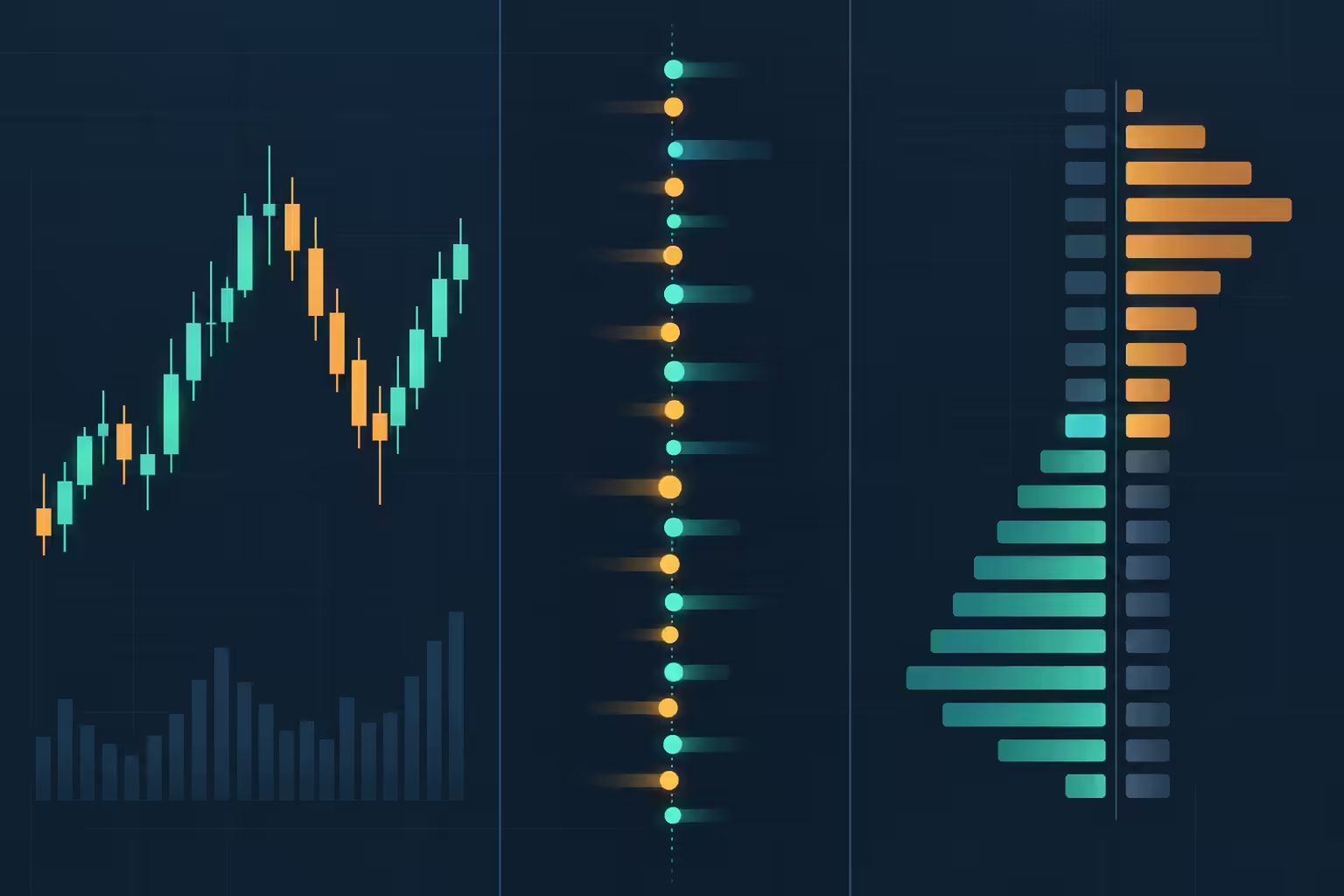
Bar data summarizes activity over intervals. Trade data records executed transactions. Quote data records displayed buying and selling prices, often with sizes. Order-book data can describe multiple price levels or individual order events, depending on the feed.
Instrument definitions provide the contract identifiers, tick sizes, multipliers, and expiration information that make prices interpretable.
Fundamental or event data adds another timing problem: when was the information actually released? A revised economic value downloaded today may not match the number available to the strategy at the time.
Databento’s futures documentation illustrates why instrument definitions and futures-specific conventions belong in a data workflow, not just the final price table.
What each trading data type can test
Use the table to pick the least detailed data that still answers your backtest question. Moving one row down usually adds cost, file size, and cleaning work.
| Data type | What it records | What it can test | What it cannot show |
|---|---|---|---|
| Daily bars | Open, high, low, close, and volume per session | End-of-day signals that act at a later open or close | The order of intraday highs and lows |
| Intraday bars | The same summary over minutes or seconds | Intraday signals with conservative fill rules | Whether a stop or target was hit first inside the bar |
| Trade prints | Each executed price and size with a timestamp | Traded volume, time and sales, and last-price behavior | The bid and ask you would have paid |
| Quotes | Best bid, best ask, and their sizes | Spread costs and market-order fills | Queue position behind other resting orders |
| Order book | Multiple price levels or individual order events | Depth, queue, and limit-order fill models | Your own latency unless you model it |
If the column on the right describes an assumption your strategy depends on, the data type on that row is not enough on its own.
Choose a source and test a small download
Compare three routes: an exchange or specialist historical-data vendor, exports from your trading platform, and public datasets used for learning. Judge each against the required instruments, dates, granularity, timestamps, correction policy, and permitted use. A free sample with undocumented construction is useful for practicing code, but it is weak evidence for a strategy’s execution quality.
Before committing, request the same short period from the source you intend to use in research and the feed you expect to use in practice. Reconcile the contract, session volume, missing intervals, and price conventions. Differences need an explanation before you interpret them as an edge.
A minimal trade-data record should identify the actual contract, event timestamp with time zone, price, and size. A quote-based test also needs bid, ask, their sizes, and appropriate timing fields. Keep instrument definitions alongside the records so a symbol change or multiplier error cannot silently change the backtest.
Finally, test a disconnect or missing-data interval. Define whether the strategy pauses, waits for recovery, or abandons that session. Filling missing prices forward without a rule can make an unavailable market look tradable.
Where algorithmic trading data actually comes from
The three routes above look different in practice, and the route you pick decides how much verification work is left for you afterward.
Exchanges sell their own history directly. CME Group’s DataMine is a self-service platform for the exchange’s historical, alternative, and analytic datasets, sold by subscription, so for CME contracts you can buy the source’s own records instead of a third party’s copy. That is as close to a primary source as a retail researcher can buy.
Specialist vendors wrap exchange data in documented APIs and consistent schemas. You are paying for someone else having solved the format, timestamp, and symbol-mapping problems before you, which is exactly the work that quietly breaks backtests when it is done badly. The Databento pages linked earlier in this post show what that level of documentation looks like when a vendor does it well.
Exports from your trading or backtesting platform are the route you already pay for, and they are fine for daily-bar prototypes. The catch is the purpose behind the file: an export built for statements and records was not designed as a research feed, so check what history depth, granularity, and timestamp fields it actually carries before building anything on it, and treat its documentation the way you would treat a vendor’s spec sheet.
Free public data is for learning, not for evidence. The repositories that are genuinely free are organized around stocks, crypto, and economic series, with services like Alpha Vantage and open-source wrappers such as yfinance among the common starting points, while free futures depth is scarce. Use them to debug code and test plumbing, not to certify a result, and remember that the question of how many trades you need to backtest only becomes meaningful once the data underneath it is sound.
- Exchange-direct. The source’s own records, by subscription. Most credible for audit-style work, most integration effort.
- Specialist vendors. Documented schemas and APIs over exchange feeds. Fastest to build on, and you inherit the vendor’s construction choices.
- Platform exports. Included with the software, built for records first. Right for daily-bar prototypes once you verify the fields.
- Free repositories. No contract, no cost, thin futures coverage. Right for learning the pipeline, weak evidence for an edge.
Retrieve and store trading data for backtests
Most sources deliver historical data in one of two ways: bulk file downloads for a date range, or an API you query from code. Files are simple to archive and reuse. An API is easier to automate, but request limits, pagination, and changing defaults can quietly alter what you receive.
Save every raw download unchanged, with the request parameters that produced it. Build cleaned tables and features from those files in a separate step, so you can rebuild them after fixing a bug.
CSV is readable but slow and loose about types at tick scale. Columnar or binary formats such as Parquet or HDF5, or a time-series database, can load large histories faster and keep timestamps and prices in consistent types. Choose the simplest option your data volume allows.
Check trading data timestamps before testing

Different timestamps can refer to different events. An exchange event time, a publisher send time, and a vendor receive time do not necessarily match.
The Databento standards documentation describes these distinctions in its own feeds. Other providers may name and order them differently, so read the documentation for the dataset you actually use.
Normalize time zones while preserving the original timestamps. Check daylight-saving transitions, overnight sessions, holidays, and early closes.
Then verify that a signal never consumes a record that becomes available only after the assumed decision time. A small timing mistake can give a fast strategy information it would not have in practice.
For slower systems, timestamp errors still matter around daily boundaries and scheduled releases. A one-day shift can turn a predictive-looking signal into a simple alignment bug.
Handle continuous futures data carefully

A futures contract expires. A long historical strategy therefore needs a rule for changing from one contract to the next.
Continuous datasets can map a symbol to a changing sequence of contracts. Some providers back-adjust prices to reduce rollover gaps, while others preserve original prices. Databento’s symbology guide explicitly describes its continuous prices as unadjusted and maps them to actual instruments.
Record whether your roll rule uses calendar timing, volume, or open interest. Also record when that information becomes available. A roll selected using the completed day’s volume cannot necessarily be chosen at the start of that same day.
Use adjusted series carefully for analysis, but model orders against the tradable contract and its actual prices. Otherwise, an attractive historical level may never have been executable.
Audit trading data with small, targeted checks
Before running a large backtest, inspect a sample that includes an ordinary session, a volatile session, a holiday boundary, and a rollover period.
Useful checks include:
- Missing intervals during expected trading hours.
- Duplicate records and conflicting updates.
- Incorrect contract multipliers or tick sizes.
- Prices outside a plausible range for that contract and period.
- Negative or inconsistent sizes where the schema does not permit them.
- Out-of-order events and unexplained timestamp gaps.
- Unexpected changes in session volume or record counts.
A check should identify a specific failure mode. Do not silently delete every unusual record; a genuine extreme move can be the most important part of the test.
Keep a transformation log so you can distinguish source data from cleaned data and reproduce the result later.
Make execution assumptions match trading data
Suppose a one-minute bar has a high above your target and a low below your stop. The bar alone does not tell you which was reached first.
Choosing the profitable ordering by default can materially overstate performance. Use finer data, a conservative assumption, or an explicitly reported ambiguity rule.
Likewise, a limit price being touched does not guarantee your order filled. Queue position, available size, latency, and cancellations can matter. Market-order simulations need bid-ask costs and slippage rather than automatically filling at the last trade.
Test whether the strategy survives less favorable assumptions. If a small increase in costs removes the apparent edge, that sensitivity is part of the result.
Execution algorithms raise the bar again
If the strategy itself is an execution algorithm, the data requirement moves up another level, because each common benchmark consumes a different series. A TWAP algorithm paces a parent order across a window toward the time-weighted average price, so the backtest has to replay every interval the order could have filled in. A VWAP algorithm targets the volume-weighted average price, which needs per-interval volume rather than prices alone. A percentage-of-volume algorithm holds your participation at a set share of market volume, so the simulated fills depend on the volume that arrives while the order is being worked.
None of that is testable on daily bars. If your strategy description contains TWAP, VWAP, or a participation rate, the minimum useful data is trade prints with volume across the execution window, and the benchmark you report against must be built from the same records the fills were simulated on. A VWAP comparison computed from a different dataset than the fills is a comparison between two datasets, not between your execution and the market.
Check trading data access and licensing
Confirm whether your license permits historical research, live use, storage, redistribution, and commercial deployment. Those permissions can differ even when the data arrives through the same API.
Also distinguish free delayed data from live executable quotes. A dataset can be useful for education while being unsuitable for the strategy’s timing requirements.
Ask providers about coverage, corrections, symbol history, and gaps before committing. A small sample purchase or download can expose mismatches more cheaply than rebuilding a full research pipeline later.
Create a reproducible trading data record
Save the provider, dataset name, download time, covered period, schema, time convention, contract mapping, and cleaning rules. Keep the original data separate from derived features.
Then rerun a small known test after any data change. The purpose is to detect altered assumptions before they become a new performance claim.
Trustworthy data makes the research question testable. It does not establish profitability, and a backtest remains a simulation with limits that live trading can expose.
Frequently asked questions
What data do you need for algorithmic trading?
At minimum you need price data at the granularity your strategy decides and trades on, plus instrument definitions such as contract identifiers, tick sizes, and multipliers. Daily bars can support end-of-day signals, while intraday execution tests may need trades, quotes, or order-book records with reliable timestamps.
Is free data good enough for backtesting a trading algorithm?
Free data can be useful for learning and for early code tests. It is often delayed, undocumented, or missing correction and session details, so it is weak evidence for execution quality. Before trusting a result, reconcile a sample against the source you expect to trade with.
Should you backtest futures on continuous contract data?
A continuous series can help with long-range analysis, but it may be back-adjusted or stitched with a roll rule that was not knowable in real time. Model orders against the actual contract and its original prices, and record the roll rule you used.
Can ChatGPT write a trading algorithm?
An AI assistant can draft strategy and data-handling code, but it does not know your data’s timestamp conventions, session definitions, or roll rules unless you supply them. Treat its output as a starting point and test it against a small, known dataset before trusting any backtest.
Is algorithmic trading actually profitable?
It can be for some traders, but automation does not create an edge on its own. Many strategies that look strong in a backtest fail live because of data errors, optimistic fills, or costs, so profitability depends on the strategy, execution, and risk control rather than the code.
.svg)
.svg)
.svg)
.svg)





.webp)