


TL;DR: Prop firms can monitor account equity, open P&L, position size, order activity, trading times, and program-rule compliance through their trading and account systems. Automated controls may reject orders or liquidate positions, while separate reviews can examine behavior and payout eligibility. Exact systems differ by firm. End-of-day drawdown calculation does not mean losses are checked only at the close, and a profitable final balance does not erase an earlier real-time breach.
Your account closes a trade above the drawdown line, yet the dashboard reports a breach. The missing detail may be what happened while the position was still open.
Risk monitoring often follows the path of account equity, not just the final realized result. A loss boundary can be touched before an exit fills, and the final balance can look different after the market moves.
Understanding that distinction helps you manage the account you actually have instead of the simpler version suggested by a closing-balance screenshot.
Separate prop-firm risk limits from performance goals
A profit target is an objective. A maximum-loss threshold is a boundary. A consistency requirement may affect qualification without functioning like either one.
Programs can also use contract limits, trading-hour rules, inactivity conditions, and restrictions on particular behavior. Guides to common prop-firm rules outline several of these categories.
The same firm may apply different rules during evaluation, simulated funding, and live trading. Keep those stages separate when reading a help page or interpreting a dashboard value.
Your own daily loss budget should also remain distinct from the firm’s maximum permitted loss. The firm’s boundary is not a suggested amount to risk in a session.
What account data can support risk monitoring
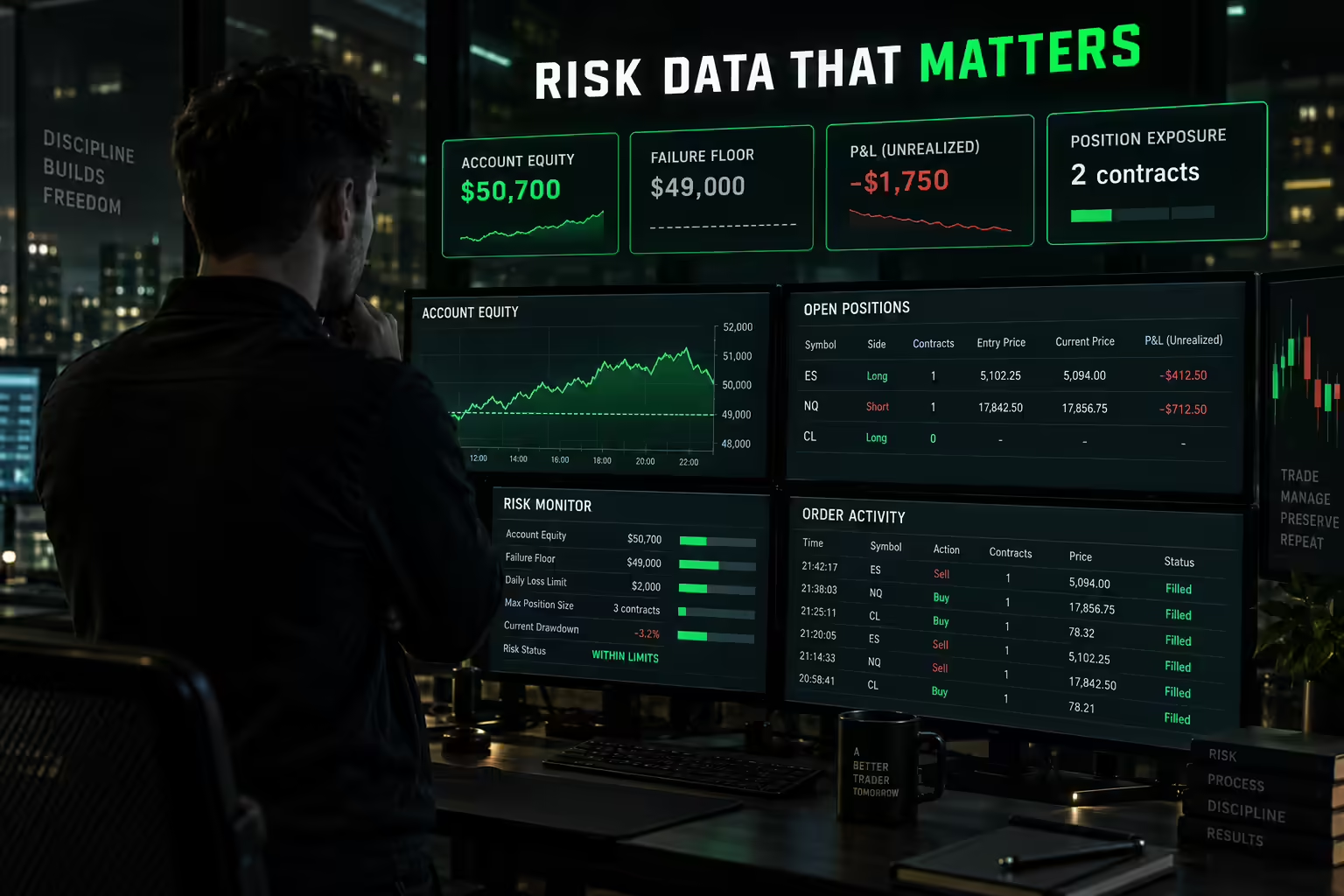
Trading systems can record account balances, open positions, fills, order changes, and timestamps. These records allow checks against configured limits and help reconstruct the sequence of an incident.
At a practical level, a firm may need to know the current exposure, unrealized P&L, cumulative session result, and whether a new order would exceed a size restriction.
Risk-technology vendors such as Trade Tech Solutions describe account-risk capabilities for prop programs. That establishes the availability of such tools; it does not establish that every named firm uses that vendor or every advertised feature.
Do not assume access to a firm’s private surveillance rules, review thresholds, or internal scoring model. Unless the firm publishes those details, they remain unknown.
How real-time loss monitoring differs from drawdown updates

Two clocks can operate at once. One determines when the drawdown threshold moves. The other determines when account equity is checked against the existing threshold.
For an end-of-day trailing model, the floor may update after the session based on closing performance. During the next session, that floor can still be enforced continuously.
Suppose a hypothetical account begins the session with equity of $50,700 and a failure floor of $49,000. An open position briefly pulls net equity to $48,950 before recovering. If the rule fails the account on touching the floor, a later close at $49,100 does not undo the earlier event.
The exact breach definition and liquidation process are program-specific. Read whether the rule uses balance, equity, net P&L, fees, or unrealized losses rather than assuming those terms are interchangeable.
Why automated controls do not replace a trade stop

An account control may reject an order, flatten positions, cancel pending orders, or pause further trading. Which action occurs depends on the platform and rule.
Those actions are not guaranteed fills at a precise price. In a fast market, slippage can move the final result beyond the point that triggered the control.
Your trade plan therefore needs its own stop and size calculation before approaching the account limit. Leaving a buffer is a response to execution uncertainty, not wasted buying power.
Also confirm what happens to resting orders after a position is flattened. An unused entry or exit order should not be left to create unintended exposure.
What a separate prop-firm review can examine
Automated risk controls and later account review serve different purposes. A platform can accept an order even though the behavior is later assessed under the program agreement.
Published prohibited-conduct rules may address simulated-fill exploitation, unauthorized account use, prohibited hedging, or trading activity inconsistent with the program’s conditions. Payout review may also verify identity and qualification criteria.
The fact that an account made a profit does not establish compliance with those conditions. Equally, a review flag is not by itself proof of intentional misconduct.
If a firm requests clarification, provide accurate records of the strategy and activity. Do not invent an explanation or assume another firm’s policy applies.
Why prop firms may review several accounts together
An account can stay inside its own size limit while several accounts carry concentrated exposure to the same market move. That is one reason risk systems can combine account-level checks with a broader view of positions and trading patterns. A vendor’s advertised consolidated dashboard describes a capability, not proof of the exact system a particular firm operates.
Separate three questions: did an order comply with that account’s limits, did the activity comply with account-use and conduct rules, and what exposure did it create across the relevant accounts? A profitable outcome answers none of those questions by itself.
Simulated programs and firms trading live capital also face different operational exposures. In simulation, account rules and contractual payout obligations still matter even though a displayed position does not prove an equivalent exchange order was placed. For live exposure, execution, liquidity, and aggregation can affect actual market risk. Avoid assuming every firm copies every trade or uses the same routing model.
Reconstruct a risk incident with useful evidence
Start with the account and plan version, then collect the relevant order IDs, fills, timestamps, positions, and dashboard messages. Keep the time zone visible.
Compare the risk threshold before the incident with the equity path while the trade was open. Include commissions and other deductions if the rule counts them.
Separate what you can observe from what you infer. “The final fill was above the floor” is observable. “The system never saw equity below the floor” requires data you may not have.
Send the firm a concise sequence and the specific rule you are asking it to apply. That gives support a clearer question than a screenshot accompanied only by a statement that the result seems wrong.
A program-specific risk example
Tradeify’s daily loss limit guide distinguishes a session pause from a maximum-drawdown failure. It also warns against using the daily limit as a trade stop because execution can exceed the threshold.
The practical lesson is to monitor both remaining session room and remaining account room. Whichever constraint is closer can matter first, and one protection should not be assumed to shield the other automatically.
Other programs can define soft and hard breaches differently. Use the example to understand the distinction, then apply your own account’s published rules.
Make prop-firm risk visible before entry
Before trading, confirm the current floor, remaining loss room, allowed size, close time, and the stage-specific rules. Keep your personal risk below the point where the firm must intervene.
You do not need to know a firm’s private monitoring system to follow its published conditions. You do need to understand the numbers it is monitoring and the events that can change your account’s status.
Frequently asked questions
What do prop firms monitor in a trader’s account?
Prop firms can monitor account equity, open P&L, position size, orders, fills, timestamps, and compliance with the program’s published rules. Those records let automated systems check limits and let staff reconstruct an incident later. Private review thresholds and scoring models are usually not published.
Do prop firms check drawdown in real time or only at the end of the day?
It depends on the program. An end-of-day trailing model may move the drawdown floor only after the session closes, while account equity can still be checked against that floor continuously during the next session. A brief dip below the floor may count as a breach even if the trade later closes above it.
Can a prop firm close your positions automatically?
Yes, an account control may reject an order, flatten positions, cancel pending orders, or pause trading when a limit is reached. These actions are not guaranteed fills at a precise price, so slippage in a fast market can push the result past the trigger point. Your own stop and size plan should sit well inside the firm’s limit.
What are the risks of prop firm trading?
The main risks are breaching a loss limit through an intraday equity dip, slippage beyond an automated liquidation point, and failing a conduct or payout review despite a profitable result. Rules can also differ between evaluation, simulated funding, and live stages. Reading the published rules for your exact account reduces surprises.
Can a profitable account still fail a prop firm review?
Yes. A profit does not establish compliance with rules on prohibited hedging, simulated-fill exploitation, account use, or payout qualification. A review flag is not proof of misconduct either, so accurate records of your orders and strategy help if the firm asks for clarification.