



TL;DR: Scalping means holding a trade for seconds to minutes to capture a small move, so costs and bar noise decide most results. On 2-minute E-mini S&P 500 bars, a 2-point target and 1-point stop resolved inside one bar on 24.76% of trades. Price the round turn in points, compute the break-even win rate, and size so costs stay a small share of risk.
You can read the next two minutes correctly and still lose money scalping. That is the uncomfortable part of the style, and it is why this guide starts with arithmetic rather than setups.
Scalping is a trading style built on many small trades. A scalper opens a position, aims for a move of a few ticks or points, and closes it within seconds or minutes. The appeal is easy to see. Small moves happen all the time, while large ones are rare.
The catch is just as plain. When the target is small, two things that barely matter to a swing trader start to dominate the result. The first is cost, the commission and spread you pay on every round turn. The second is noise, the ordinary back-and-forth inside a single bar that can hit your stop and your target in the same minute. This guide covers what scalping is, how it compares with other styles, the strategies and indicators scalpers use, and then prices both problems with measured E-mini futures data so you can test a scalping plan on paper before the market tests it for you.
What Scalping Is and What a Scalper Tries to Capture
Scalping is a short-term trading style that tries to profit from small price changes by trading often and holding briefly. Investopedia describes scalpers placing anywhere from 10 to a few hundred trades in a single day, with holding times from seconds to minutes. Every position is closed well before the session ends.
A scalper is not trying to call the day's direction. The goal is narrower: find a spot where the next few ticks are more likely to go one way than the other, take that slice, and get out. A swing trader might ask where the market will be next week. A scalper asks what happens in the next two minutes, and whether the answer is clear enough to pay for the trade.
The name fits the method. A scalp is a thin slice taken off the top of a move, and the style repeats that slice many times rather than holding for the whole move. Because each slice is thin, a scalper needs three things to line up on every trade:
- A move that is large enough, after costs, to be worth taking.
- A market liquid enough to get in and out near the quoted price.
- A stop that is close enough to keep the loss small but far enough not to be hit by routine noise.
Most scalping plans fail on the tension between the second and third points. A stop tight enough to keep losses small is also tight enough to be hit by a bar that means nothing.
Related lesson: Day trading
Scalping vs Day Trading, Swing Trading and Position Trading
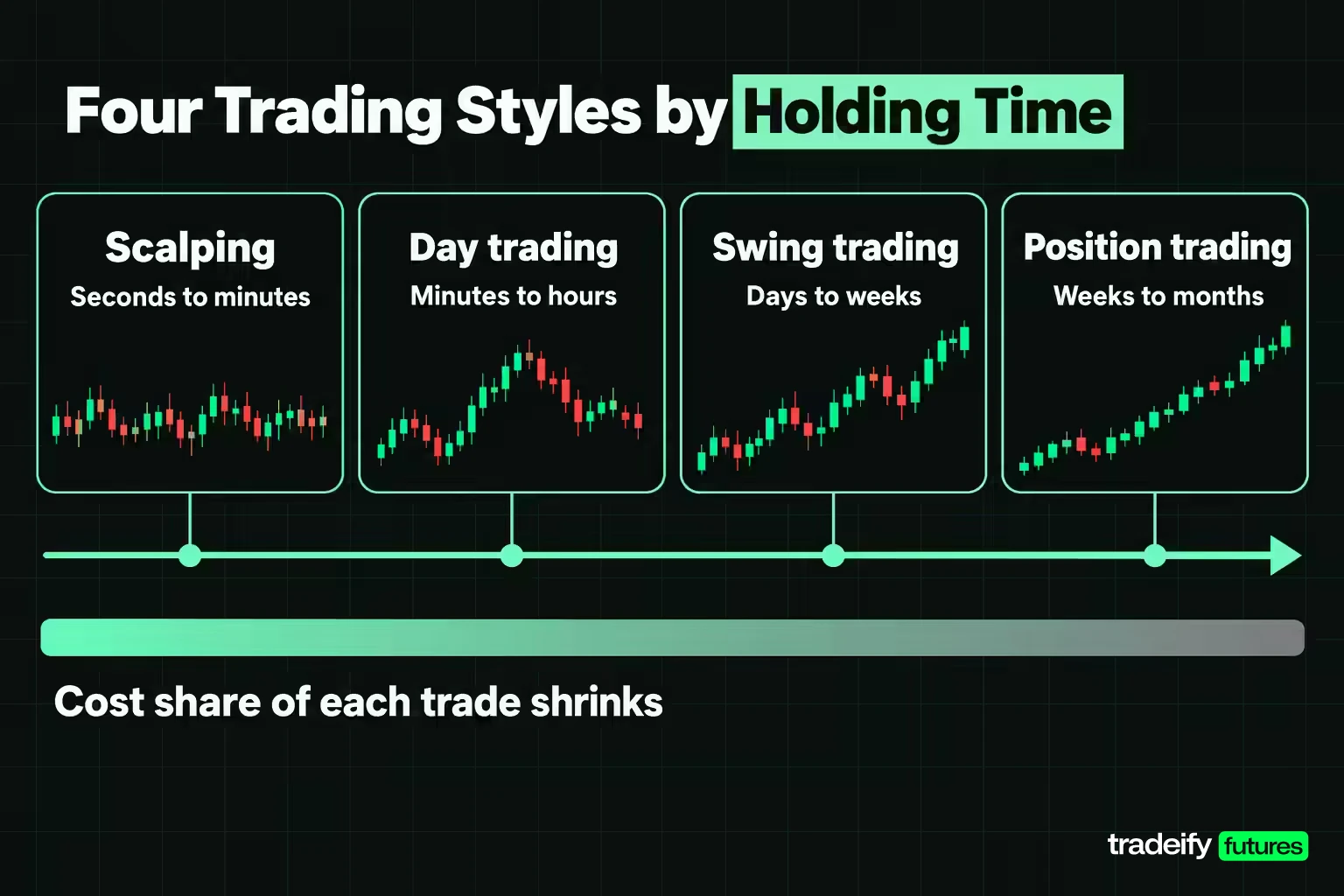
Scalping is the fastest of the four common trading styles, which are usually sorted by how long a trade is held. The holding period sets how wide the stop is, how many trades you take, and how much of each trade goes to costs.
| Style | Typical hold | Typical chart | Trades per session | Stop width on ES (illustrative) | Cost share of a $4.00 round turn |
|---|---|---|---|---|---|
| Scalping | Seconds to minutes | Tick to 2 minute | Many | 0.5 to 2 points | 16.00% of a 0.5 point target |
| Day trading | Minutes to hours | 5 to 15 minute | One to a few | 4 to 10 points | 2.00% of a 4 point target |
| Swing trading | Days to weeks | Hourly to daily | A few per week | Dozens of points | Under 1% |
| Position trading | Weeks to months | Daily to weekly | A few per month | Hundreds of points | Negligible |
The stop widths and costs in the table are illustrative, using the E-mini S&P 500 (ES) at $50 per point and an assumed $4.00 round-turn cost per contract.
Scalping and day trading are both intraday, so the question "which is better, scalping or intraday?" really asks whether a shorter hold inside the same day is worth the extra costs. A scalp trades frequency for cost: more decisions, more data and less exposure to any single news hit, but a much larger share of each trade paid away. A day trade holds longer for a target big enough that costs barely register, and accepts fewer trades and larger swings against the position. Neither is better in general. The better one is the style whose target clearly exceeds its costs and whose pace you can execute without mistakes. If you hesitate on entries or freeze on exits, a faster style will expose that, not fix it.
Related lesson: Day trading vs swing trading
How Trading Noise Decides a Small Scalping Bracket
Trading noise is the price movement inside a bar that carries no useful direction. For a scalper it matters because a small bracket (target plus stop) can fit inside a single bar, and when a bar touches both levels, the chart cannot tell you which one filled first.
To measure how often that happens, this guide uses an illustrative study computed for this article. The data is the continuous front-month E-mini S&P 500 (ES) and E-mini Nasdaq-100 (NQ) futures from the Yahoo Finance chart feed, 2-minute bars, regular session only (9:30 AM to 4:00 PM ET), across 25 sessions from October 1 to November 4, 2026. That is 4,871 bars per contract. The rule is mechanical: go long at the close of every bar when flat, place a fixed target and stop, and check later bars in the same session. Any bar that touches both levels is counted as ambiguous, and the win rate is reported twice, once with every ambiguous trade counted as a loss and once as a win. There is no entry filter, so this measures the bracket, not a strategy.
Measured scalping noise on ES and NQ 2-minute bars
In this guide's study of Yahoo Finance bar data, the median 2-minute bar range was 3.75 points on ES, worth $187.50 per contract, and 21.75 points on NQ, worth $435.
| Contract and bracket on 2-minute bars | Trades | Share of trades decided inside one bar | Win rate range |
|---|---|---|---|
| ES 2 point target, 1 point stop | 4,277 | 24.76% | 24.97% to 49.73% |
| ES 4 point target, 2 point stop | 2,669 | 5.43% | 31.17% to 36.61% |
| ES 4 point target, 4 point stop | 1,770 | 2.32% | 48.14% to 50.45% |
| ES 8 point target, 4 point stop | 1,059 | 0.85% | 32.01% to 32.86% |
| NQ 8 point target, 4 point stop | 4,624 | 35.55% | 21.45% to 57.01% |
| NQ 16 point target, 8 point stop | 3,553 | 13.99% | 28.45% to 42.44% |
| NQ 32 point target, 16 point stop | 1,876 | 2.72% | 31.61% to 34.33% |
Read the first row slowly, because it is the whole argument in one line. A 2-point target with a 1-point stop on ES was decided inside a single 2-minute bar on about one trade in four. The measured win rate could be as low as 24.97% or as high as 49.73% depending only on how those bars are scored. One end of that range loses money. The other end looks like a great system. Same trades, same data.
Three ES bars from one session
Three trades from Tuesday, November 3, 2026, show how this plays out with a 4-point target and 2-point stop on ES 2-minute bars:
- A clean loss. Entry at 7,592.00 at the close of the 10:00 AM bar. The next bar traded down to 7,588.75, through the 7,590.00 stop.
- A clean win. Entry at 7,584.50 at the close of the 10:04 AM bar. The next bar traded up to 7,594.25, through the 7,588.50 target.
- An ambiguous trade. Entry at 7,608.00 at the close of the 11:26 AM bar. The 11:30 AM bar traded a high of 7,612.00 and a low of 7,602.50, touching both the 7,612.00 target and the 7,606.00 stop. The 2-minute bar cannot say which came first.
Wider brackets shrink the problem quickly. In the same Yahoo Finance bar study, only 1.52% of ES 2-minute bars were 12 points or wider, so an 8-point target with a 4-point stop was rarely decided inside one bar. The tradeoff is that wider brackets give fewer signals and bigger swings per trade. A scalper does not get to avoid noise. You only get to choose which problem you want: more trades that are harder to measure, or fewer trades that are easier to measure and hurt more when they lose.
Scalping Timeframes From Tick Charts to 5-Minute Bars
Scalping timeframes are usually short: tick charts, 1-minute and 2-minute bars, and 5-minute bars for context. Investopedia lists one-minute and five-minute charts as the usual scalping views. The chart you choose changes more than the look of the screen. It changes how much of each bar your bracket fills.
In this guide's study of Yahoo Finance ES and NQ bars at 5-minute resolution (49 sessions, August 27 to November 4, 2026), the median bar range was 5.50 points against 3.75 on 2-minute bars. NQ moved from 21.75 to 30.75 points. A 2-point target with a 1-point stop on ES 5-minute bars was decided inside one bar on 38.82% of trades, and its win rate range widened to 18.60% to 57.41%. The 4-point and 2-point bracket was ambiguous on 12.31% of 5-minute trades, against 5.43% on 2-minute bars.
That gives a practical rule of thumb for scalping timeframes. Your execution chart should have bars that are smaller than your bracket most of the time, or you are reading results the chart cannot resolve. A 1-minute or tick chart suits a 1 to 2 point ES bracket. A 5-minute chart is better used for context (trend, key levels, the session's range so far) than for timing a 2-point scalp. Tick charts print a new bar after a fixed number of trades, so they shrink bars automatically when activity is high, which is one reason many futures scalpers prefer them.
Related lesson: Tick charts
What Transaction Costs and Spreads Do to a Scalping Target
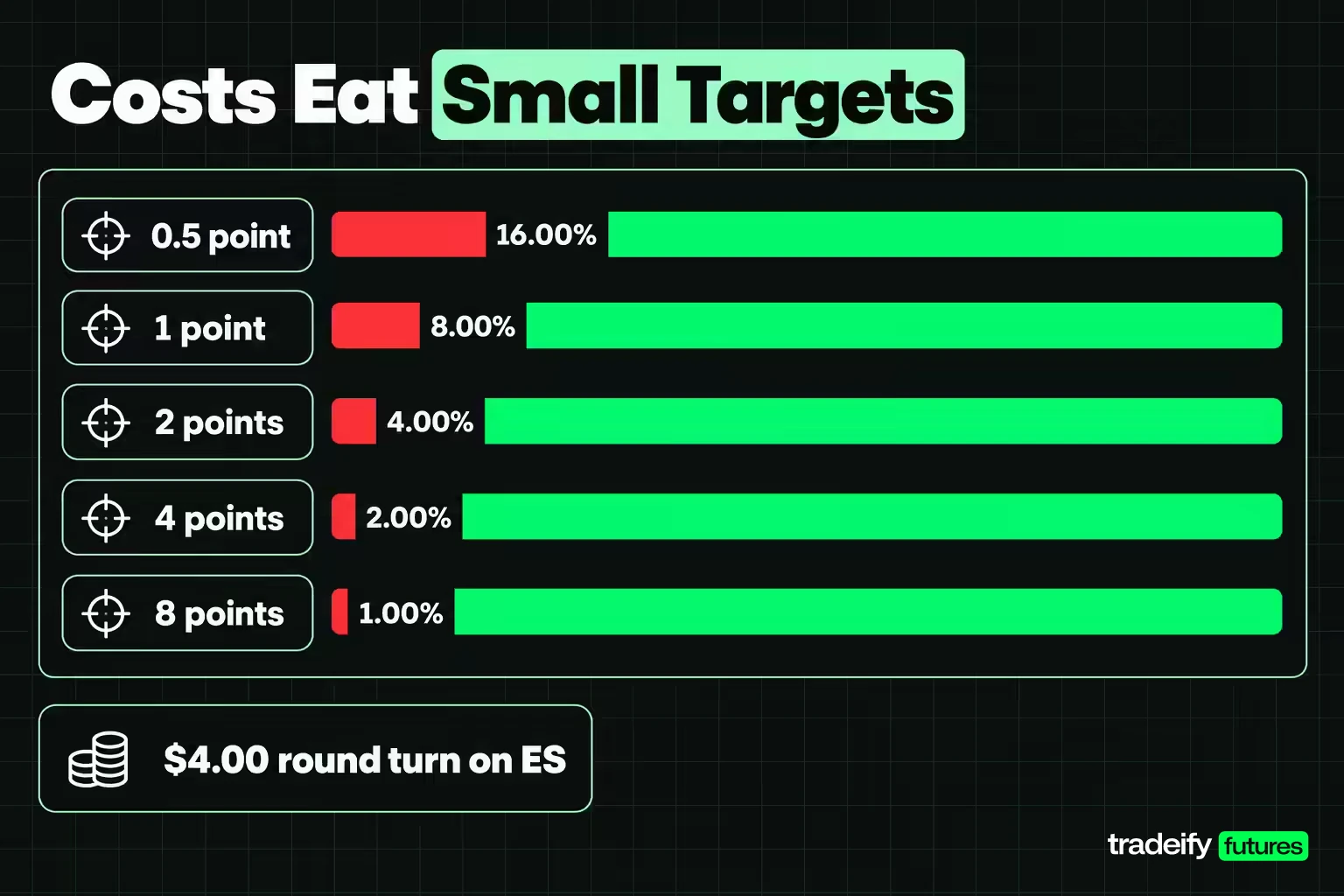
Transaction costs are the commissions, exchange fees and spread a scalper pays on each round turn. They are fixed per contract, so the smaller the target, the larger the share they take. This section uses an illustrative $4.00 round turn per contract; your broker's all-in figure will differ, so swap in your own.
On ES at $50 per point, $4.00 is 0.08 points. On NQ at $20 per point, the same $4.00 is 0.20 points, two and a half times more in points. That catches traders who assume the faster Nasdaq contract is cheaper to scalp. In dollars it costs the same. In points, which is how your target is set, it costs more.
| ES target | Gross per contract | Share paid to a $4.00 round turn |
|---|---|---|
| 0.5 point | $25 | 16.00% |
| 1 point | $50 | 8.00% |
| 2 points | $100 | 4.00% |
| 4 points | $200 | 2.00% |
| 8 points | $400 | 1.00% |
| NQ target | Gross per contract | Share paid to the same $4.00 |
|---|---|---|
| 2 points | $40 | 10.00% |
| 4 points | $80 | 5.00% |
| 8 points | $160 | 2.50% |
| 16 points | $320 | 1.25% |
The spread is the bigger cost for market-order scalpers
Commission is only part of the bill. If you buy at the ask and sell at the bid with market orders, you also pay the spread. In a one-tick market that is $12.50 per round turn on ES (0.25 points) and $5.00 on NQ. Add that to the $4.00 and the ES cost becomes $16.50, or 0.33 points per round turn, while NQ becomes $9.00, or 0.45 points. For a 1-point ES scalp, a third of the gross move is gone before the market does anything. You would need to be right far more often just to stand still.
That is why many scalpers try to enter with limit orders where they can. A limit order can earn the spread instead of paying it, at the risk of not being filled when price moves away. Slippage on stops adds another layer, because a stop becomes a market order when triggered.
Related lesson: The bid-ask spread
Is Scalping Profitable? Break-Even Math and the Evidence
Scalping can be profitable, but only when a setup's win rate clears its break-even win rate with room to spare, and that hurdle is higher than most traders assume. Every scalping bracket carries a break-even win rate you can compute before the first trade:
Break-even win rate = (stop + round-turn cost in points) / (target + stop)
Using the illustrative $4.00 round turn on ES (0.08 points) and NQ (0.20 points), the table compares each bracket's break-even with the win rate range measured in this guide's own study of Yahoo Finance 2-minute bars (ES and NQ, regular session, October 1 to November 4, 2026, entry at every bar close with no filter):
| Bracket | Break-even with $4.00 cost | Measured win rate range on 2-minute bars |
|---|---|---|
| ES 2 point target, 1 point stop | 36.00% | 24.97% to 49.73% |
| ES 4 point target, 2 point stop | 34.67% | 31.17% to 36.61% |
| ES 4 point target, 4 point stop | 51.00% | 48.14% to 50.45% |
| ES 8 point target, 4 point stop | 34.00% | 32.01% to 32.86% |
| NQ 16 point target, 8 point stop | 34.17% | 28.45% to 42.44% |
| NQ 32 point target, 16 point stop | 33.75% | 31.61% to 34.33% |
What the measured scalping brackets show
Three things stand out in the scalping break-even table.
First, costs move the hurdle above the clean geometric figure. Without costs, a 2-to-1 bracket breaks even at 33.33% and a 1-to-1 bracket at 50%. Add $4.00 and the 1-to-1 ES bracket needs 51.00%. Add one tick of spread as well and the 2-point, 1-point ES bracket needs 44.33% instead of 36.00%.
Second, where the bracket is wide enough to measure, the unfiltered entries fell short. The ES 8-point and 4-point bracket measured 32.01% to 32.86% against a 34.00% break-even. The ES 4-point and 4-point bracket measured 48.14% to 50.45% against 51.00%. Entering on every bar with no edge is a losing game once costs are in. That is the expected result, and it is useful, because it shows the size of the gap any real setup has to close.
Third, on the small brackets the measured range straddles break-even. The ES 2-point and 1-point bracket could be anywhere from clearly losing to clearly winning, depending on scoring alone. That does not make it profitable. It makes it unmeasurable on 2-minute bars, so you need tick data or real fills to know.
Evidence on very active retail trading
The wider evidence on very active retail trading is sobering. In a study of individuals who day traded Brazilian equity index futures, Chague, De-Losso and Giovannetti found that of the 1,551 who kept at it for more than 300 days, 97% lost money net of fees. Scalping is not singled out in that study, but it is the most cost-intensive way to day trade, so the lesson carries. Any scalping edge has to come from selection (which bars you trade and which you skip) and from execution quality, not from the bracket itself.
Related lesson: Commission-adjusted futures breakeven
Why Scalping Needs Volatility and Liquidity Together
Scalping needs two market conditions at once. Volatility supplies the movement that pays a target. Liquidity lets you enter and exit near the quoted price, so the move is not eaten by spread and slippage. A market with only one of the two is a poor scalping market.
High volatility with thin liquidity is the dangerous combination. Bars are wide, which looks like opportunity, but the spread widens and stops slip, so the realized loss is larger than the planned one. Deep liquidity with low volatility has the opposite problem. Fills are clean, but bars are so small that a target large enough to beat costs rarely gets reached before the session drifts.
The ES data in this guide's study of Yahoo Finance bars (October 1 to November 4, 2026) shows how thin the window is. On 2-minute bars, 66.48% of bars were at least 3 points wide, enough to contain a 2-point target and a 1-point stop. Only 19.05% were 6 points or wider, and 8.42% were 8 points or wider. On NQ, 83.90% of 2-minute bars spanned 12 points or more. NQ offers more movement per bar, which is why it attracts scalpers, and also more noise inside each bar, which is why small NQ brackets were the hardest to measure.
A practical check before you scalp any market: look at the typical spread in ticks during your hours and the median bar range on your execution chart. If the spread is regularly more than a tick, or the median bar is smaller than your target plus costs, the market is not offering a scalp at that moment.
Related lesson: Slippage explained
Best Markets and Instruments for Scalping
The best markets for scalping combine tight spreads, deep order books, steady activity during your hours, and a cost structure you can price exactly. Index futures, major forex pairs and the most liquid stocks are the usual candidates. Each has a different cost profile.
| Market | How price moves are valued | Main scalping cost | Points to check |
|---|---|---|---|
| Index futures (ES, NQ, MES, MNQ) | Fixed dollar value per tick | Commission and fees per contract, plus spread | Very liquid in the regular session; Globex trades nearly 24 hours on weekdays |
| Major forex pairs | Pips, value depends on lot size | Spread, sometimes plus commission | Spread varies by broker and by session |
| Liquid stocks and ETFs | Cents per share | Spread and per-share or per-order fees | Rules on margin accounts are changing |
| Options | Premium per contract | Wide spreads relative to price, plus time decay | Spread often several ticks wide |
Index futures are popular with scalpers because every tick has a fixed, known value. ES moves in 0.25-point ticks worth $12.50, NQ in 0.25-point ticks worth $5.00. The micro contracts are a tenth the size: MES ticks are worth $1.25 and MNQ ticks $0.50. That makes micros useful for testing a scalping plan at small size, though commissions per contract do not shrink by the same factor, so micro costs are a larger share of each tick. CME Globex trades the E-mini Nasdaq-100 from Sunday 6:00 PM to Friday 5:00 PM ET, with a daily maintenance break from 5:00 PM to 6:00 PM ET.
Stock and options scalping
Stocks have their own rules for scalpers. FINRA Regulatory Notice 26-10 replaces the old pattern day trader requirements, including the $25,000 minimum equity, with new intraday margin standards. It took effect June 4, 2026, with a phase-in that ends October 20, 2027, so some brokers may still apply the old rules for now. Futures were never subject to the pattern day trader rule.
Options scalping applies the same idea to option contracts, taking small moves in the option's premium. It is harder than it looks, because option spreads are often wide relative to the premium, and the option's value is also moving with time and implied volatility, not just with the underlying price.
Related lesson: Scalping futures
Best Time of Day to Scalp
The best time of day to scalp is when bars are wide enough to pay a target and the book is deep enough to fill you cleanly. For US index futures, that is usually the first hour after the 9:30 AM ET stock market open. The quietest stretch is early to mid afternoon.
The 2-minute study shows the shape of the day clearly:
| Half hour starting (ET) | ES median 2-minute range | NQ median 2-minute range |
|---|---|---|
| 9:30 AM | 6.25 points | 47.50 points |
| 10:00 AM | 5.00 points | 34.50 points |
| 12:00 PM | 3.25 points | 18.50 points |
| 2:30 PM | 2.75 points | 15.50 points |
| 3:30 PM | 3.50 points | 20.25 points |
The ES median range in the first half hour was more than double the 2:30 PM figure. A 2-point ES target is a modest ask at 9:30 AM and a stretch by mid-afternoon, when it is close to the size of a whole typical bar. Range picks up again in the last half hour before the 4:00 PM close.
Width is not the whole story. The opening half hour also has the fastest moves and the most violent reversals, so stops are more likely to slip. Many scalpers let the first few minutes print, then trade the rest of the first hour. The temptation at 2:30 PM is the opposite: the bars are small, nothing is happening, and a trade feels overdue. That is usually the cue to stop, not to size up. For forex scalpers, the busiest stretch is usually the London and New York overlap, 8:00 AM to 12:00 PM ET, when both centers are active.
Related lesson: Global trading sessions
Common Scalping Strategies
Scalping strategies differ in what triggers the entry, but each needs a clear reason to expect the next few ticks to go one way, and a clear point that proves the reason wrong.
- Momentum scalping. Join a strong, fast move after a short pause, expecting a few more ticks of continuation. Invalidation: the pause breaks against you, or volume dries up on the next push.
- Range scalping. Fade the edges of a well-defined range, buying near support and selling near resistance. Invalidation: a bar closes outside the range with volume. Ranges break, and a range scalper who keeps fading a breakout is trading a hope.
- Breakout scalping. Trade the first move out of a tight consolidation. Invalidation: price returns inside the range within a bar or two, which marks a failed breakout.
- VWAP or moving average pullback. In a trending session, wait for price to pull back to VWAP (volume-weighted average price, which resets each session) or a short exponential moving average, then enter in the trend's direction. Invalidation: a close through the average against the trend.
- News scalping. Trade the first reaction to a scheduled release. This is the highest-slippage form of scalping, because spreads widen and stops can fill far from their price in the first seconds.
- Market making style scalping. Post bids and offers and try to capture the spread. Professional market makers do this with fast technology and exchange arrangements. A retail trader resting orders by hand mostly gets filled when price is about to move through them.
Whatever the strategy, the test is the same. Does the setup, on your execution chart, produce a win rate above the bracket's break-even across a meaningful sample? A strategy name is not evidence. Your journal is.
Related lesson: VWAP
Technical Indicators for Scalping and Their Default Settings
Technical indicators for scalping are tools for filtering entries, not signals on their own. The common set falls into a few groups, each with standard default settings that you can shorten for fast charts.
| Indicator | What it measures | Common default | How scalpers use it |
|---|---|---|---|
| Moving averages (EMA or SMA) | Average price over a window | Varies; short EMAs are common | Trend direction and pullback levels |
| VWAP | Volume-weighted average price for the session | Resets each session | Intraday fair value and pullback level |
| RSI | Speed and size of recent moves on a 0 to 100 scale | 14 periods; 70 overbought, 30 oversold | Stretched conditions in a range |
| Stochastic oscillator | Close relative to the recent range | 14 periods; %D is a 3-period average of %K; 80 and 20 | Turns at range edges |
| Bollinger Bands | Moving average plus bands set by standard deviation | 20 periods, 2 standard deviations | Relative highs and lows, squeezes |
| Volume and pivot points | Participation and prior-session reference levels | Session-based | Confirm breakouts and mark levels |
The RSI was introduced by J. Welles Wilder Jr. in 1978, and the stochastic oscillator was developed by George Lane in the 1950s. Both were designed on daily data. On a 1-minute chart, a 14-period RSI covers just 14 minutes, so readings swing to extremes far more often. John Bollinger's own rules for his bands make a useful point for scalpers: a touch of the upper or lower band is a tag, not a signal, and in a trend price can walk along a band.
Choosing the best indicator for scalping
So what is the best indicator for scalping? There is no single answer, and stacking more indicators rarely helps. Two momentum oscillators mostly tell you the same thing twice. A sensible scalping chart usually has one trend reference (VWAP or a short moving average), one measure of stretch or momentum, and volume. The price level you are trading from matters more than any of them. If price is stuck in the middle of a range, adding another indicator does not create direction.
Scalping Entry and Exit Rules
Scalping entry and exit rules need to be written before the session, because there is no time to decide them during a 30-second trade. A workable rule set covers four questions.
- Where is the setup? Name the level (range edge, VWAP, prior high) and the condition that makes it tradable, such as a rejection bar with rising volume.
- What confirms the entry? Decide whether you enter on the touch with a limit order or wait for a confirming bar close. Waiting costs a tick or two but filters some false starts.
- Where are the stop and target? Place both the moment the entry fills, as a bracket. The stop goes where the setup is proven wrong, not at a dollar amount you happen to like.
- When do you leave without either? A time stop helps. If the trade has not moved your way within a set number of bars, the reason for it has probably faded, so exit at market.
Exit discipline matters more than entry precision in scalping. Moving a stop further away "just this once" turns a 1-point scalp into a 4-point loss, and that one trade erases several winners. Taking profits early is subtler but just as costly, because it lowers the average win while the average loss stays the same, which raises the break-even win rate.
Know when not to enter, too. If price is stuck in the middle of a range, if the spread has widened, or if a scheduled release is seconds away, standing aside is a valid trade decision.
Related lesson: Stop-loss orders and placement
Risk Management in Scalping
Risk management in scalping comes down to three controls: size each position from the stop distance, watch costs as a share of risk, and cap the day's total loss.
Position size should follow from a fixed dollar risk divided by the stop's dollar value per contract. The catch for scalpers is that tight stops allow more contracts, and costs scale with contract count. With an illustrative $200 risk budget on ES and a $4.00 round turn:
| Stop distance | Contracts at $200 risk | Commission cost | Cost as share of risk |
|---|---|---|---|
| 4 points | 1 | $4 | 2.00% |
| 2 points | 2 | $8 | 4.00% |
| 1 point | 4 | $16 | 8.00% |
| 0.5 point | 8 | $32 | 16.00% |
Now add one tick of spread on each of those 8 contracts. That is another $100, or 50% of the $200 risk, on a single round turn. Tight stops feel safe because the per-contract loss is small, but the contract count can turn costs into the biggest line on the trade.
A daily loss limit is the second control. Scalping produces streaks quickly, and a run of fast losses invites the urge to win it back. Decide in advance the dollar loss, or the number of consecutive losses, that ends the session. Many platforms can enforce a personal limit automatically so the decision is made before emotions arrive.
Stop discipline is the third. Every scalp needs a stop on the server the moment the entry fills. A scalper who relies on clicking out manually will, sooner or later, freeze during a fast move or lose a connection at the wrong time.
Related lesson: Position sizing futures contracts
Scalping Platforms, Order Types and Execution Tools
Scalping platforms need to do a few things quickly and reliably: show real-time data, place bracket orders in one action, and keep your stops working if your connection drops. The features that matter most:
- Real-time data. Delayed data, even by a few seconds, means your bars are not the bars the exchange printed. For a 2-point bracket that is fatal.
- Bracket and OCO orders. A bracket attaches a stop and a target to the entry, linked so one cancels the other. Placing them by hand after each fill is too slow.
- Server-side orders. Stops and targets that sit on the broker's or data provider's server keep working if your internet or computer fails. Orders held only on your computer do not.
- A depth-of-market ladder (DOM). A price ladder lets you place and move orders with single clicks and see resting bids and offers near the market.
- Hotkeys. Keyboard shortcuts for entries, flattening and cancelling all orders save seconds when it counts.
- Time and sales. The tape shows each trade's price and size as it prints, which helps confirm whether a level is holding.
Order types decide your cost profile. A market order gets filled but pays the spread and may slip. A limit order controls the price but may not fill. A stop becomes a market order when triggered, so it can fill worse than its price in a fast market. A scalper who understands that tradeoff on every entry and exit will spend less on execution than one who does not.
Related lesson: Order flow analysis
Scalper Psychology and Discipline
Scalper psychology is shaped by speed. A scalper makes more decisions in a morning than a swing trader makes in a month, and every one of them happens under time pressure. That pace creates specific traps.
The first is the missed entry. Price leaves without you, and the next tick feels like a second chance. It is not. Missing the entry does not make the next price a good entry. It makes it a different trade with a worse location.
The second is the revenge trade. Three quick losses in ten minutes can feel like the market is taking something from you, and the fastest way to "get it back" is to trade bigger or faster. That is exactly when a scalper is least able to judge setups.
The third is boredom. In a slow afternoon, bars shrink and good setups disappear, but the habit of clicking remains. Inventing trades in a quiet market is one of the most expensive habits in scalping, because each one pays full costs for a below-average setup.
The fix in each case is a rule decided in advance, not willpower in the moment:
- A maximum number of trades per session.
- A stop after a set number of consecutive losses, followed by a real break away from the screen.
- A fixed trading window, such as the first 90 minutes, after which the platform closes.
- Unchanged size after a loss.
Disciplined scalpers often look calm, not because they feel nothing, but because the decisions were made before the session started. A clean loss does not call for revenge. It calls for the same risk on the next qualified setup.
Building a Scalping Plan and Daily Routine
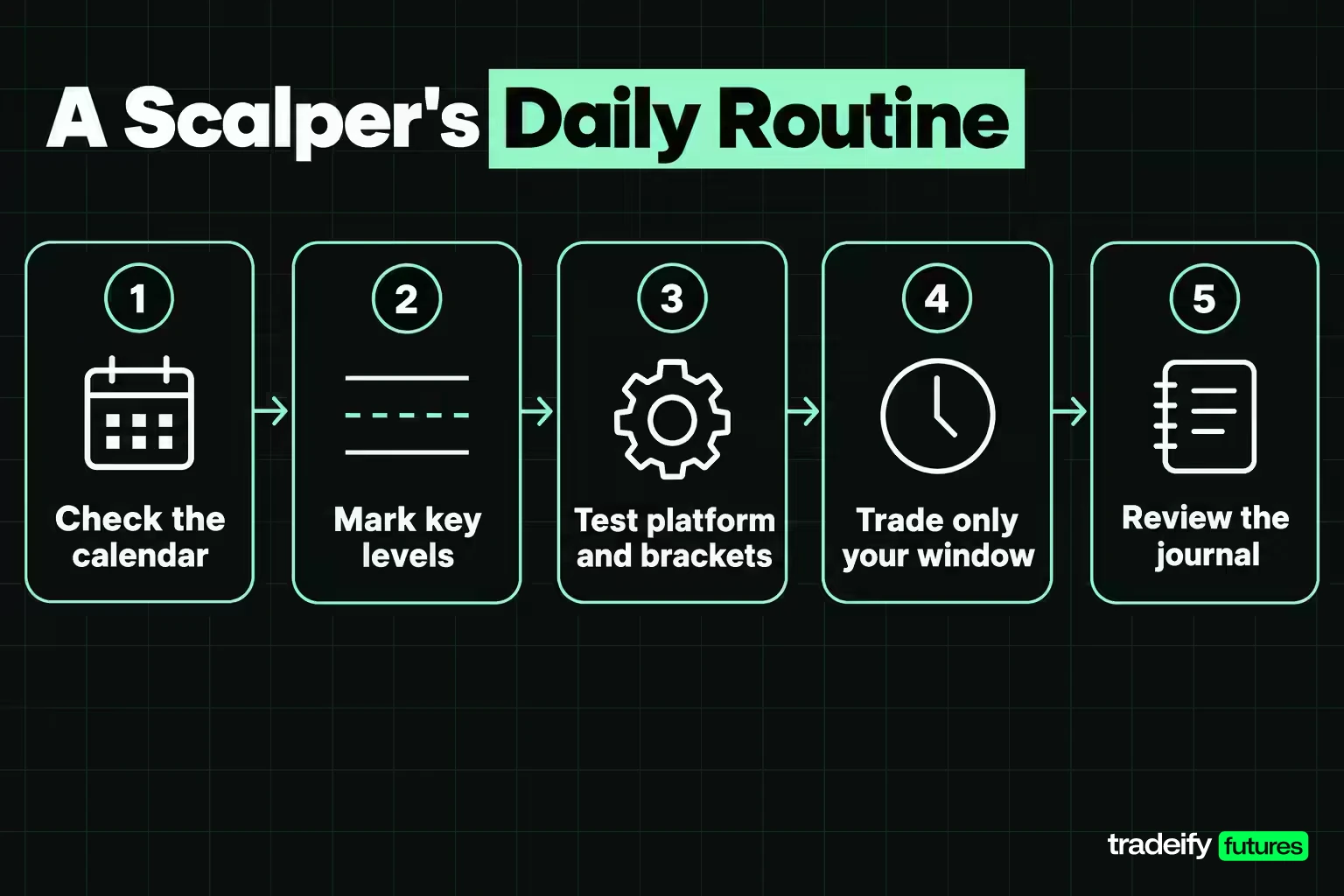
A scalping plan is a short written checklist, covering market, hours, setups, costs and limits, that you follow every session. It should fit on one page.
The plan itself covers:
- Market and contract. One or two instruments you know well. Switching between many markets dilutes your read of each.
- Hours. A defined window, such as the first 90 minutes after the open, when bars are wide enough to pay your target.
- Setups. Two or three named setups with written entry, stop, target and time-stop rules.
- Costs. Your actual round-turn cost in points and the break-even win rate for each bracket you trade.
- Limits. Maximum trades per day, maximum daily loss, and a consecutive-loss stop.
A daily routine then puts the plan into practice:
- Before the session, check the economic calendar for scheduled releases during your window and mark them.
- Mark key levels: the prior day's high, low and close, the overnight range, and any level you plan to trade.
- Confirm your platform, data feed and bracket templates are working on a test order in simulation.
- Trade only your window and setups. Log each trade as you go.
- After the session, review the journal while the trades are fresh.
The journal is what turns scalping from a series of reactions into a process. For each trade, record the time, setup name, entry, stop, target, exit, result after costs, and the high and low of the exit bar. That last column matters for small brackets, because it shows which trades your chart could not truly score.
How to Evaluate Scalping Performance
Evaluating scalping performance means measuring results in a way that separates skill from noise. Win rate alone is not enough. Track these:
- Net expectancy per trade after costs. Average win times win rate, minus average loss times loss rate, minus costs. If this is negative over a large sample, nothing else matters.
- Win rate against break-even. Compare each setup's win rate to its own break-even win rate, not to a round number like 50%.
- Average win and average loss in points. If your wins are shrinking while your losses stay full size, your exits are leaking.
- Slippage. The difference between the planned and actual entry and stop prices.
- Ambiguous trades. The share of trades whose exit bar touched both the stop and the target. If it is large, your scored win rate is partly a choice, so report it as a range.
Sample size is the hard part. If a setup's true win rate is 35%, the normal statistical wobble over 100 trades is about 4.8 percentage points either way, and over 400 trades it is still about 2.4 points. A break-even of 34.67% sits inside that wobble for any sample a single trader builds in a week or two. So a scalping plan should be judged on hundreds of trades, not a good Tuesday. One rough week is one line in the sample, not a verdict.
Related lesson: Risk of ruin
Common Scalping Mistakes
Common scalping mistakes repeat because they come from the structure of the style, not from bad luck.
- A bracket smaller than the bar. A 2-point target and 1-point stop on ES 2-minute bars sits inside a median bar of 3.75 points, so the outcome is often decided by noise. Fix it by using a faster chart or a wider bracket.
- Ignoring costs in points. A 1-point ES scalp pays 8.00% of its gross move to an illustrative $4.00 round turn, and much more if you also pay the spread. Fix it by writing your cost in points next to every target.
- Overtrading. Taking trades because the screen is moving rather than because a setup is present. Fix it with a daily trade cap.
- Sizing up to make small targets worthwhile. More contracts multiply the costs and the loss on a bad fill. Fix it by sizing from the stop and a fixed dollar risk.
- Moving stops. One widened stop can undo a morning of winners. Fix it with server-side brackets placed at entry.
- Trading through scheduled news by accident. Slippage on a release can exceed several normal losses. Fix it by marking release times before the session.
- Judging a method on a few days. Small samples cannot separate an edge from luck. Fix it by reviewing in blocks of at least a hundred trades.
Is Scalping Legal and Which Rules Apply to Scalpers
Scalping as a trading style is legal. Buying and selling quickly for small profits is ordinary short-term trading on regulated exchanges.
The confusion comes from a different practice that shares the name. In SEC v. Capital Gains Research Bureau (1963), the US Supreme Court described an investment adviser buying a stock shortly before recommending it to clients and then selling into the price rise, a practice "known in the trade as 'scalping'", and held that it operates as a fraud on clients under the Investment Advisers Act of 1940. That kind of scalping is illegal. A retail trader taking small moves on the E-mini futures is not doing it.
Fast trading does have legal limits. Under the Commodity Exchange Act it is unlawful to engage in "spoofing", meaning bidding or offering with the intent to cancel before execution. A scalper who places large orders to create a false impression of demand, with no intention of trading them, is breaking the law regardless of the holding period.
Account rules matter as well. For US stock accounts, FINRA Notice 26-10 is replacing the pattern day trader requirements with intraday margin standards, phased in through October 20, 2027. Brokers and proprietary trading firms can also set their own rules on very short holding times, so read the terms of any account before building a scalping plan around it.
On our funded accounts, scalping is allowed, but very short holds can affect payouts. To request a payout, more than 50% of your trades must be held longer than 10 seconds, and more than 50% of your profit must come from those trades; the rule applies to funded accounts, not evaluations. All positions close by 4:45 PM ET, and our funded accounts are simulated.
Scalping FAQ
What is scalping in option trading?
Scalping in option trading means buying and selling option contracts quickly to capture small changes in their premium. It is harder than futures scalping, because option spreads are often wide relative to the premium and the premium also changes with time and implied volatility. Many option scalpers trade only the most liquid near-the-money contracts for that reason.
Why is it called scalping?
The name describes taking a thin slice off the top of a price move, again and again, rather than holding for the whole move. Each slice is small, so the method relies on repetition. The same word is used in securities law for a fraudulent adviser practice, which is a separate thing.
What is the best indicator for scalping?
No single indicator is best for scalping. Most scalpers use one trend reference such as VWAP or a short moving average, one momentum or stretch measure such as RSI or a stochastic, and volume. The price level you trade from matters more than the indicator settings.
Which is better, scalping or intraday trading?
Neither is better for everyone, but longer intraday trades are easier for most newer traders to execute and measure. Scalping is a form of intraday trading with a much shorter hold, which gives more trades per day and spends a far larger share of each trade on costs. Longer intraday trades need fewer decisions and absorb costs easily.
How many trades does a scalper make per day?
Investopedia describes scalpers placing anywhere from 10 to a few hundred trades in a day. A retail futures scalper often takes far fewer, because each trade must clear its costs and a capped number of high-quality setups usually beats constant activity.
Can you scalp with a small account?
Yes, micro futures make it possible at small size, with MES ticks worth $1.25 and MNQ ticks worth $0.50. Check the commission per contract, though, because costs on micros are a larger share of each tick than on the full-size contracts.
This article is educational and is not investment advice or a recommendation to trade any instrument. Futures and other leveraged products can produce losses larger than expected, and fast styles like scalping magnify costs and execution risk. The bar study is historical and illustrative, with no entry filter, and past results do not predict future ones. Funded and evaluation accounts are simulated and differ from live trading in fills and costs. Trade only with money you can afford to lose and confirm current contract specifications and fees with your provider.


